




















Groundhog Day activities are a fun way to bring February 2 to life with crafts, games, and learning moments that kids will love. Whether the groundhog sees his shadow or not, this quirky tradition offers the perfect chance to explore weather, seasons, and storytelling. With engaging hands-on activities and simple science experiments, Groundhog Day becomes more than folklore as it turns into a meaningful and memorable experience for children at home or in the classroom. Let’s dive in!
10+ Groundhog Day Activities for Kids
Celebrate February 2nd with hands-on fun! Try these creative ideas that blend learning, laughter, and a little bit of shadow magic.
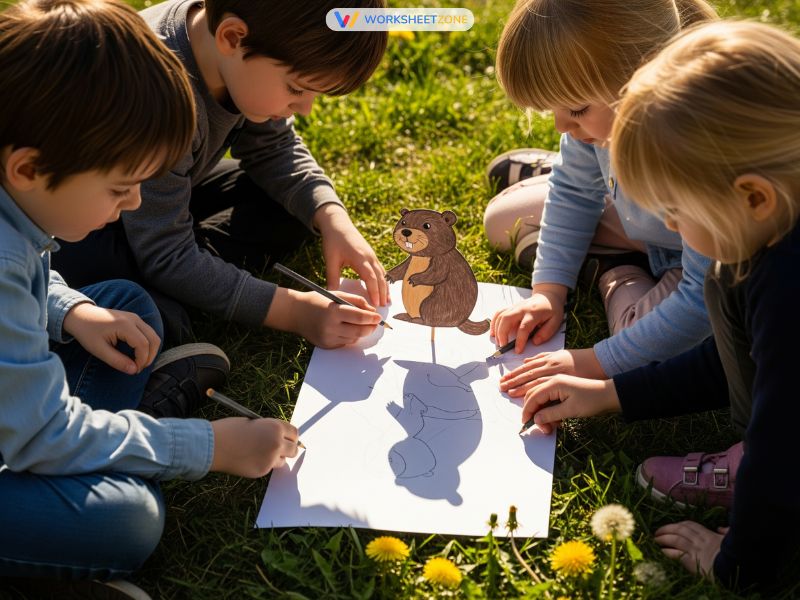
1. Groundhog Shadow Tracing
This activity encourages observation and introduces the concept of shadows in a fun, artistic way. It’s a great hands-on experience for understanding how light creates shadows and how their shape can change.
Materials Needed:
- Large sheets of paper (butcher paper or poster board works well)
- Pencils or markers
- A sunny day or a strong lamp
- Small groundhog figurine or a cutout
Instructions:
- On a sunny day, take your groundhog figurine or cutout outside. If it’s cloudy or dark, use a strong lamp indoors.
- Position the groundhog so that it casts a clear shadow on the large sheet of paper.
- Carefully trace the outline of the groundhog’s shadow with a pencil or marker.
- Discuss how the shadow changes if you move the light source or the groundhog.
- Decorate the traced groundhog, adding features and a spring or winter background.
2. Predict the Weather Graph
This activity is a fantastic way to introduce basic concepts of graphing and data collection while engaging with the Groundhog Day tradition. It encourages critical thinking about predictions and outcomes.

Materials Needed:
- Large chart paper or whiteboard
- Markers
- “Groundhog Sees Shadow” and “Groundhog Doesn’t See Shadow” labels
- Pictures or drawings representing each outcome
- Stickers or small magnetic markers
Instructions:
- Before February 2nd, discuss the two possible outcomes of Groundhog Day (sees shadow = 6 more weeks of winter; no shadow = early spring).
- Create a simple bar graph on your chart paper or whiteboard with two columns: “Groundhog Sees Shadow” and “Groundhog Doesn’t See Shadow.”
- Have each child make their prediction for what will happen on Groundhog Day and place a sticker or marker in the corresponding column.
- On February 2nd, watch or read about the official Groundhog Day prediction.
- Compare the actual outcome to the class’s predictions, discussing who was “right” and the nature of predictions.
3. Build a Groundhog Burrow
Understanding animal habitats is an important part of learning about the natural world. Building a groundhog burrow allows children to explore the concept of a safe, underground home.

Materials Needed:
- Large cardboard box (appliance box is ideal)
- Brown paper or construction paper
- Crayons, markers, or paint
- Scissors
- Tape or glue
- Optional: Old blankets, pillows, or fabric scraps
Instructions:
- If using a large box, help children cut out an entrance hole for their burrow.
- Cover the inside and outside of the box with brown paper to simulate dirt.
- Children can then draw or paint details like roots, rocks, or other burrow features.
- Crumple up brown paper or use old blankets and pillows to create soft, “earthy” bedding inside the burrow.
- Encourage imaginative play as children pretend to be groundhogs in their cozy new home.
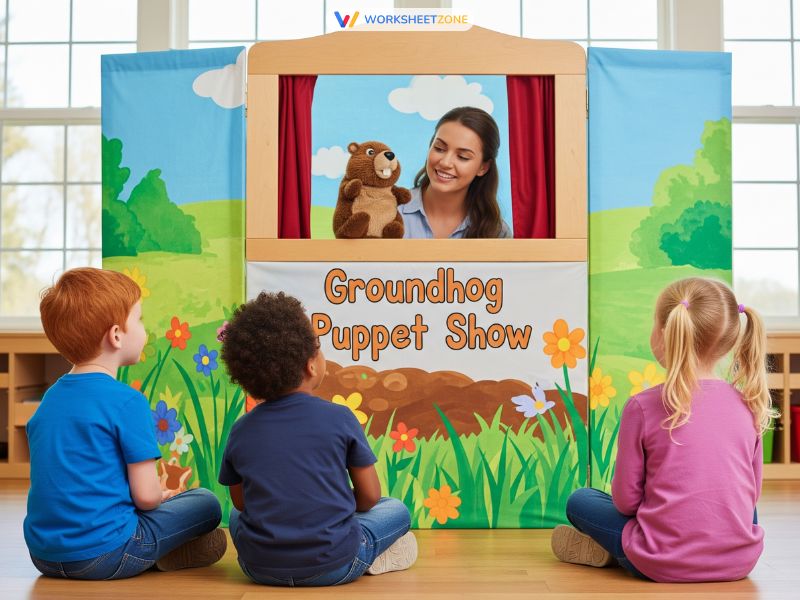
4. Groundhog Puppet Show
Puppetry is a wonderful way to foster creativity, storytelling, and public speaking skills. A Groundhog Day puppet show can be simple yet highly engaging.
Materials Needed:
- Brown paper bags or socks
- Construction paper (brown, black, pink, white)
- Googly eyes (optional)
- Glue or tape
- Scissors
- Craft sticks (if using paper bag puppets)
Instructions:
- Help children create groundhog puppets from paper bags or socks. They can cut out ears, noses, and teeth from construction paper and glue them on. Add googly eyes for extra fun.
- Discuss the Groundhog Day story and its characters (the groundhog, the townspeople, the weather).
- Encourage students to create short skits or a play about Groundhog Day.
- Set up a simple “stage” (a table turned on its side, or a large box) and let the puppet show begin!
5. Groundhog Shadow Play
This activity is a dramatic and visual way to explore shadows and light. It’s particularly engaging for younger children and can lead to interesting discussions about cause and effect.

Materials Needed:
- White sheet or thin curtain
- Strong light source (flashlight, lamp, or projector)
- Groundhog cutout (or a child acting as a groundhog)
- Props related to winter and spring (paper snowflakes, paper flowers, sun cutout)
Instructions:
- Hang a white sheet or thin curtain in a darkened room, creating a screen.
- Position the light source behind the screen, shining towards it.
- Have a child or use a groundhog cutout to stand in front of the light, casting a shadow on the screen.
- Discuss whether the groundhog “sees” its shadow.
- Use props to act out the consequences: if the shadow is seen, bring in winter props; if not, bring in spring props.
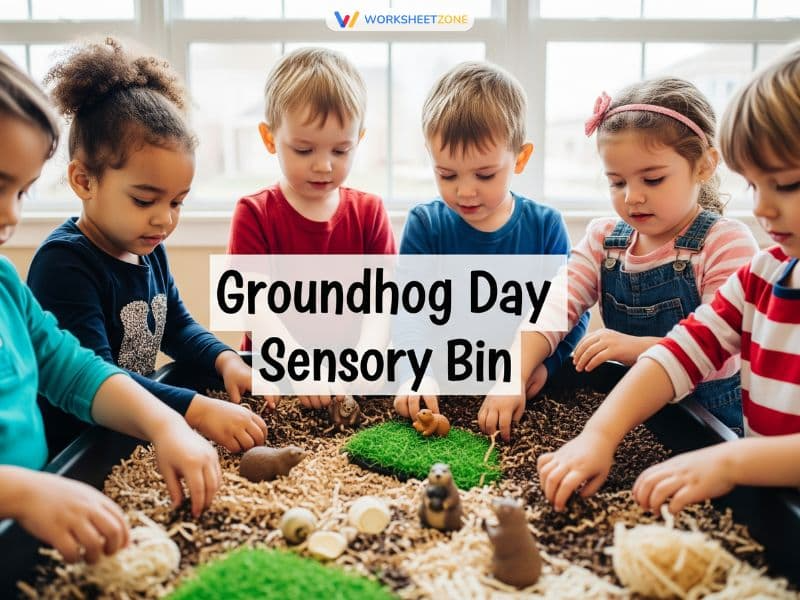
6. Groundhog Day Sensory Bin
Sensory bins provide a hands-on, multi-sensory experience that can be calming and educational. This activity allows children to explore textures and concepts related to the groundhog’s habitat.
Materials Needed:
- Large plastic bin
- Filler materials: shredded brown paper, dried beans, brown rice, or dirt (if outside)
- Small groundhog figures or toy animals
- Plastic tunnels or cardboard tubes
- Artificial grass or green fabric scraps
- Small plastic rocks or sticks
Instructions:
- Fill the bin with your chosen filler material (shredded brown paper is a clean indoor option).
- Add the groundhog figures, tunnels, artificial grass, and other natural elements.
- Encourage children to explore the bin, burying and unearthing the groundhogs, and creating their own “burrows.”
- Discuss the textures and the groundhog’s environment as they play.
7. Groundhog Day Science Experiment: Shadow Exploration
This experiment delves deeper into the science of shadows, allowing for observation and data collection. It’s suitable for older children or a more in-depth exploration.

Materials Needed:
- Various objects of different shapes and sizes
- A strong, consistent light source (e.g., a desk lamp)
- White paper
- Pencils
- Ruler
Instructions:
- In a dimly lit room, set up the light source and place a piece of white paper as a surface for shadows.
- Place an object in front of the light source, casting a shadow on the paper.
- Have students trace the outline of the shadow.
- Experiment with moving the object closer or farther from the light, and closer or farther from the paper. Observe how the shadow’s size and shape change.
- Discuss observations: “What happens to the shadow when the object moves closer to the light?” “How does the angle of the light affect the shadow?”
8. Groundhog Day Cookie Decorating
Combining learning with a sweet treat can make for a memorable experience. This activity allows for creative expression and fine motor skill development.

Materials Needed:
- Groundhog-shaped (or round) sugar cookies
- Brown, black, and pink icing
- Edible googly eyes or small round candies for eyes
- Sprinkles (optional)
- Small spatulas or butter knives for spreading icing
Instructions:
- Provide each child with a groundhog cookie.
- Offer different colors of icing and decorative elements.
- Encourage them to decorate their groundhog cookies, adding faces, fur, and any other details.
- Discuss the groundhog’s features as they decorate.
- Enjoy the delicious results!
9. Groundhog Day Word Search/Crossword Puzzle
Reinforce vocabulary and spelling skills with a Groundhog Day-themed word search or crossword puzzle. This can be a quiet individual activity or a collaborative one.

Download this adorable Groundhog Day Crossword to boost kids’ learning with seasonal vocabulary and fun facts!
Materials Needed:
- Printed Groundhog Day word search or crossword puzzle
- Pencils
Instructions:
- Create or print a Groundhog Day word search or crossword puzzle using relevant vocabulary (e.g., groundhog, shadow, winter, spring, burrow, Punxsutawney, prediction, February).
- Distribute the puzzles to the students.
- Have them complete the puzzles individually or in pairs.
- Review the answers as a class, discussing the meaning of each word.
10. Read Groundhog Day Books
Reading aloud or having children read books related to Groundhog Day is an excellent way to introduce the tradition, build literacy skills, and spark discussion.

Materials Needed:
- A selection of Groundhog Day-themed picture books (e.g., Groundhog Day by Gail Gibbons, Substitute Groundhog by Pat Miller, Gretchen Groundhog, It’s Your Day! by Candace F. Fleming)
Instructions:
- Gather a selection of age-appropriate Groundhog Day books.
- Read one or more books aloud to the class.
- After reading, engage in a discussion about the story, the groundhog, and the tradition.
- Ask questions like: “What did the groundhog in the story do?” “How do you think the groundhog feels?” “What would you do if you were the groundhog?”
11. Create a Groundhog Day Collage
This artistic activity allows for creative expression while integrating various textures and images related to the holiday.

Materials Needed:
- Large sheet of construction paper or cardstock as a base
- Magazines, old calendars, or printed images related to winter, spring, groundhogs, shadows, and weather
- Fabric scraps, cotton balls, twigs, small leaves, glitter (for texture)
- Glue sticks or liquid glue
- Scissors
Instructions:
- Have children find and cut out images from magazines or printouts that relate to Groundhog Day themes (e.g., sunny skies, snowflakes, flowers, groundhogs, burrows).
- Encourage them to use textured materials like cotton balls for snow, green fabric for grass, or brown paper for dirt.
- Arrange the cutouts and materials on the base paper to create a collage.
- Glue everything down securely.
- Discuss the elements included in their collages and what they represent.
12. Groundhog Day Map Study: Punxsutawney Phil
This activity combines geography, research, and cultural understanding by focusing on the home of the most famous groundhog, Punxsutawney Phil. It’s a great way to introduce real-world locations and traditions.

Materials Needed:
- World map or U.S. map
- Markers or pins
- Internet access or encyclopedias for research (optional, for older students)
- Whiteboard or chart paper for notes
Instructions:
- Introduce Punxsutawney Phil as the famous groundhog who makes the official prediction each year.
- Locate Punxsutawney, Pennsylvania on a U.S. map. Discuss its location relative to your own.
- For older students, encourage them to research interesting facts about Punxsutawney or the history of Groundhog Day.
- Discuss why a small town in Pennsylvania became so famous for this tradition.
- Optionally, have students draw a simple map to Punxsutawney from your location, or draw a picture of what they imagine the town looks like on Groundhog Day.
FAQs
1. What is the meaning of Groundhog Day?
Groundhog Day is a traditional event celebrated on February 2nd in the United States and Canada. According to folklore, if a groundhog emerges from its burrow and sees its shadow, there will be six more weeks of winter. If it doesn’t see its shadow, spring will come early. It’s a lighthearted way to mark the seasonal transition.
2. How do schools teach children about Groundhog Day?
Schools often use groundhog day activities to make learning fun and meaningful for students. These activities may include:
- Craft projects like groundhog puppets or burrow dioramas
- Simple science experiments exploring shadows and light
- Weather prediction games and class graphs
- Reading books and writing stories about groundhogs
- Vocabulary practice with themed word searches or crossword puzzles
Through these engaging lessons, students not only learn about the Groundhog Day tradition but also develop skills in science, language arts, and creative thinking.
3. Is Groundhog Day a national holiday?
No, Groundhog Day is not a national holiday. It is a cultural tradition, primarily celebrated in the United States and Canada, but schools and businesses remain open.
Sum Up
Groundhog Day may be a lighthearted tradition, but it offers meaningful ways to engage kids in learning about weather, seasons, and cultural stories. With these fun and educational Groundhog Day activities, children can explore science, creativity, and teamwork while celebrating a quirky holiday they will remember for years to come. Whether at home or in the classroom, February 2 is the perfect Groundhog Day activity to turn curiosity into hands-on discovery.


