




















Bell ringer questions are short, engaging prompts given at the immediate start of a lesson to settle students and transition them into an academic mindset. By providing a consistent starting point, teachers can effectively reduce morning chaos while handling essential administrative tasks like attendance. These short, engaging prompts bridge the gap between social hallway time and focused academic learning. Whether you are teaching primary grades or high schoolers, implementing a variety of questions ensures that every student starts their day with a win.
40+ bell ringer questions
In a classroom setting, these questions work best when they are displayed clearly on a board or digital screen as students enter the room. A consistent “bell-to-bell” instructional model significantly improves classroom management and student information retention.
Bell ringer questions can be categorized into several distinct styles, each serving a unique purpose, from academic retrieval to emotional check-ins. Selecting the right type of prompt helps educators tailor the start of class to the specific needs of their students and curriculum.
The “review & recall”

The primary purpose of review and recall prompts is to combat the “forgetting curve” by forcing students to retrieve information from previous lessons. This low-stakes retrieval practice strengthens long-term memory and highlights areas that may need a quick re-teaching.
1. List three key facts you remember from yesterday’s lesson.
2. Define the “vocabulary word of the day” from yesterday in your own words.
3. What was the most important event in the chapter we read last night?
4. Summarize the main argument of our current unit in exactly ten words.
5. What is one question you still have about the topic we covered on Tuesday?
6. Look at the image on the board; how does it relate to our current study?
7. Which formula would you use to solve the problem currently displayed?
8. Identify the three main causes of the historical event we discussed.
9. Give an example of the concept we defined in class yesterday.
10. If you had to teach yesterday’s lesson to a younger sibling, what is the first thing you’d say?
Social-emotional learning (SEL) & check-ins

1 questions are designed to build rapport and allow teachers to gauge the emotional “temperature” of the room. These prompts foster a sense of belonging and help students develop self-awareness and empathy before diving into academics.
1. On a scale of 1-5 (1: being tired, 5: being energized), how are you feeling today?
2. What is one thing you are looking forward to this week?
3. Name one person in this school who has helped you recently and why.
4. What is a personal goal you want to achieve by this Friday?
5. Describe your mood today using only a color and an animal.
6. What is one way you can show kindness to a classmate today?
7. If you could change one thing about your morning so far, what would it be?
8. What is a “small win” you’ve had in the last 24 hours?
9. Who is a role model in your life, and what is one quality they have that you admire?
10. How do you handle stress when a task becomes difficult?
11. What is one thing that always makes you smile, no matter what?
12. List three things you are grateful for today.
Critical thinking & ethics

These prompts challenge students to analyze complex situations and justify their opinions with logic. The goal is to move beyond rote memorization and encourage students to think like philosophers, lawyers, or critics.
1. Is it ever justifiable to break a rule for the “greater good? Why or why not?
2. If you could live in a world without technology, would you? Explain.
3. Should people be held responsible for mistakes they made ten years ago?
4. What is more important in a leader: kindness or intelligence?
5. Is it better to have too much freedom or too much security?
6. If you found a wallet with $100 and no ID, what would you honestly do?
7. Does money truly buy happiness, or does it just buy comfort?
8. Why do you think some people fear change more than others?
9. If you could redesign the school day, what would the first hour look like?
10. Is “common sense” actually common? Provide an example.
11. Should social media platforms be allowed to censor users?
12. If you were a judge, what would be the fair punishment for [insert hypothetical scenario]?
Creative “brain teasers”
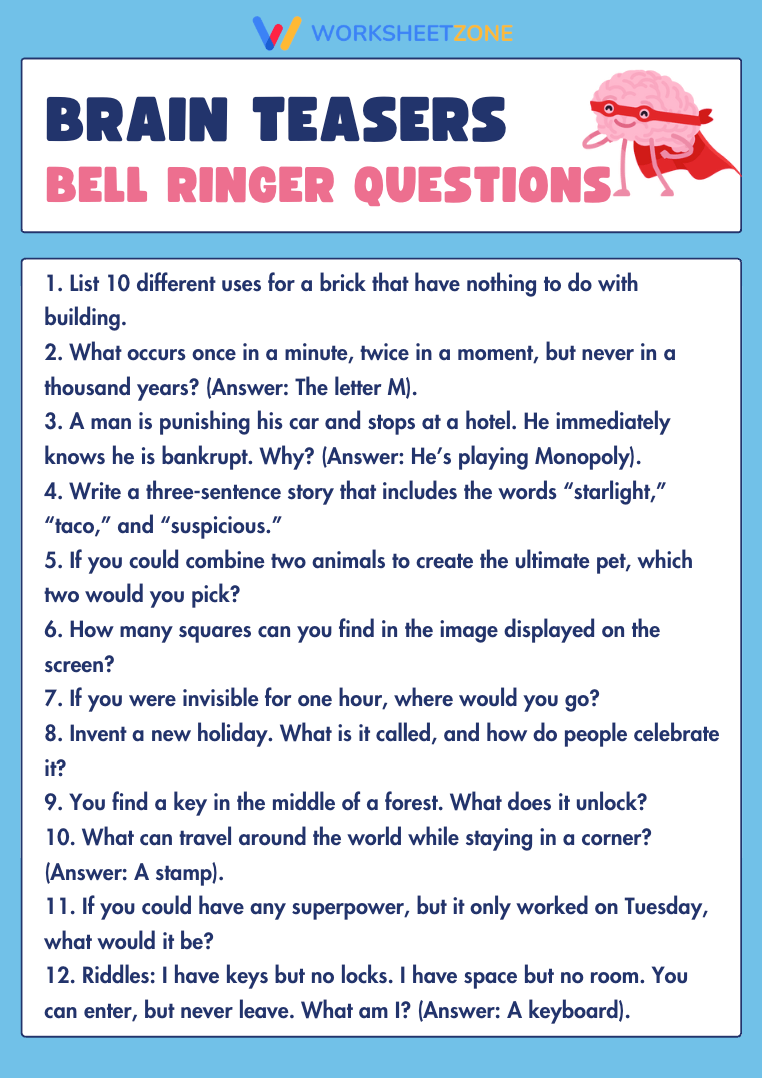
Brain teasers are excellent for “re-waking” the brain after a long bus ride or a boring lunch period. They encourage lateral thinking and help students approach problems from unconventional angles.
1. List 10 different uses for a brick that have nothing to do with building.
2. What occurs once in a minute, twice in a moment, but never in a thousand years? (Answer: The letter M).
3. A man is punishing his car and stops at a hotel. He immediately knows he is bankrupt. Why? (Answer: He’s playing Monopoly).
4. Write a three-sentence story that includes the words “starlight,” “taco,” and “suspicious.”
5. If you could combine two animals to create the ultimate pet, which two would you pick?
6. How many squares can you find in the image displayed on the screen?
7. If you were invisible for one hour, where would you go?
8. Invent a new holiday. What is it called, and how do people celebrate it?
9. You find a key in the middle of a forest. What does it unlock?
10. What can travel around the world while staying in a corner? (Answer: A stamp).
11. If you could have any superpower, but it only worked on Tuesday, what would it be?
12. Riddles: I have keys but no locks. I have space but no room. You can enter, but never leave. What am I? (Answer: A keyboard).
Tips for creating effective bell ringer questions
Crafting the perfect opening prompt requires a strategic balance of timing, curriculum alignment, and student engagement. These practical tips will help you design high-impact bell ringer questions that streamline your classroom management while maximizing instructional value.
1. Keep it short
Aim for prompts that students can realistically finish within 3-5 minutes to avoid eating into your primary instructional time. A clear, concise question ensures that students don’t feel overwhelmed as they transition into the classroom environment and allows you to wrap up administrative tasks quickly.
2. Align with learning objectives
Effective bell ringer questions should act as a bridge between previous lessons and the day’s specific goals. By rooting your warm-ups in your curriculum, you turn the first few minutes of class into a valuable formative assessment tool that reinforces core concepts.
3. Vary the question types
Mixing up your approach prevents the morning routine from becoming stale or predictable for your students. Rotate between content-heavy review, creative brainstorming, and social-emotional check-ins to keep the class energized and engaged every day of the week.
4. Consider student needs
Ensure your questions are accessible to all learners by using clear language and providing scaffolding or visual aids when necessary. Taking a moment to consider the diverse academic levels and current energy of your students helps make the bell ringer a welcoming and inclusive start for everyone.
5. Incorporate technology
Digital tools can transform a simple written prompt into an interactive, high-energy experience that provides immediate feedback. To make this time truly engaging, consider using Worksheetzone’s Live Game or Assign features, which allow you to gamify your bell ringer questions and track student participation in real-time.
Frequently Asked Questions (FAQ)
How do I manage students who arrive late?
For late arrivals, we recommend having a “catch-up station” where the prompt is printed or permanently displayed. This prevents the late student from interrupting the flow of the class while still allowing them to participate in the mental warm-up. Consistency in your routine is the best way to handle these interruptions.
Can bell ringers be used for all subjects?
Absolutely. Whether you are teaching math, literacy, or science, a well-placed question can prime the brain for that specific subject. For example, a math bell ringer might use a Math Crossword Puzzle to review yesterday’s formulas.
Do these questions help with standardized testing?
Yes. Many bell ringer questions—especially those in the “Recall” and “Critical Thinking” categories—directly mirror the types of analytical tasks found on standardized assessments. By practicing these skills in a low-stakes environment every morning, students build the stamina and accuracy needed for formal testing.
Final thoughts
Incorporating bell ringer questions into your daily teaching routine is more than just a strategy for quiet; it is a way to build a culture of curiosity and consistency. By choosing prompts that range from academic review to social-emotional check-ins, you cater to the holistic needs of your students. Remember that the best questions are those that provoke thought without causing stress, setting a positive tone for the entire lesson ahead. Start small, stay consistent, and watch your classroom engagement soar as students anticipate their daily morning challenge.


