




















Running out of 100th day of school ideas? Then you’ve come to the right place. In this article, we’ll share 20+ simple and engaging activities, complete with easy-to-find materials and step-by-step instructions to help you plan with confidence. With everything clearly laid out, preparing for the 100th day becomes stress-free and fun. So why wait? Let’s dive in!
100th Day of School Ideas
100th day of school ideas are thematic educational activities that celebrate the milestone of reaching 100 days of instruction while reinforcing mathematical and social concepts. These ideas refer to counting challenges, historical reflections, and community projects designed for students in grades PreK–5.
According to the National Council of Teachers of Mathematics (NCTM), celebrating the 100th day is a vital way to help young students internalize the structure of the base-ten number system.
1. 100 Ways We Are Kind

Materials:
- “100 Ways We Are Kind” chart template
- Large sheet of chart paper or construction paper
- Sticky notes
- Markers or pens
- Scissors and glue or tape
How to do:
Prepare the chart by copying and attaching the template to a large piece of paper. When students notice acts of kindness (such as helping a classmate, showing patience, or working cooperatively) they write the action on a sticky note and add it to the chart. Add ten circles with space for ten sticky notes in each, or five circles that hold twenty notes per group.
2. “If I had a hundred, I would…”

Materials:
- “If I Had a Hundred, I Would…” writing prompt (multiple versions included in the packet)
- “When I Am 100 Years Old, I Will…” writing and drawing sheet
- Pencils, crayons, or colored pencils
- Optional: extra paper for extended writing
How to do:
Begin by introducing the open-ended sentence starter “If I had a hundred, I would…”. While the traditional prompt focuses on “If I had a hundred dollars…”, students can offer alternatives such as puppies, toys, or anything they imagine. The activity naturally extends into a second writing task, “When I Am 100 Years Old, I Will…” Students write about their future selves and can continue their ideas on the back of the page if needed.
3. A 100 poster
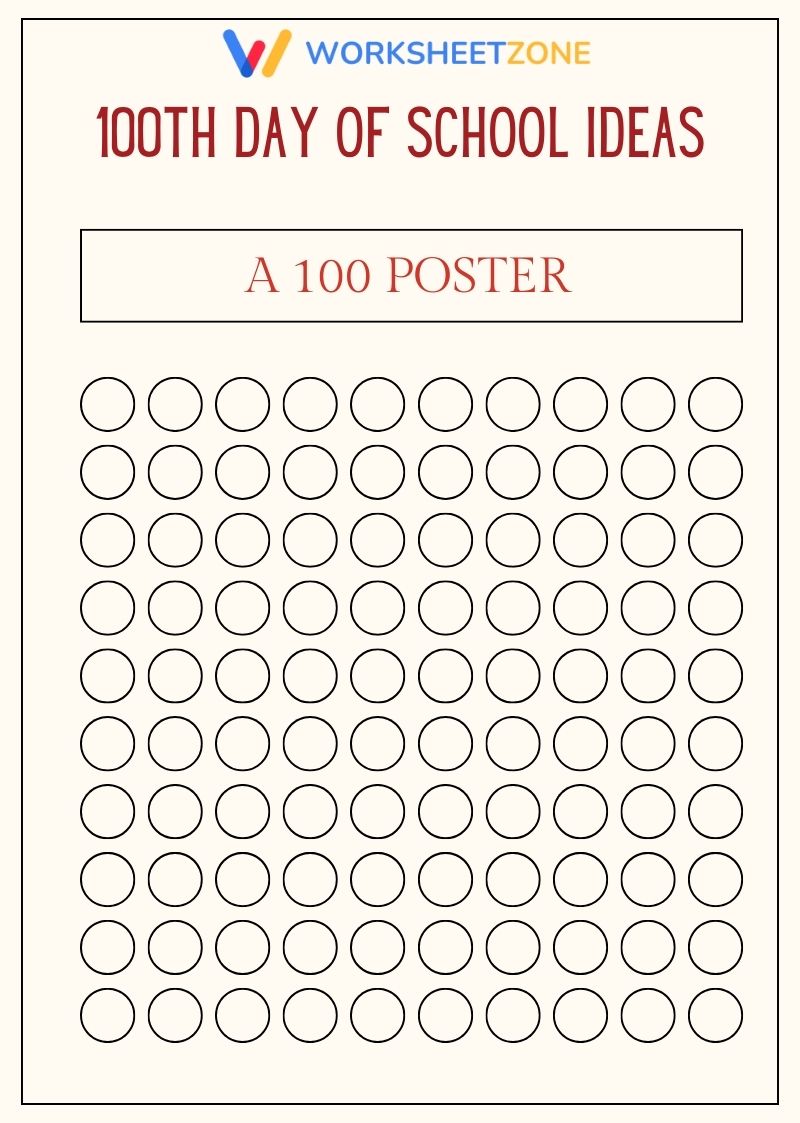
Materials:
- Large poster paper or construction paper
- Glue sticks or liquid glue
- 100 small objects per student (brought from home)
- Extra classroom supplies for backup (buttons, cereal, beads, etc.)
- Sorting mat for counting by tens (included in the packet)
How to do:
Create a poster by gluing 100 small objects onto a large sheet of paper. Students are encouraged to bring items from home, which adds excitement and personal ownership to the project. Before gluing, have students use the provided sorting mat to organize their objects into groups of ten.
4. “100 Day Smarter” bookmarks

Materials:
- “100 Day Smarter” bookmark printables (boy and girl versions)
- Crayons or colored pencils
- Pencils or markers
- Laminator and laminating sheets (optional)
How to do:
As students enter the classroom, place the “100 Day Smarter” bookmarks on their desks and invite them to begin coloring right away. Once finished, students write their names on the back of the bookmark to personalize it. To extend the life of the bookmarks, laminate them after coloring so students can use them throughout the year during independent reading time.
5. “What Do You Think?” booklet

Materials:
- “What Do You Think?” booklet (100-themed writing prompts)
- Pencils or pens
- Crayons or colored pencils (optional)
- Stapler or binding clips
How to do:
Inside the booklet, students respond to a variety of questions such as listing items that weigh 100 pounds, things that cost or might cost $100, places they believe are 100 miles away, objects they think are 100 years old, or foods they could eat 100 of.
6. 100th Day Mascot

Materials:
- Dalmatian mascot template named “Spot”
- Bingo dabbers or cotton swabs (Q-tips)
- Washable paint
- Paper towels or wipes for cleanup
How to do:
Introducing a class mascot, for example, a friendly dog named John. Students are given a printed template of John and the task of adding exactly 100 spots to his body. Using bingo dabbers or Q-tips dipped in paint, students carefully count each dot as they work. Students must stop precisely at 100 spots.
7. 100 Chart Secret Picture

Materials:
- 100-chart worksheets
- Crayons or colored pencils
- List of numbers to call out (in random order)
How to do:
Each student begins with a blank 100 chart. As the teacher calls out numbers in random order, students listen carefully, locate each number on their chart, and color it in. As more numbers are colored, a hidden pattern gradually appears. By the end of the activity, students discover that the completed chart forms the number 100.
8. Pass the Paper

Materials:
- “Pass the Paper” number chart worksheet (1-100)
- Pencils
- Timer or verbal cues for “go” and “pass”
How to do:
Each student starts with a blank 1-100 chart. When the teacher signals “go,” students begin writing numbers in order, starting from 1. At the cue “pass,” students immediately pass their paper to the next classmate and receive a new chart that another student has already started. Students continue writing numbers from the point where the previous student stopped, paying close attention to number order and placement.
9. Rolling a die 100 times

Materials:
- Recording sheet for rolling a die 100 times
- Standard six-sided dice
- Prediction and reflection questions
- Bar graph template
- Coin and 100-grid recording sheet
- Color-by-number worksheet
- Additional math and writing activities (100 subtraction problems, “If I Had $100” writing prompt)
How to do:
Students begin by predicting which number they believe will appear most often when rolling a die 100 times. As they roll and record each result, they track their data carefully, then compare the final outcome with their original prediction. Once all rolls are complete, the class uses the collected data to create a bar graph.
10. 100th Day of School Snack

Materials:
- Individual snack ingredients (100 pieces per student), such as cereal, crackers, dried fruit, or chocolate chips
- Large bowls or containers for mixing
- Snack cups or bags
- Baby carrots
- Cucumber slices (two per serving)
- Snack bags with a “100th Day” themed topper
How to do:
One popular option is a class trail mix, where each student contributes exactly 100 pieces of a single ingredient. After counting and checking their portions, all ingredients are combined to create a shared snack. For a healthier option, prepare a simple snack that visually represents the number 100. Use one baby carrot as the “1” and two cucumber slices as the “0s.”
11. 100-Second Challenge
Materials:
- Timer set for 100 seconds
- Challenge-specific materials such as linking cubes, paper clips, counting bears, pom-poms, or paper and pencils
- Recording sheet for predictions and results (optional)
How to do:
Before each challenge begins, students predict how many times they think they can complete the task within 100 seconds. Once predictions are recorded, start the timer and allow students to work until time runs out. Challenges can include stacking or connecting cubes, linking paper clips into a chain, sorting objects by color, transferring small items into a container, or writing and drawing continuously for 100 seconds.
12. “Can You Be Silent for 100 Seconds?”

Materials:
- Timer set for 100 seconds
- Optional reward or follow-up activity
How to do:
Students must remain completely silent for 100 seconds. Start the timer and encourage students to monitor their behavior until the time is up. To increase motivation, this challenge can be paired with a lighthearted incentive, such as earning a pretend $100 bill or unlocking the next activity if the class succeeds.
13. 100th Day Science Experiment

Materials:
- Candy-coated chocolates (100 per group, such as M&Ms, Skittles, or jelly beans)
- Counting mat for grouping by tens
- Large white dish or shallow pan
- Very warm water (teacher use only)
- Observation sheet or drawing paper
- Pencils or crayons
How to do:
Begin by having students count out 100 pieces of candy, ideally grouping them by tens using a counting mat. Once students have their candies, they arrange them on a white dish to form a shape or design. Before adding water, guide students to make a prediction about what they think will happen when the warm water is poured in. As the water reaches the candies, the colored coating dissolves and spreads, creating visible patterns across the dish.
14. “Which Container Has 100 Items?”
Materials:
- Three clear containers
- Small counting items such as candies or counters
- Recording sheet or chart for student guesses
How to do:
Begin by setting out three containers, filling only one of them with exactly 100 items while the others contain more or fewer pieces. Without counting, students examine the containers and predict which one they believe holds exactly 100 items. Once all predictions are collected, pour out the contents of each container and count the items together as a class. Students then compare the actual totals with their original estimates.
15. A 100-page
Materials:
- A printable number 100 page
- Scissors
- Glue
- A blank sheet of paper
- Optional: a ready-made 100th Day of School activity packet
How to do:
Begin by distributing a 100-page book to each student. Students cut out the number and glue it onto a blank piece of paper. Once the number is in place, students transform the number 100 into something new using their imagination. It could become an animal, a robot, glasses, or any creative design they choose.
16. 100th day seek and find

Materials:
- Seek-and-find hidden pictures worksheet
- Crayons or colored pencils in multiple colors
- Pencil for counting and checking totals
How to do:
Students search the worksheet to locate hidden pictures, working toward a total of 100 objects. To support accuracy, students use different colors to circle each type of object they find. As students review their colored circles, they count how many of each object they found and check that their combined total reaches 100.
17. Personalized $100 bills

Materials:
- Student photos
- Access to an online photo-editing tool that creates $100 bill templates
- Printer and paper (optional, for physical copies)
How to do:
Using a simple online photo tool, upload each student’s photo and place it onto a $100 bill template. Once completed, the personalized $100 bills can be printed or shared digitally with students. These bills can be used as keepsakes, rewards for completing challenges, or as part of other 100th Day activities.
18. 100 Days theme
Materials:
- 100 Days theme color-by-code worksheet
- Crayons or colored pencils
- Clear color key displayed on the worksheet or board
How to do:
Simply provide students with the worksheet and review the color key together to ensure everyone understands how to match numbers with colors. Students then follow the code to color each section correctly. Because the directions are straightforward and familiar, this activity requires minimal teacher explanation and allows students to work independently.
Looking for the perfect printable for this activity? Download the 100th Day of School Printable & Interactive Worksheet Here!
19. “Can We Read 100 Books?”

Materials:
- Large chart paper with a 10 x 10 grid
- Small book-title printable cards (included in the packet)
- Crayons or colored pencils
- Scissors and glue
- 100s chart (included in the packet, for reference)
How to do:
Create a simple 10 x 10 grid chart titled “Can We Read 100 Books?” Each time a student finishes a book, they write the book title on a small printable card. After writing the title, students color the card, cut it out, and bring it to the chart to be glued in place. To keep the process organized and frustration-free, teachers can glue the cards themselves or add visual guides.
20. The “Move It”
Materials:
- “Move It” activity checklist (printable)
- Clipboards or hard surfaces for writing (optional)
- Pencils or crayons
- Space in the classroom or hallway
- Optional extension materials: small bags with 100 LEGO pieces each
How to do:
Assign the volunteer a small group of five to ten students and set them up in a hallway or designated open area. Each student receives a simple checklist and completes the movements listed, checking off each task as they finish. One effective option is counting by ones up to 100, adding actions for number patterns, for example, students crouch on numbers ending in five and jump on multiples of ten. Another engaging follow-up is a building challenge using 100 LEGO pieces per student.
21. The 100’s Day crown
Materials:
- Star template (included in the packet)
- Cardstock for printing
- Crown strips (10 strips per student, each with a different pattern)
- Crayons or colored pencils
- Scissors and glue
- Four-inch paper bands or rubber bands
- Stapler
How to do:
Copy the star template onto cardstock for durability. Students color and cut out the star while you prepare a four-inch crown band. Staple a rubber band to the band for a flexible fit. Each crown has ten patterned strips, which can be made ahead of time and attached later. Glue the star firmly on top of the crown, trimming the points if needed for safety.
22. 100-Link Paper Chain

Materials:
- Paper strips labelled with numbers 1-100
- Masking tape
- Markers
- Open hallway or large space
How to do:
Ask students to estimate the length of a 100-link paper chain and mark their predictions in the hallway with labeled masking tape. Then, divide the class into groups to order numbered strips and create mini chains. Connect all chains from 1 to 100, lay the finished chain in the hallway, and compare its length to the students’ estimates.
23. A heads/tails penny flip

Materials:
- Printable heads/tails recording sheet (included in the packet at the back)
- Pennies (one per student or per pair)
- Two different coloring tools (crayons or colored pencils)
- Small plastic cups (optional, for shaking instead of flipping)
How to do:
Students flip a penny and record the result by coloring one section for “heads” and another for “tails,” using two different colors to clearly track outcomes. As the activity progresses, teachers can naturally introduce simple math concepts such as probability and prediction, helping students build early math vocabulary in a hands-on way. To reduce distractions and keep the classroom organized, students can place a penny inside a small cup and shake it instead of flipping it onto the floor.
Frequently Asked Questions
When is the 100th day of school?
The 100th day of school typically falls in late January or early February, depending on your school’s start date and any unexpected closures. It is often celebrated as a major milestone marking the halfway point of the academic year.
Can I do these activities during remote learning?
Absolutely. Many of the challenges, like the “100-Second Challenge” or the “If I had a hundred…” writing prompt, work perfectly in a virtual classroom. Use our Interactive Worksheet Maker to create digital 100-charts that students can complete on their own devices.
How do I involve parents in the celebration?
We recommend sending home a checklist of “100 objects” for students to collect with their parents for their posters. This bridges the gap between school and home and allows families to participate in the milestone.
Final thoughts
We hope these 20+ 100th day of school ideas have inspired you and made planning for this special milestone much easier. With a little preparation and the right ideas, this day can become a highlight of the school year for both teachers and students. We hope you feel confident and excited to bring these activities into your classroom and make the 100th day truly unforgettable.


