


























Views
Downloads

Food Likes and Dislikes Worksheet | Printable Grade K
Paste this activity's link or code into your existing LMS (Google Classroom, Canvas, Teams, Schoology, Moodle, etc.).
Students can open and work on the activity right away, with no student login required.
You'll still be able to track student progress and results from your teacher account.
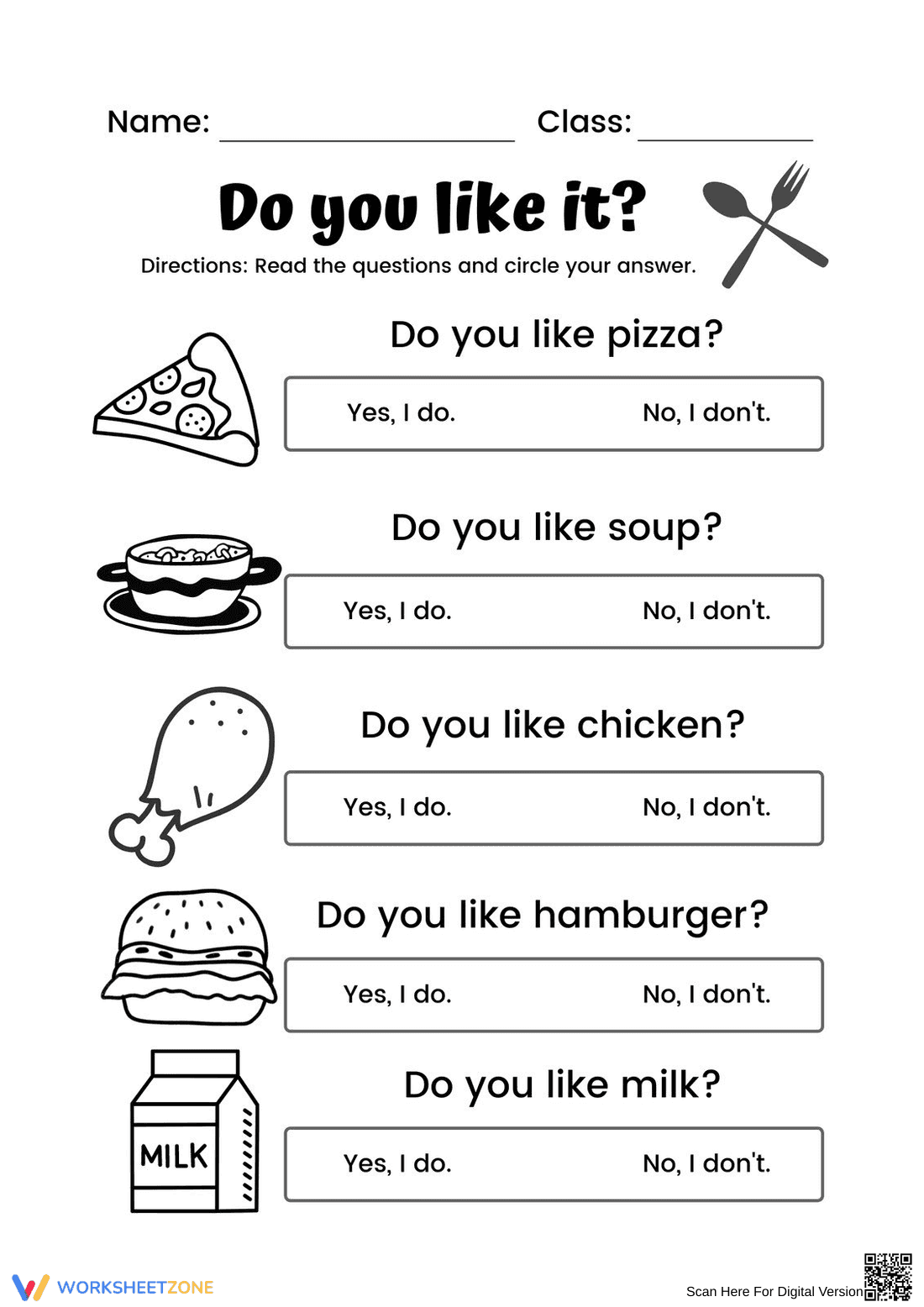
This Grade K food likes and dislikes worksheet helps young learners express personal preferences through simple reading and circling tasks. Students engage with five common food items to practice responding to "Do you like...?" questions. This activity builds foundational literacy skills and oral language confidence by providing clear visual cues and repetitive sentence frames for immediate student success.
At a Glance
- Grade: K · Subject: ELA
- Standard:
CCSS.ELA-LITERACY.SL.K.6— Speak audibly and express thoughts, feelings, and ideas clearly- Skill Focus: Expressing personal preferences
- Format: 1 page · 5 problems · Answer key included · PDF
- Best For: Early literacy and speaking practice
- Time: 10–15 minutes
What's Inside
The worksheet features a clean layout containing five distinct sections. Each section includes a line-art illustration of a food item—pizza, soup, chicken, a hamburger, and milk—paired with a direct question. Students are provided with two clear response options: "Yes, I do" and "No, I don't." The large font and spacing are designed for early writers developing fine motor control.
Zero-Prep Workflow
The workflow for this resource is designed for efficiency. First, print the single-page PDF (30 seconds). Second, distribute the sheets and model the circling task (1 minute). Third, review responses as a group (5 minutes). Total teacher preparation time is under 2 minutes, making this an ideal choice for morning work or literacy centers.
Standards Alignment
This resource is primarily aligned with CCSS.ELA-LITERACY.SL.K.6: "Speak audibly and express thoughts, feelings, and ideas clearly." It also supports CCSS.ELA-LITERACY.L.K.1.D by helping students understand and use question words. By selecting a response, students are making a claim about their own experiences. Both standard codes can be copied directly into lesson plans, IEP goals, or district curriculum mapping tools.
How to Use It
Use this worksheet during a "Healthy Eating" or "My Senses" unit to facilitate classroom discussions. It works best after direct instruction on "Do you like" question structures. As a formative assessment, observe which students can read the food words independently versus those who rely on the images. Expect completion within 10 to 15 minutes, depending on whether students color the images afterward.
Who It's For
This activity is perfect for Kindergarten students, English Language Learners (ELLs) in the beginning stages of proficiency, and students with special needs who benefit from visual supports. It pairs naturally with a "Food" themed anchor chart or a read-aloud book about picky eaters. The simple design ensures that the focus remains on the language task without unnecessary distractions.
This Kindergarten ELA resource focuses on CCSS.ELA-LITERACY.SL.K.6, which requires students to express thoughts and feelings clearly. By engaging with 5 distinct food-related prompts, learners practice the linguistic structures necessary for communicating personal preferences. According to Fisher & Frey (2014), providing young learners with visual scaffolds alongside repetitive sentence structures—such as the "Yes, I do" and "No, I don't" frames used here—is essential for developing oral language proficiency and reading confidence. This worksheet serves as a foundational tool for early literacy, bridging the gap between visual recognition and written expression. The clear black-and-white design minimizes cognitive load, allowing students to focus entirely on the communicative task. Educators can utilize this resource to gather formative data on student vocabulary and sentence structure usage while engaging in a relatable, high-interest topic that encourages peer-to-peer interaction.


