




























Views
Downloads


George Washington Carver Biography | Printable ELA Worksheet

Paste this activity's link or code into your existing LMS (Google Classroom, Canvas, Teams, Schoology, Moodle, etc.).
Students can open and work on the activity right away, with no student login required.
You'll still be able to track student progress and results from your teacher account.
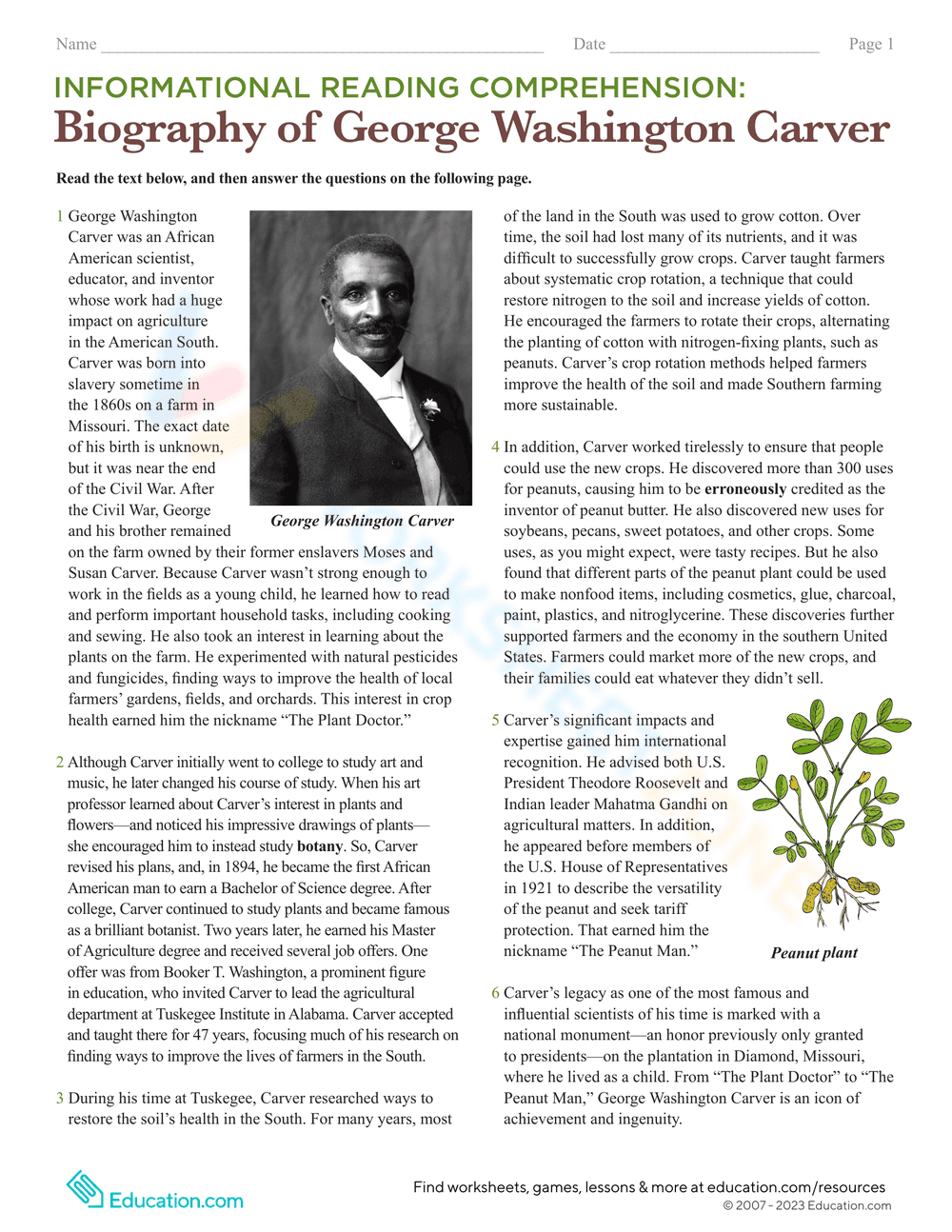
This informational reading comprehension worksheet helps middle school students analyze the life and legacy of George Washington Carver. Students read a detailed biography of the famous agricultural scientist and inventor, then answer text-dependent questions to demonstrate mastery. This resource targets central ideas, vocabulary in context, and drawing evidence-based inferences.
At a Glance
- Grade: Grade 7 · Subject: English Language Arts
- Standard:
CCSS.ELA-LITERACY.RI.7.2— Determine central ideas and write an objective summary of informational text- Skill Focus: Informational reading comprehension
- Format: 2 pages · 7 problems · Answer key included · PDF
- Best For: Independent reading practice and assessment
- Time: 30–45 minutes
This 2-page printable resource features a comprehensive biographical passage detailing Carver's early life, education at Tuskegee Institute, and groundbreaking agricultural research. The second page contains 7 structured comprehension questions, including multiple-choice items for central ideas and vocabulary, alongside open-ended prompts requiring written text evidence and summary writing.
The worksheet follows a structured skill progression to guide students toward independent mastery. First, guided practice begins with identifying the central idea and defining key vocabulary like "botany" using context clues. Next, supported practice tasks require students to locate specific text evidence to back up their claims about Carver's childhood. Finally, independent practice challenges students to synthesize the text by writing a complete summary of Carver's agricultural contributions. This gradual-release model ensures students build confidence as they transition from basic recall to higher-order analysis.
Standards Alignment
This resource aligns directly with the Common Core State Standard CCSS.ELA-LITERACY.RI.7.2, which requires students to determine central ideas in a text and provide an objective summary. Additionally, it supports CCSS.ELA-LITERACY.RI.7.1 by asking students to cite textual evidence to support their inferences. Both standard codes can be copied directly into lesson plans, IEP goals, or district curriculum mapping tools.
How to Use It
Use this worksheet during direct instruction on informational text structures, or assign it as a independent reading assessment after teaching summarization strategies. For a formative assessment, observe how students approach the two-part evidence question; check if they can successfully link their vocabulary definition to a specific sentence in paragraph 2. Expect students to complete the reading and questions within 30 to 45 minutes.
Who It's For
This activity is designed for students in grades 6 through 9 who are developing their close reading skills. It is highly beneficial for general education classrooms, structured ELA intervention groups, and English language learners requiring scaffolded vocabulary support. Pair this worksheet with an anchor chart on text evidence or a introductory lesson on Black History Month to maximize student engagement.
This informational reading comprehension worksheet provides targeted practice to help middle school students master standard CCSS.ELA-LITERACY.RI.7.2. By analyzing the biography of George Washington Carver, students practice identifying central ideas, defining domain-specific vocabulary, and writing objective summaries. According to the Fisher & Frey (2014) framework for gradual release of responsibility, structured reading tasks that combine direct text evidence retrieval with independent synthesis are critical for developing advanced literacy. This 2-page resource scaffolded approach ensures that students transition smoothly from basic comprehension to critical analysis, making it an excellent tool for formative assessment. Teachers can confidently integrate this worksheet into their curriculum to support diverse learners in meeting rigorous state standards. The inclusion of multiple-choice and open-ended questions allows educators to measure student progress accurately.


