


























Views
Downloads

Printable Main Idea Graphic Organizer | Grades 3-5 ELA
Paste this activity's link or code into your existing LMS (Google Classroom, Canvas, Teams, Schoology, Moodle, etc.).
Students can open and work on the activity right away, with no student login required.
You'll still be able to track student progress and results from your teacher account.
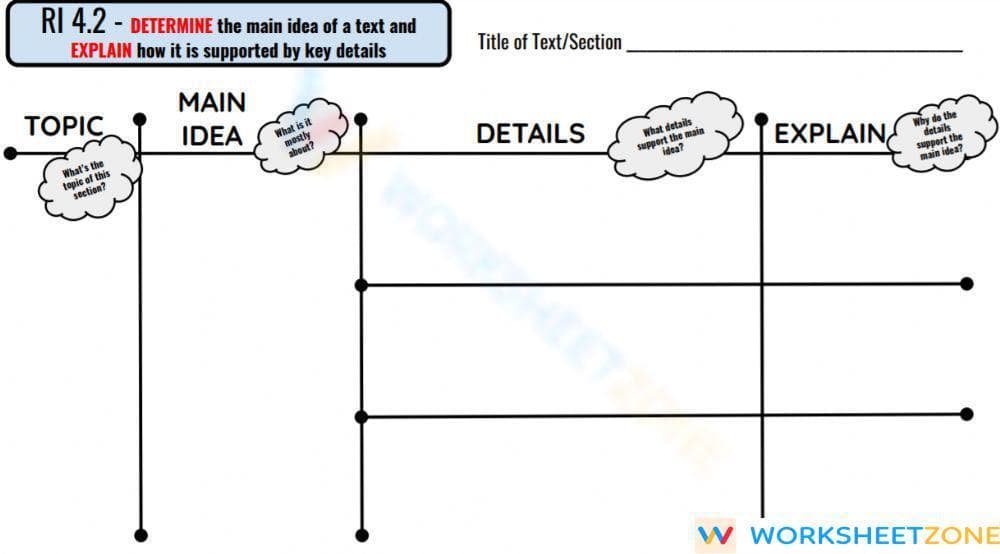
This printable main idea graphic organizer helps students in Grades 3-5 master the essential skill of identifying the central message and supporting evidence. By providing a visual structure, this worksheet enables learners to synthesize complex information into a coherent summary, fostering deeper reading comprehension across all subjects.
At a Glance
- Grade: 4 · Subject: English Language Arts & Literature
- Standard:
RI.4.2— Determine the main idea and explain how key details support it- Skill Focus: Main Idea and Supporting Details Identification
- Format: 1 printable page · 4 tasks · Answer key included · High-quality PDF
- Best For: Literacy centers, independent practice, and reading comprehension assessment
- Time: 15–20 minutes of focused classroom work
What's Inside
This clean graphic organizer features a central field for the main idea and three supporting detail boxes. The one-page layout minimizes visual clutter, allowing students to focus on text analysis. A comprehensive answer key example is included to help teachers model the process or quickly grade student submissions during independent work blocks.
Zero-Prep Workflow
This worksheet is designed for maximum efficiency. Teachers can print and distribute the organizer in under 60 seconds. Students can begin work immediately following direct instruction or during silent reading. Reviewing student work takes approximately 1 minute per page, as the visual layout allows for instant checks of textual evidence. It is an ideal sub-plan resource requiring zero teacher setup.
Standards Alignment
This resource is aligned to CCSS.ELA-LITERACY.RI.4.2, which requires students to determine the main idea of a text and explain how it is supported by key details. It also supports RI.3.2 and RI.5.2 by emphasizing textual evidence. Both standard codes can be copied directly into lesson plans, IEP goals, or district curriculum mapping tools for curriculum tracking.
How to Use It
Use this organizer as a formative assessment during the independent practice phase of a lesson. While students read a non-fiction passage, have them fill in the organizer to track their understanding. Teachers should observe whether students can distinguish between themes and main ideas. This worksheet also works well in small-group interventions, serving as a scaffold for students who struggle with summarizing.
Who It's For
This worksheet is perfect for general education students in Grades 3-5 and English Language Learners who benefit from visual scaffolds. It pairs naturally with any informational passage or science textbook chapter. The simple structure makes it a versatile tool that can be used repeatedly as students progress to more complex texts and higher-level analysis.
Research from Fisher & Frey (2014) emphasizes the importance of visual organizers in helping students move from surface-level reading to deep structural understanding of a text. This Main Idea Graphic Organizer provides the necessary cognitive scaffold for students to map out the hierarchical relationship between a central thesis and its supporting evidence, a core requirement of RI.4.2. By externalizing the mental process of synthesis, the worksheet reduces cognitive load and allows learners to focus on textual evidence required for academic mastery. Educational data from NAEP indicates that students who consistently use structured tools for reading comprehension perform significantly better on standardized assessments involving informational text analysis. This resource ensures that students are not just reading, but actively constructing meaning in a way that is visible to the teacher and ready for formative feedback or summative grading.


