


























Views
Downloads

Essential Letter U Beginning Vowels Worksheet | Grade K-1
Paste this activity's link or code into your existing LMS (Google Classroom, Canvas, Teams, Schoology, Moodle, etc.).
Students can open and work on the activity right away, with no student login required.
You'll still be able to track student progress and results from your teacher account.
Mastering initial vowel sounds is a critical milestone for early readers. This comprehensive Letter U worksheet provides students with targeted practice in isolating and identifying both the short and long /u/ sounds. By engaging with visual cues and word-building tasks, learners strengthen their phonemic awareness and foundational decoding skills for future reading success.
At a Glance
- Grade: Kindergarten · Subject: ELA Phonics
- Standard:
CCSS.ELA-LITERACY.RF.K.3.B— Associate the long and short sounds with common spellings for major vowels- Skill Focus: Initial Vowel Sound /u/ Recognition
- Format: 3 pages · 10 problems · Answer key included · PDF
- Best For: Letter-of-the-week centers or morning work
- Time: 15–20 minutes
What's Inside
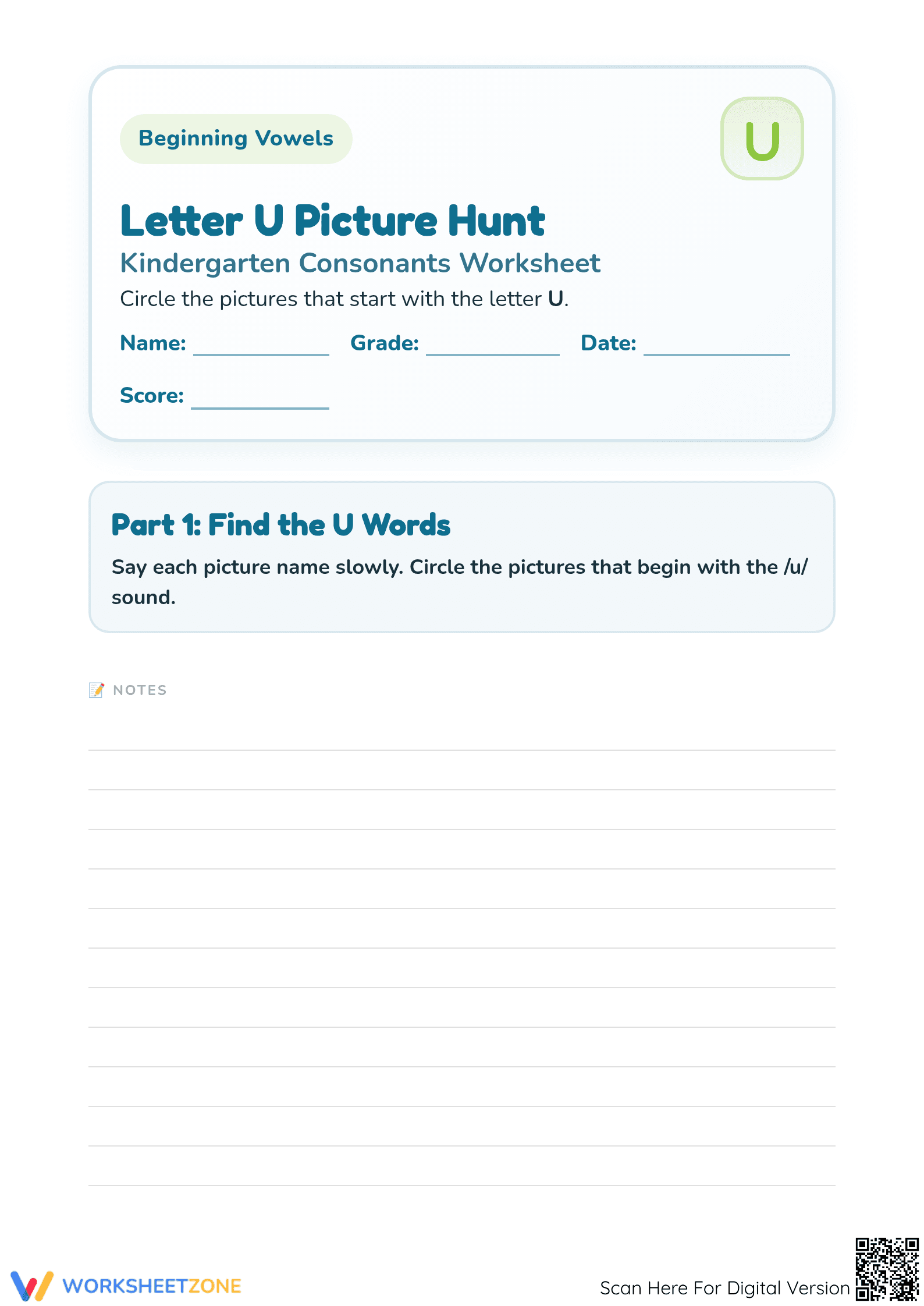
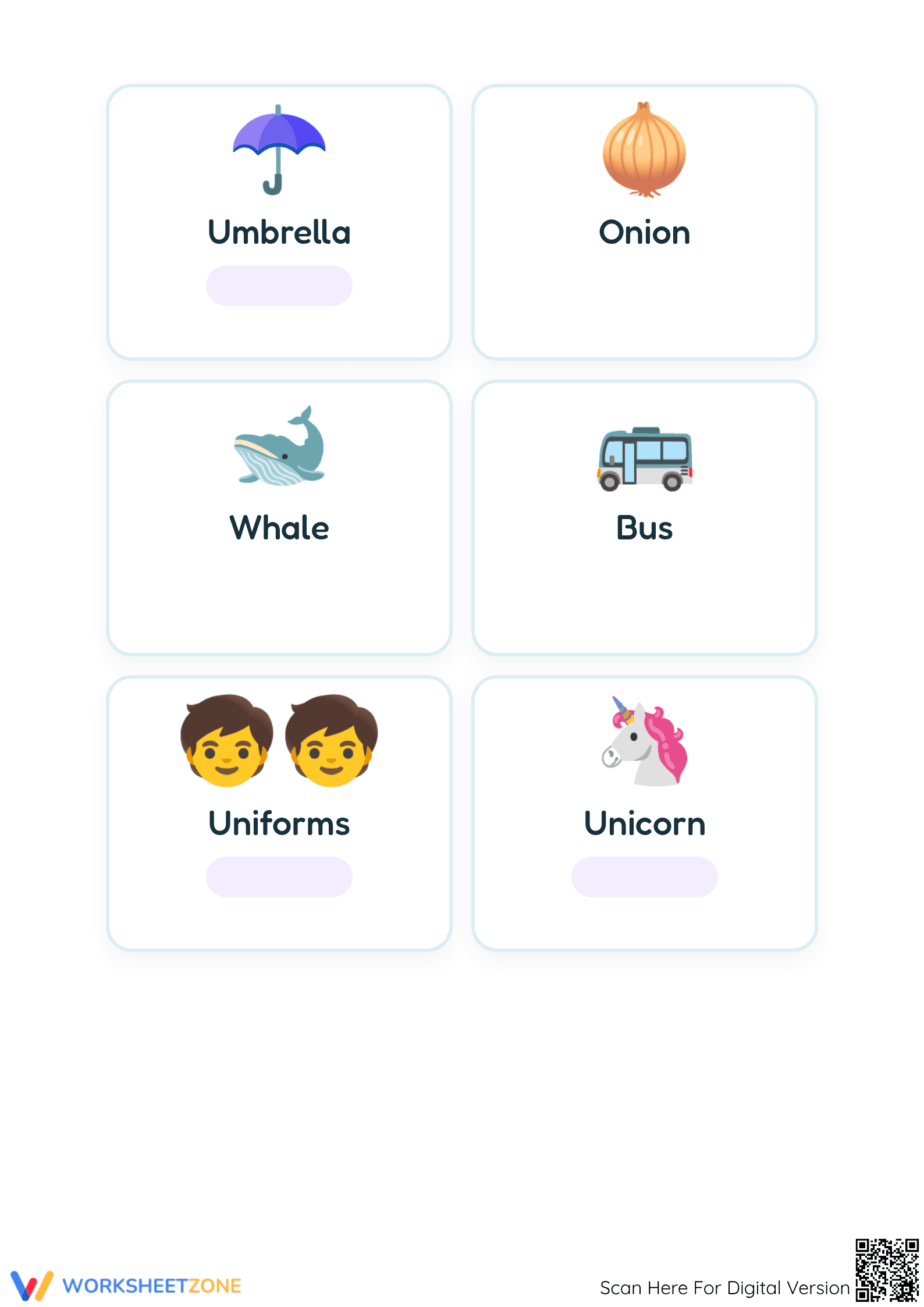
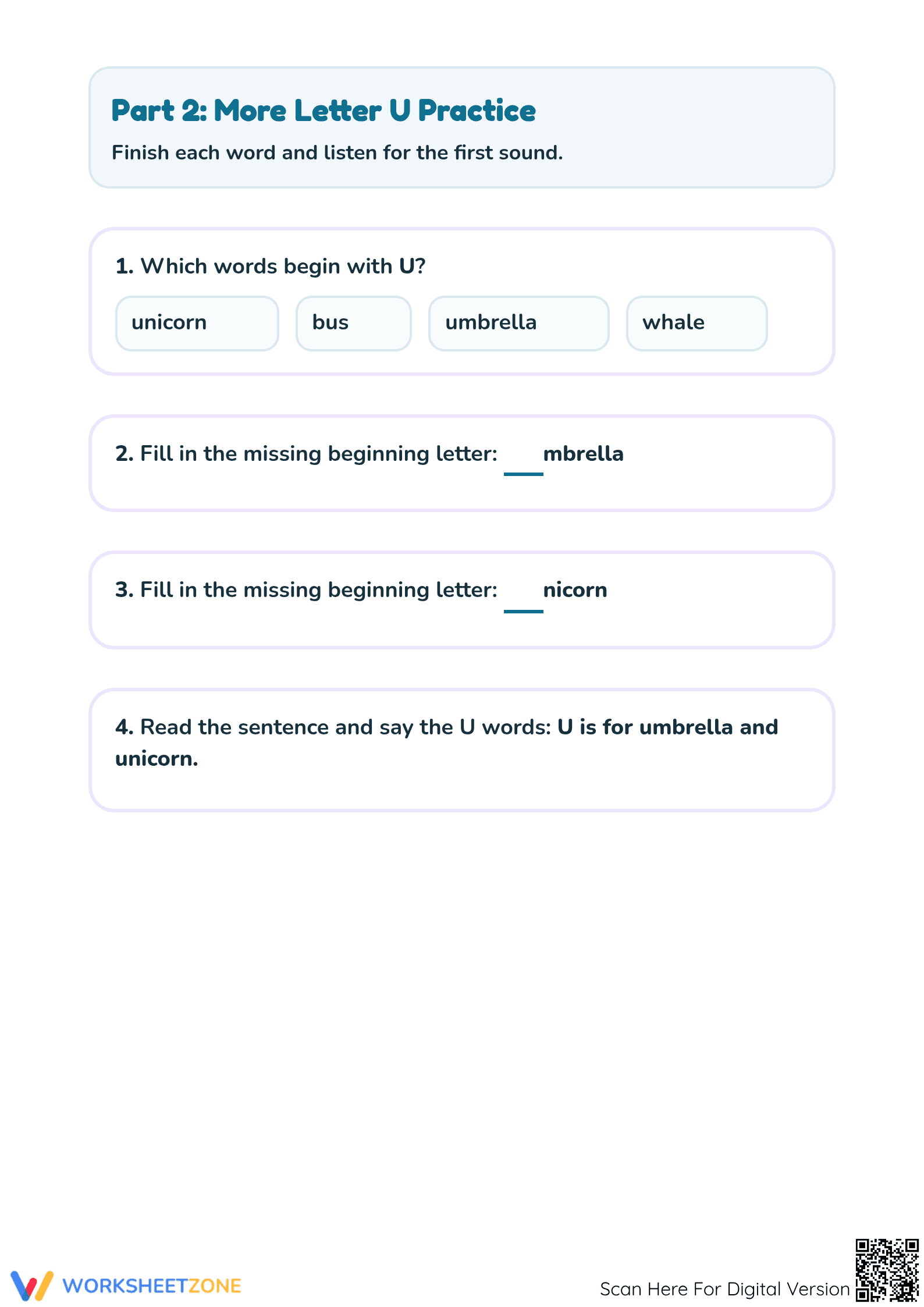
This three-page instructional set includes a "Letter U Picture Hunt" where students identify words like umbrella, uniforms, and unicorn. It transitions from visual identification to word-level practice, featuring multiple-choice questions and fill-in-the-blank spelling tasks. The packet includes clear illustrations, a dedicated notes section for teachers or parents, and a complete answer key for rapid grading.
Zero-Prep Workflow
The zero-prep design ensures this resource is classroom-ready in seconds. First, print the three-page PDF (30 seconds). Next, distribute the packets to students for independent or small-group work (1 minute). Finally, use the included answer key to review student responses during a transition period or as part of a quick formative assessment (under 2 minutes). It is a perfect addition to any emergency sub-plan.
Standards Alignment
This resource aligns directly with `CCSS.ELA-LITERACY.RF.K.3.B`, focusing on the phonological awareness required to distinguish vowel sounds. Students must recognize that the letter U represents different phonemes in words like "umbrella" and "unicorn." This standard code can be copied directly into lesson plans, IEP goals, or district curriculum mapping tools. Both standard codes can be copied directly into lesson plans, IEP goals, or district curriculum mapping tools.
How to Use It
Use this worksheet during the "You Do" phase of a gradual-release lesson on vowels. As students work, circulate to observe if they can distinguish between the initial vowel sounds of "umbrella" and "onion," providing a quick formative check on their auditory discrimination. It also serves as an excellent quiet activity for early finishers or a meaningful homework assignment.
Who It's For
Designed for Preschool, Kindergarten, and Grade 1 students, this packet supports diverse learners through clear visual scaffolding. It is particularly effective for students requiring extra phonics support or English Language Learners (ELL) who benefit from the pairing of images with vocabulary. Pair this with a high-interest alphabet book or a digital vowel-sorting game for a complete lesson.
Phonics instruction that emphasizes phoneme isolation and letter-sound correspondence is a cornerstone of evidence-based literacy programs. According to the RAND AIRS 2024 report, students who master initial vowel identification in Kindergarten show significantly higher fluency rates by the end of second grade. This worksheet facilitates this mastery by providing 10 structured opportunities to engage with the `CCSS.ELA-LITERACY.RF.K.3.B` standard through visual, auditory, and written modalities. By requiring students to not only find pictures starting with the /u/ sound but also to complete the graphemic representation, the resource bridges the gap between sound recognition and spelling. This dual approach aligns with Fisher & Frey's 2014 research on the importance of multi-modal exposure during the early stages of the "gradual release of responsibility" model. Teachers can reliably utilize this resource to gather data on student progress toward foundational literacy benchmarks.


