


























Views
Downloads


Beginning Sounds Letter A — Printable Preschool Worksheet
Paste this activity's link or code into your existing LMS (Google Classroom, Canvas, Teams, Schoology, Moodle, etc.).
Students can open and work on the activity right away, with no student login required.
You'll still be able to track student progress and results from your teacher account.
This printable Letter A worksheet helps preschoolers identify initial sounds through engaging visual recognition tasks. By connecting the /a/ phoneme to familiar objects, students develop the foundational phonemic awareness necessary for early reading success. This resource provides direct practice in isolating beginning sounds, ensuring a smooth transition from letter recognition to decoding.
At a Glance
- Grade: Preschool · Subject: English Language Arts
- Standard:
CCSS.ELA-LITERACY.RF.K.3.A— Demonstrate knowledge of letter-sound correspondences by producing the primary sound for letter A- Skill Focus: Initial Phoneme Isolation (Letter A)
- Format: 2 pages · 12 problems · Answer key included · PDF
- Best For: Literacy centers and independent morning work
- Time: 10–15 minutes
What's Inside
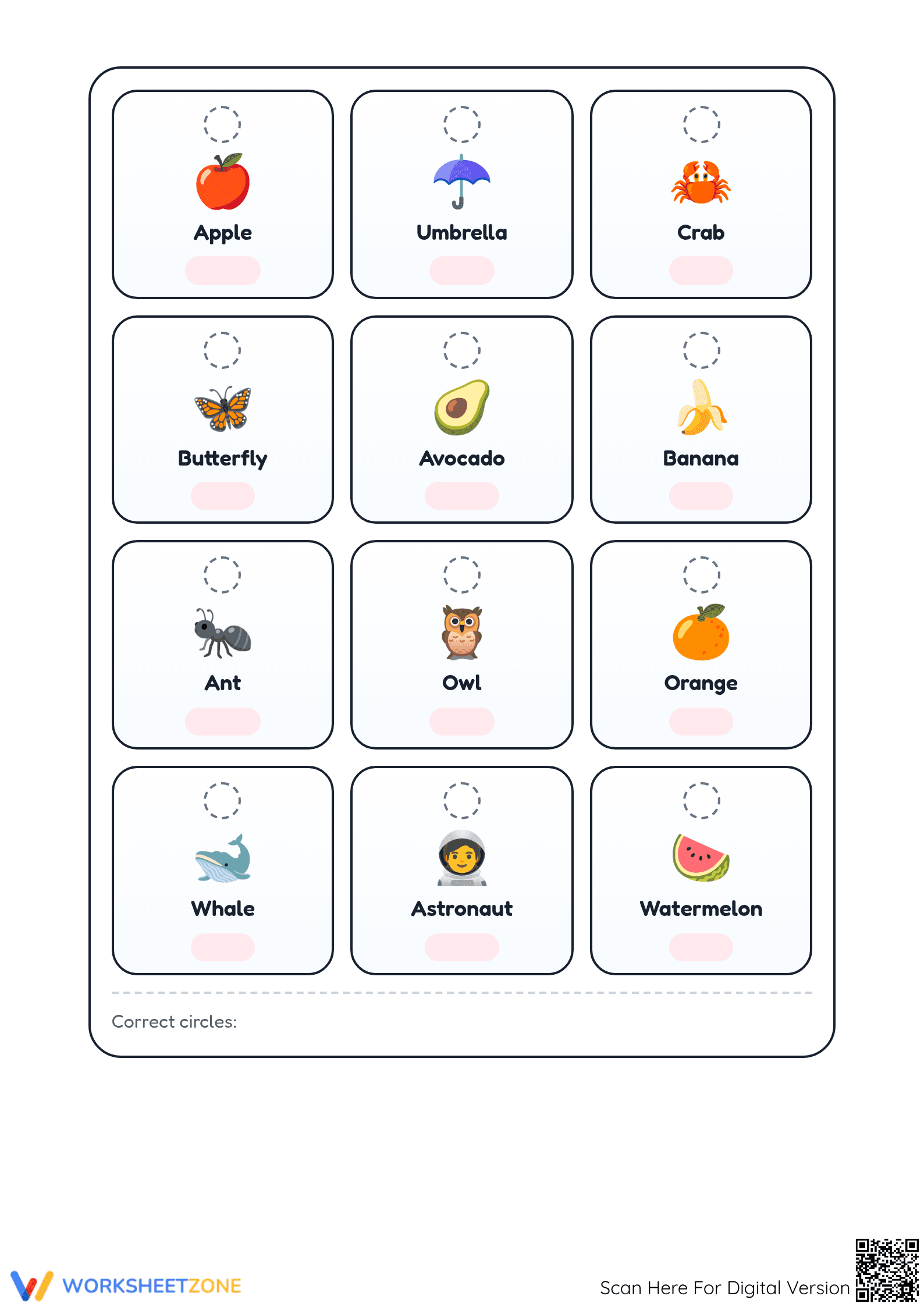
This phonics packet includes a structured instructional page and a focused activity grid. The first page features a dedicated notes section for teachers or parents to record student progress. The second page presents a 3x4 grid containing twelve distinct illustrations, including "Apple," "Ant," and distractors like "Whale." Students evaluate each picture and circle those starting with the /a/ sound.
Zero-Prep Workflow
This resource is designed to be ready in seconds. Follow these three simple steps to integrate it into your lesson:
- Print: Output the two-page PDF for your entire class in under 30 seconds.
- Distribute: Hand out the sheets with crayons or markers; no extra materials are required.
- Review: Use the provided answer key to grade all 12 tasks in less than a minute.
Total teacher preparation time is targeted at under 2 minutes, making this an ideal solution for emergency sub plans or busy morning transitions.
Standards Alignment
The primary standard for this resource is `CCSS.ELA-LITERACY.RF.K.3.A`, focusing on one-to-one letter-sound correspondences. This activity serves as a critical bridge to Kindergarten readiness by emphasizing phoneme isolation and initial sound identification. Both standard codes can be copied directly into lesson plans, IEP goals, or district curriculum mapping tools to track early literacy milestones.
How to Use It
Incorporate this worksheet after modeling the /a/ sound with an anchor chart. Have students complete the grid independently to assess their ability to distinguish the target sound from distractors. Use this as a formative assessment: observe if students subvocalize the picture names, which indicates they are actively processing the phonological components. Expected completion time is approximately 12 minutes.
Who It's For
This resource is tailored for preschool students beginning their phonics journey. It is also highly effective for Kindergarten intervention or English Language Learners building basic vocabulary. The clear illustrations provide essential visual support, making it a perfect pairing for initial sound read-alouds or alphabet-themed direct instruction lessons that require minimal teacher intervention.
Early literacy instruction relies on the systematic development of phonemic awareness, specifically the ability to isolate and identify initial sounds in spoken words. This worksheet targets the `CCSS.ELA-LITERACY.RF.K.3.A` standard by providing students with twelve distinct opportunities to evaluate phoneme-grapheme correspondences for the letter A. According to research findings by Fisher & Frey (2014), the use of visual scaffolds and direct phonemic practice is essential for bridging the gap between oral language and written text. By requiring students to say each picture name aloud, the activity reinforces the auditory-visual connection required for decoding. The inclusion of distractors ensures that students are not merely memorizing patterns but are actively discriminating between sounds. This evidence-based approach aligns with best practices for Preschool ELA instruction, offering a structured pathway toward reading fluency and phonological mastery in early childhood education settings.


