


























Views
Downloads
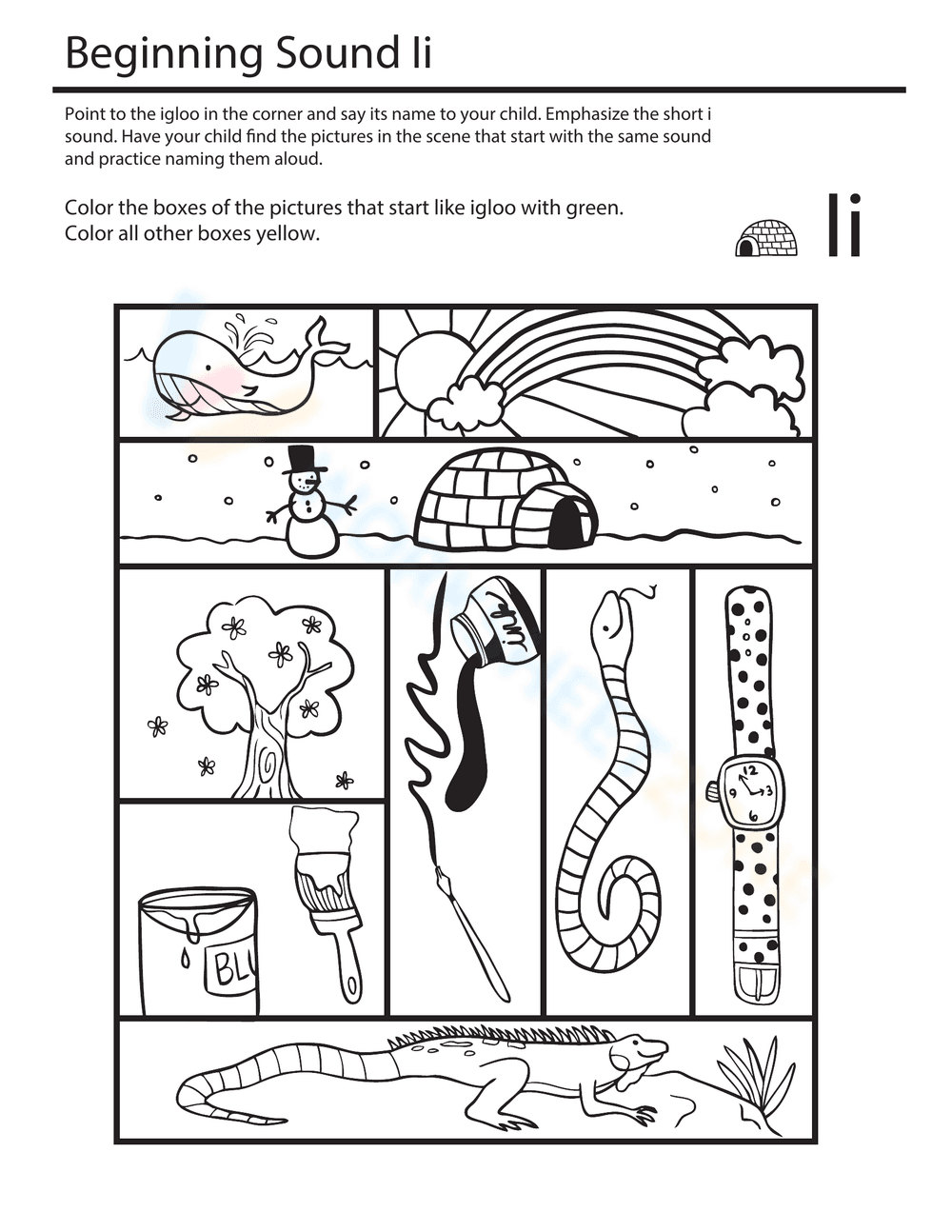

Preschool Short I Beginning Sounds — Printable Worksheet
Paste this activity's link or code into your existing LMS (Google Classroom, Canvas, Teams, Schoology, Moodle, etc.).
Students can open and work on the activity right away, with no student login required.
You'll still be able to track student progress and results from your teacher account.
This phonics worksheet develops early phonemic awareness by focusing on the short I beginning sound. Students practice auditory discrimination by identifying pictures starting with the initial sound of igloo. Through targeted coloring tasks, young learners strengthen letter-sound correspondence and build essential foundational reading skills.
At a Glance
- Grade: Preschool · Subject: ELA
- Standard:
CCSS.ELA-LITERACY.RF.K.3.A— Demonstrate basic knowledge of one-to-one letter-sound correspondences- Skill Focus: Short I beginning sounds
- Format: 1 page · 8 problems · Answer key included · PDF
- Best For: Independent practice and literacy centers
- Time: 10–15 minutes
This single-page printable features eight picture boxes designed for phoneme identification. Each box contains an illustrated vocabulary word, including an iguana, ink, whale, and snake. Students follow visual cues to color matching short I sounds green and non-matching sounds yellow. A complete answer key allows quick verification by teachers or parents.
Zero-Prep Workflow
This worksheet is designed for immediate classroom implementation with minimal preparation. The workflow operates in three rapid steps:
- Print (30 seconds): Generate the single-page PDF and make copies for the class.
- Distribute (30 seconds): Hand out the activity sheet along with green and yellow crayons.
- Review (45 seconds): Read instructions aloud and model the target short I phoneme using the igloo illustration.
Total teacher preparation time is under two minutes. This straightforward format makes the worksheet highly suitable for substitute teacher plans, morning work routines, or quick skill reinforcement.
Standards Alignment
This resource aligns with primary standard CCSS.ELA-LITERACY.RF.K.3.A, requiring students to demonstrate basic knowledge of letter-sound correspondences by producing primary vowel sounds. Additionally, it supports CCSS.ELA-LITERACY.RF.K.2.D by asking students to isolate initial sounds in spoken words. Both standard codes can be copied directly into lesson plans, IEP goals, or district curriculum mapping tools.
How to Use It
Teachers can deploy this worksheet across two instructional moments. First, it serves as independent practice immediately after direct instruction on the letter I. Second, it functions as a literacy center station where students name pictures aloud. As a formative assessment observation tip, teachers should listen to students pronounce each initial phoneme to ensure accurate auditory discrimination. Expected completion time ranges from 10 to 15 minutes.
Who It's For
This activity is tailored for preschool students developing foundational phonics skills. For differentiation, teachers can support emerging bilingual students by pre-teaching vocabulary words before assigning the task. Advanced learners can flip the page to practice writing the letter I. This worksheet pairs naturally with a classroom alphabet anchor chart or a direct instruction lesson on short vowels.
Developing early phonemic awareness through targeted practice with short I beginning sounds is essential for establishing robust reading readiness in young learners. This foundational worksheet provides structured opportunities for students to master CCSS.ELA-LITERACY.RF.K.3.A by identifying initial vowel sounds in common vocabulary words. According to research from Fisher & Frey (2014), providing structured, scaffolded practice opportunities during early literacy acquisition significantly increases student retention of letter-sound correspondences. By combining visual identification with auditory discrimination and tactile coloring tasks, this resource reinforces neural pathways associated with phoneme recognition. Early mastery of initial vowel sounds directly impacts future decoding capabilities and reading fluency. This targeted intervention ensures that early childhood educators can deliver high-quality, standards-aligned phonics practice that supports diverse learning needs while establishing the essential building blocks for lifelong literacy success.


