


























Views
Downloads

Beginning Consonants Letter T Printable | Grade Preschool
Paste this activity's link or code into your existing LMS (Google Classroom, Canvas, Teams, Schoology, Moodle, etc.).
Students can open and work on the activity right away, with no student login required.
You'll still be able to track student progress and results from your teacher account.
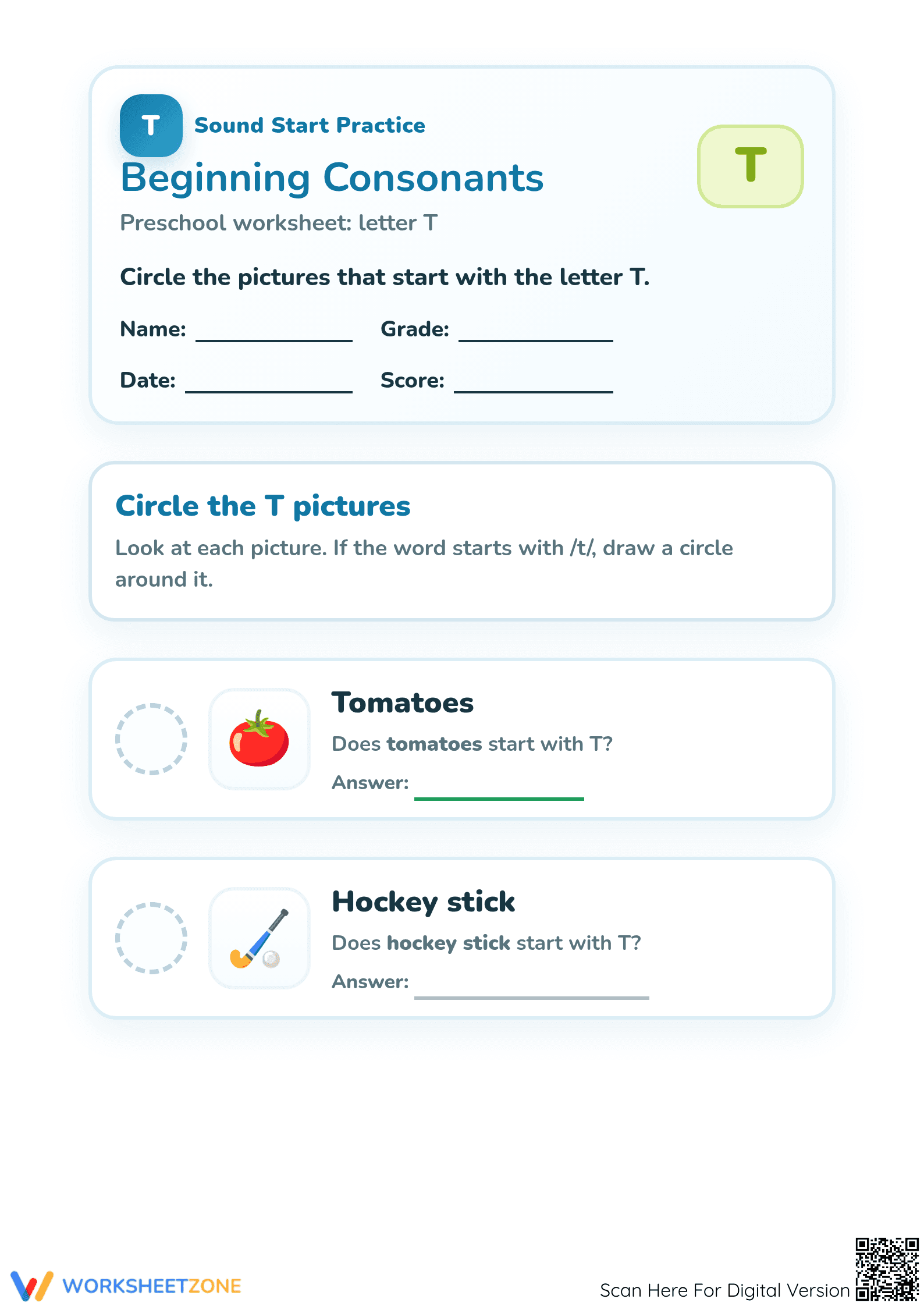
This Preschool beginning consonants worksheet helps early learners master the /t/ sound through visual identification. Students examine various objects to determine which names begin with the letter T, fostering essential phonological awareness. This foundational activity ensures young readers can distinguish initial sounds before advancing to blending and full word recognition in kindergarten.
At a Glance
- Grade: Preschool · Subject: English Language Arts
- Standard:
RF.K.3.A— Produce the primary sound for each consonant like the letter T to build phonological awareness- Skill Focus: Beginning Consonant Identification and Letter-Sound Correspondence
- Format: 2 pages · 6 problems · Answer key included · High-quality PDF
- Best For: Initial sound practice, letter of the week, and recognition
- Time: 10–15 minutes
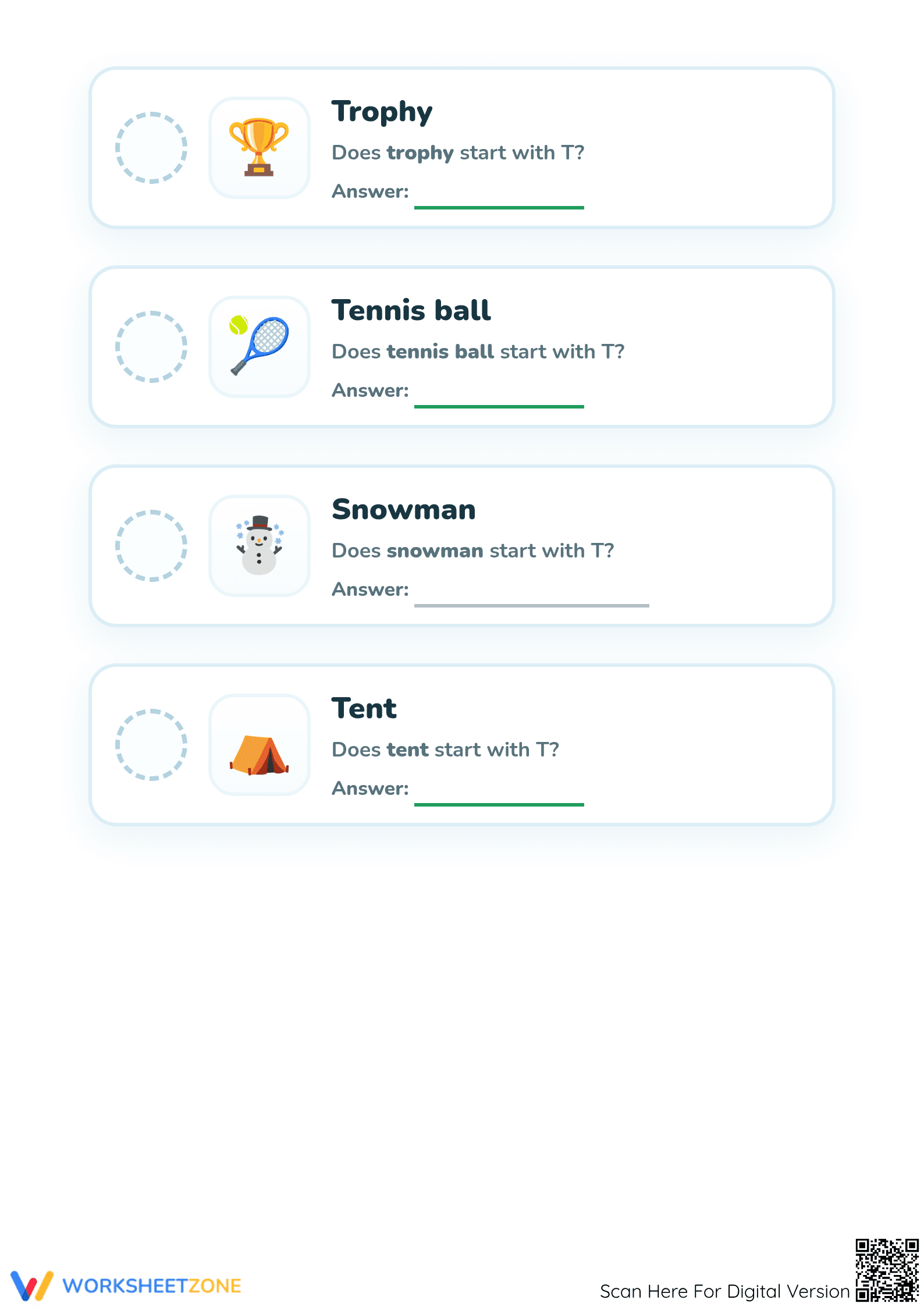
This two-page PDF resource features six high-quality image prompts accompanied by simple questions. Students are asked "Does [object] start with T?" for items such as tomatoes, a trophy, and a tennis ball. The clear, uncluttered layout is designed specifically for preschoolers, featuring large illustrations and dedicated spaces for marking answers. A complete answer key is provided for quick verification.
Skill Progression
- Guided practice: The first task uses a familiar object (tomatoes) with an explicit /t/ sound to build student confidence. (2 problems)
- Supported practice: Students encounter mixed objects, including non-examples like a hockey stick, to test discrimination skills. (2 problems)
- Independent practice: The final page requires students to apply their knowledge to diverse vocabulary like "tent" and "trophy." (2 problems)
The worksheet follows a gradual release model, moving from high-contrast examples to more challenging phonetic distinctions.
Standards Alignment
This resource is aligned to CCSS.ELA-LITERACY.RF.K.3.A, which requires students to demonstrate basic knowledge of one-to-one letter-sound correspondences by producing the primary sound for consonants. Specifically, this worksheet focuses on the phoneme /t/ and its grapheme representation. This standard code can be copied directly into lesson plans, IEP goals, or district curriculum mapping tools.
How to Use It
Use this worksheet during small-group phonics instruction or as a morning work activity to reinforce the "Letter of the Week." Teachers should observe if students are vocalizing the /t/ sound as they look at the pictures, which is a key indicator of phonological development. Expect most preschool learners to complete both pages within 10 to 15 minutes of focused work.
Who It's For
This resource is designed for preschool and pre-kindergarten students who are beginning their journey into literacy. It provides excellent support for English Language Learners (ELL) who need visual aids to connect sounds to English vocabulary. It pairs naturally with a tactile "sand tray" letter tracing activity or a shared reading passage featuring the letter T.
Effective phonics instruction in early childhood requires explicit focus on letter-sound correspondence to build a foundation for decoding. According to Fisher & Frey (2014), the gradual release of responsibility—moving from teacher-led modeling to independent practice—is crucial for preschool students mastering beginning consonants like the letter T. This worksheet aligns with CCSS.ELA-LITERACY.RF.K.3.A by providing six targeted tasks that require students to produce the primary sound for the consonant /t/ across varied visual contexts. Research from NAEP suggests that early mastery of phonological awareness is the strongest predictor of later reading success. By providing structured identification tasks with immediate feedback via an answer key, this PDF resource ensures that students develop the orthographic mapping skills necessary for kindergarten readiness and beyond.


