


























Views
Downloads

Printable Beginning Consonants Letter Q Worksheet | Grade K
Paste this activity's link or code into your existing LMS (Google Classroom, Canvas, Teams, Schoology, Moodle, etc.).
Students can open and work on the activity right away, with no student login required.
You'll still be able to track student progress and results from your teacher account.
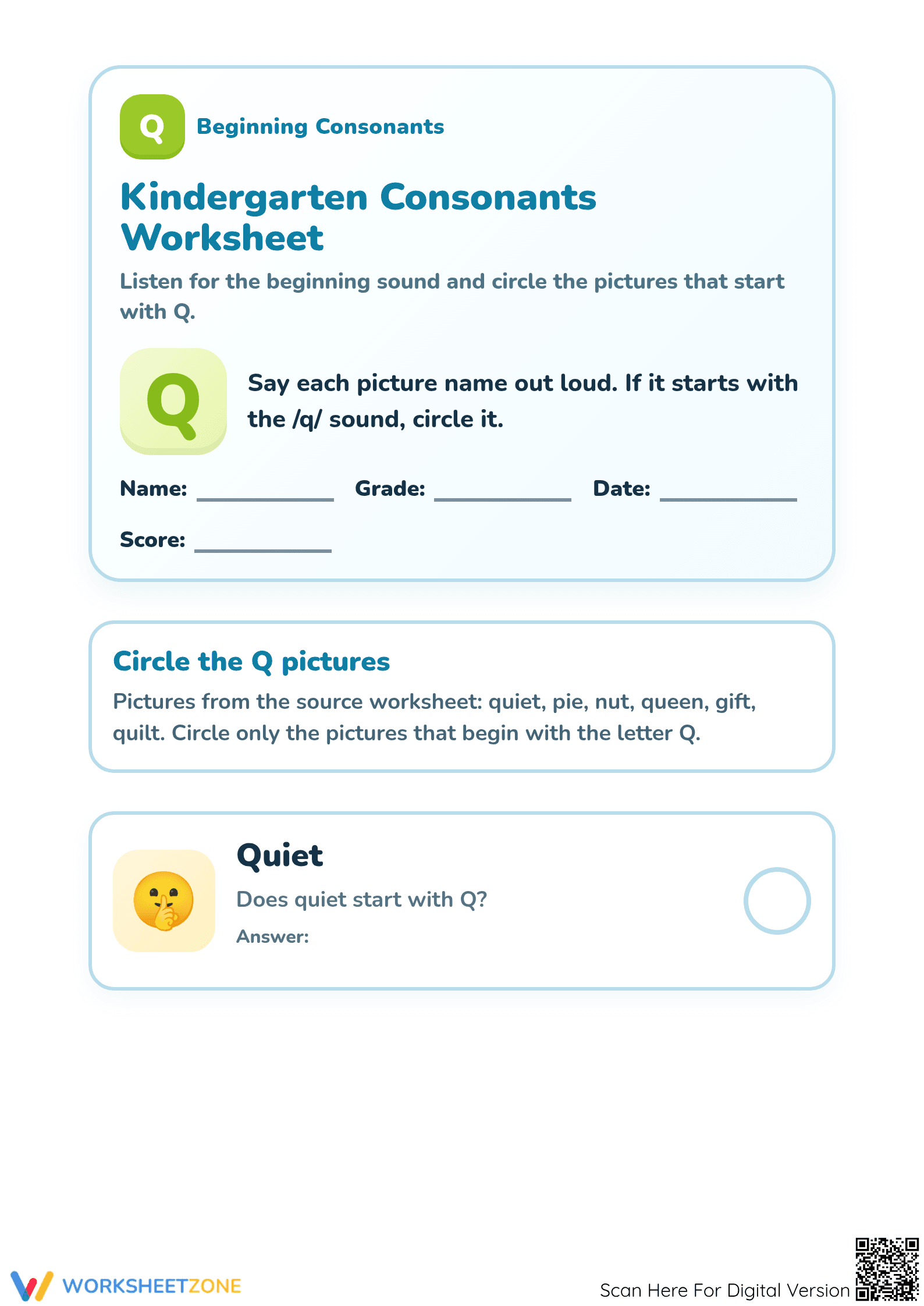
This foundational phonics worksheet helps early learners master the /q/ sound by identifying beginning consonants in familiar words. Students practice phonemic awareness by vocalizing picture names and determining which ones start with the letter Q. This essential exercise builds the necessary decoding skills for future reading success and ensures students can distinguish between similar initial sounds.
At a Glance
- Grade: Preschool · Subject: ELA
- Standard:
RF.K.3.A— Produce the primary sound for each consonant in words to build phonemic awareness- Skill Focus: Beginning consonant /q/ recognition
- Format: 2 pages · 6 problems · Answer key included · PDF
- Best For: Independent phonics practice, morning work, and literacy centers
- Time: 10–15 minutes
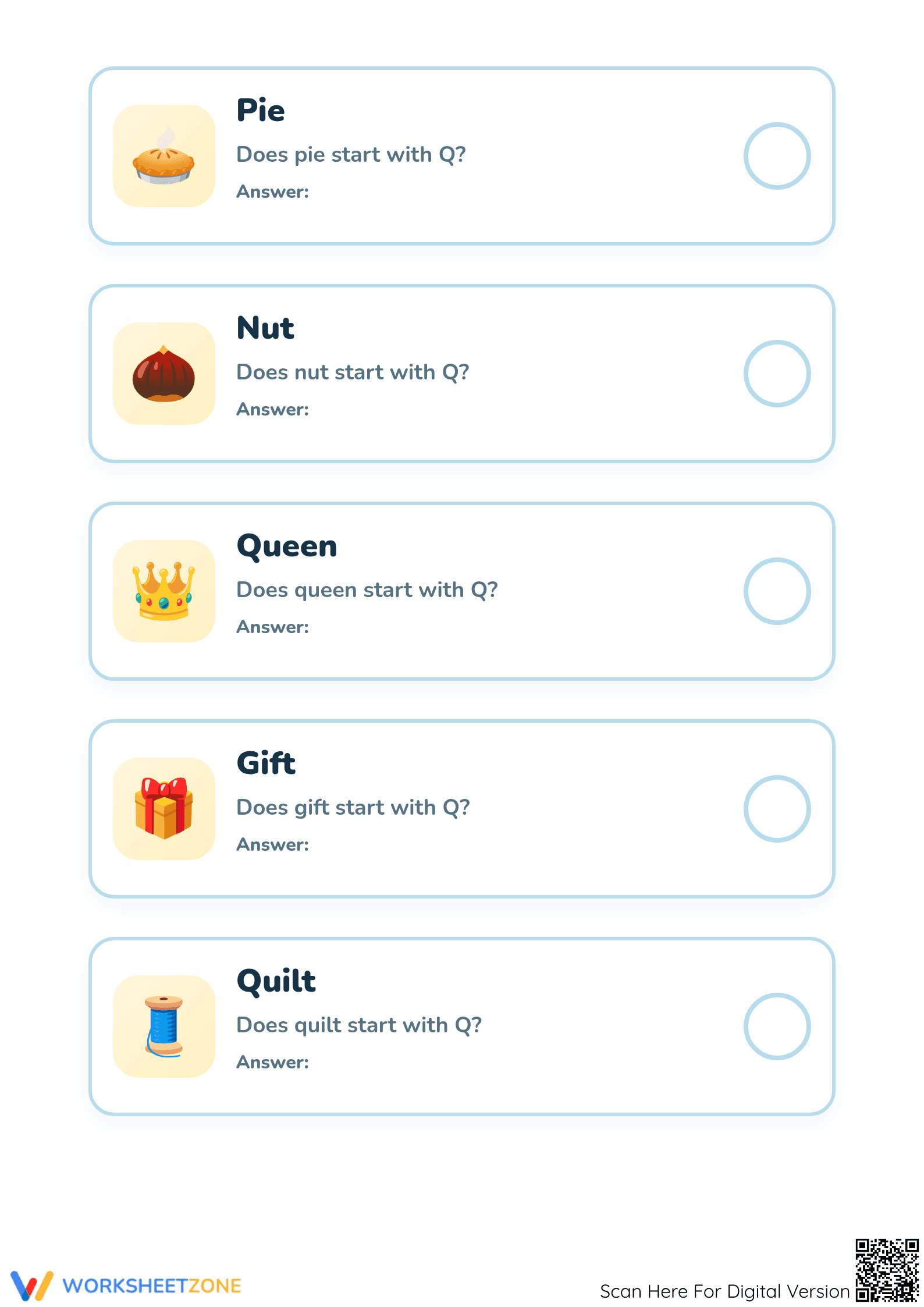
The resource consists of a two-page PDF featuring six distinct identification tasks. Each problem provides a clear, high-quality image—such as a queen, quilt, and quiet emoji—paired with a simple question asking if the word starts with the letter Q. The layout is spacious and student-friendly, including a score section and a full answer key to facilitate quick grading or self-correction by the student.
Skill Progression
- Guided practice: The first page introduces the /q/ sound with a "quiet" example, allowing teachers to model the pronunciation and circling technique for the whole class.
- Supported practice: Three subsequent problems provide varied images where students must discriminate between the /q/ sound and other consonants like /p/ or /n/.
- Independent practice: The final two problems challenge students to solidify their understanding by identifying "queen" and "quilt" without direct assistance.
This gradual-release model follows the proven "I Do, We Do, You Do" instructional framework to ensure student confidence and mastery of the target consonant sound.
Standards Alignment
This worksheet is directly aligned with CCSS.ELA-LITERACY.RF.K.3.A, which requires students to demonstrate basic knowledge of one-to-one letter-sound correspondences by producing the primary sound for each consonant. It also supports RF.K.1.D by reinforcing alphabet recognition in a functional context. Both standard codes can be copied directly into lesson plans, IEP goals, or district curriculum mapping tools.
How to Use It
Incorporate this worksheet during the "You Do" phase of a phonics lesson after introducing the letter Q. It works exceptionally well as a quiet-time center activity or a quick formative assessment to check for sound-symbol mastery. Teachers should observe if students are whispering the names of the pictures out loud, which indicates they are actively engaging in the phonological processing required for reading.
Who It's For
Designed for preschool and kindergarten students, this resource is ideal for early readers who are just beginning their phonics journey. It is particularly helpful for students needing extra practice with less common consonants. Pair this worksheet with a short reading passage or a letter-Q anchor chart to provide a comprehensive literacy experience for all learners in the classroom.
The systematic practice of phoneme-grapheme correspondence provided in this RF.K.3.A worksheet is a critical component of evidence-based literacy instruction. Research from Fisher & Frey (2014) emphasizes that the gradual release of responsibility, combined with targeted practice on specific consonants like /q/, significantly improves a child's ability to decode new words. By isolating the beginning sound in 6 structured tasks, students develop the phonological sensitivity required for orthographic mapping. This curriculum-aligned resource ensures that students transition from simple sound recognition to fluent reading. Educational analysis indicates that high-frequency practice with initial consonants serves as a predictive marker for later reading proficiency. Teachers can use this tool to provide the repetition necessary for long-term retention of phonics rules. This printable activity is designed to meet the rigorous demands of modern ELA standards while remaining accessible to young learners.


