


























Views
Plays


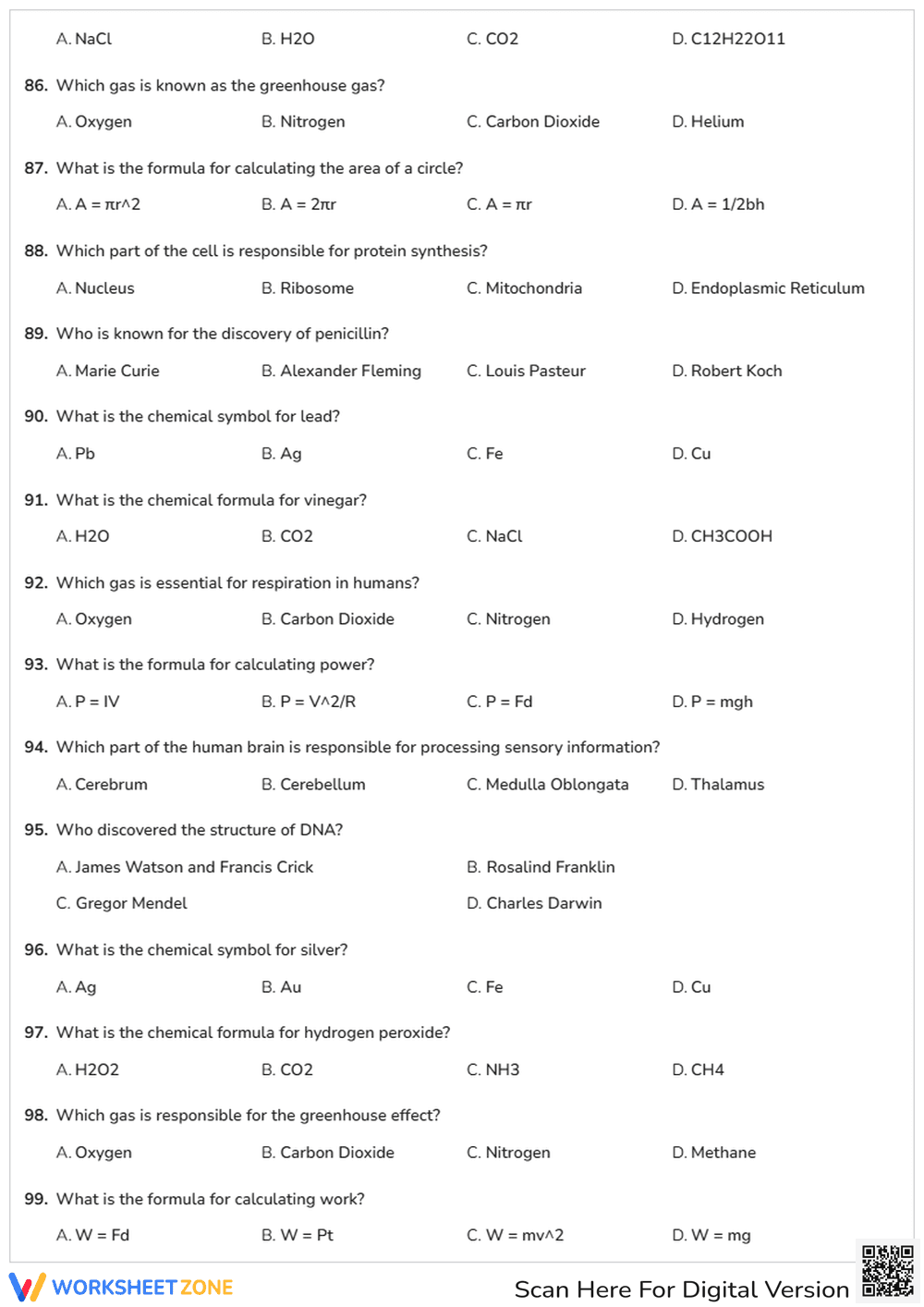


Essential PCMB Science Review Worksheet | Grades 9-12
Paste this activity's link or code into your existing LMS (Google Classroom, Canvas, Teams, Schoology, Moodle, etc.).
Students can open and work on the activity right away, with no student login required.
You'll still be able to track student progress and results from your teacher account.
This comprehensive PCMB science review worksheet provides high school students with a rigorous 102-question assessment covering the core pillars of Physics, Chemistry, Mathematics, and Biology. By engaging with these fundamental concepts, learners solidify their understanding of scientific principles and mathematical formulas essential for higher-level academic success and standardized testing preparation.
At a Glance
- Grade: 9-12 · Subject: Science (PCMB)
- Standard:
HS-PS1-1— Use the periodic table as a model to predict the relative properties of elements- Skill Focus: Multi-disciplinary Science Fundamentals
- Format: 8 pages · 102 problems · Answer key included · PDF
- Best For: Comprehensive review or diagnostic assessment
- Time: 60–90 minutes
Inside this extensive 8-page PDF, you will find 102 carefully curated multiple-choice questions. The worksheet spans a wide array of topics, including SI units, chemical symbols, biological organelles, and algebraic formulas. The structured layout ensures clarity, while the variety of tasks prevents student fatigue during long review sessions. A complete answer key is provided to facilitate rapid grading and immediate feedback for all learners.
The zero-prep workflow for this resource is designed for maximum efficiency in busy secondary classrooms. First, print the 8-page document for your class, which takes approximately 1 minute for a standard batch. Second, distribute the packets to students; the self-explanatory multiple-choice format requires no additional teacher explanation. Finally, review the results using the included key in under 5 minutes. This makes it an ideal solution for emergency sub plans or end-of-term review blocks.
This resource is primarily aligned with `HS-PS1-1`, focusing on the structure and properties of matter, as evidenced by questions regarding atomic numbers and chemical formulas. Additionally, it supports `HS-LS1-1` by assessing knowledge of cellular structures and their functions. Both standard codes can be copied directly into lesson plans, IEP goals, or district curriculum mapping tools to ensure compliance with state and national frameworks.
Use this worksheet as a diagnostic tool at the start of a semester to identify knowledge gaps across the four PCMB disciplines. Alternatively, assign it as a cumulative review before final exams to ensure students have mastered foundational concepts. For formative assessment, observe which sections students struggle with most to tailor future instruction. Expect a completion time of 60 to 90 minutes depending on student proficiency levels.
This resource is designed for students in Grades 9 through 12 who are pursuing the HSC curriculum or general high school science tracks. It is particularly effective for learners needing a broad refresher of core concepts. Pair this worksheet with a comprehensive science anchor chart or a digital periodic table to support students who require visual aids during the assessment process.
This PCMB science review resource addresses the critical need for cross-disciplinary literacy in secondary education. By integrating 102 questions across Physics, Chemistry, Mathematics, and Biology, the worksheet aligns with the HS-PS1-1 standard, which requires students to use models to predict the properties of matter. Research from the RAND AIRS 2024 report emphasizes that frequent, low-stakes retrieval practice through comprehensive question banks significantly improves long-term retention of scientific facts and mathematical procedures. Furthermore, the multi-subject nature of this assessment mirrors the complexity of modern STEM curricula, encouraging students to make connections between disparate scientific fields. By providing a structured environment for testing fundamental knowledge, this resource helps bridge the gap between basic recall and higher-order application. Educators can utilize this tool to establish a baseline of student proficiency, ensuring that all learners possess the prerequisite knowledge necessary for advanced laboratory work and complex theoretical analysis in the high school setting.


