




























Views
Downloads


Essential Base 10 Blocks Worksheet | Grade 2-4 Math

Paste this activity's link or code into your existing LMS (Google Classroom, Canvas, Teams, Schoology, Moodle, etc.).
Students can open and work on the activity right away, with no student login required.
You'll still be able to track student progress and results from your teacher account.
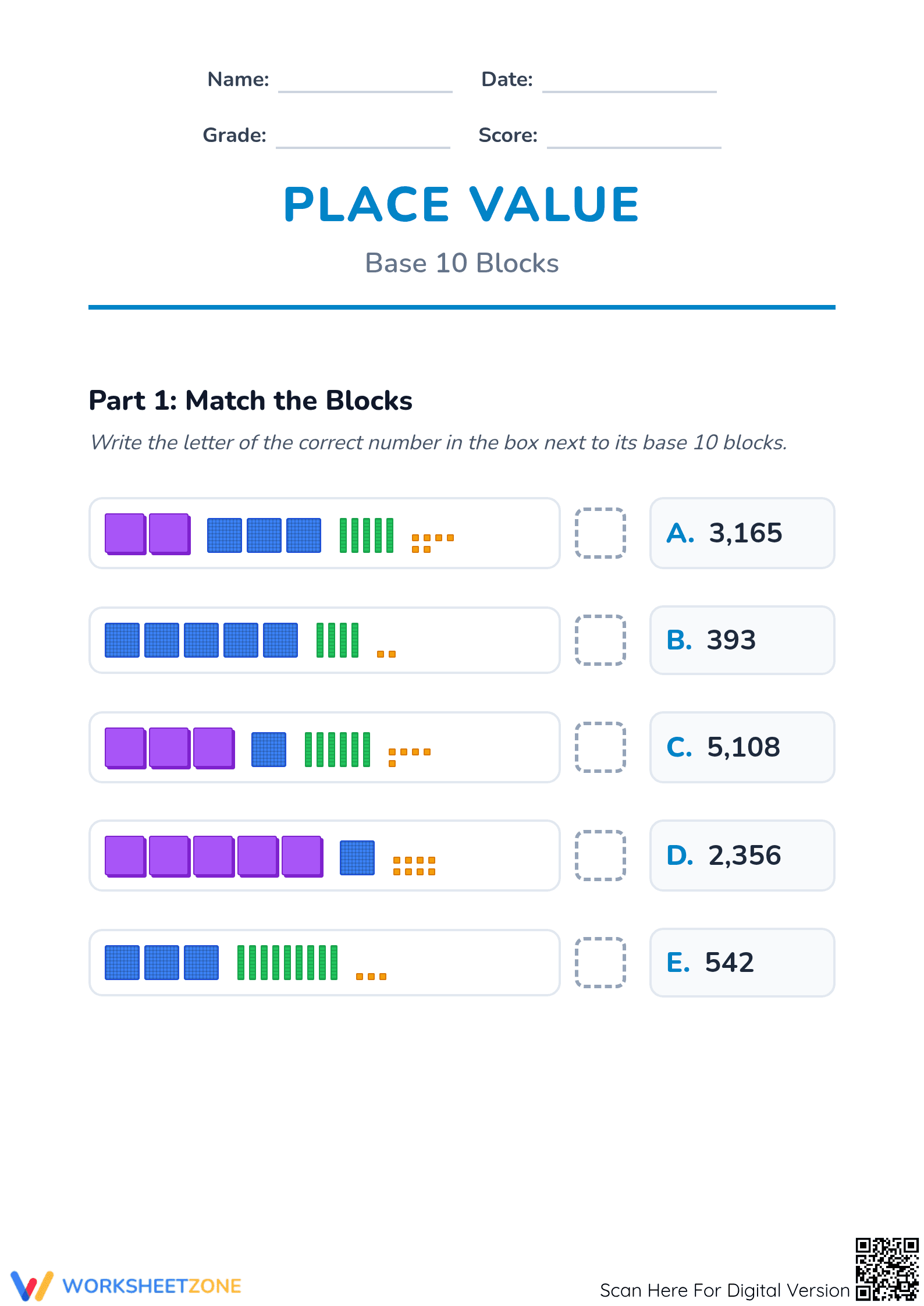
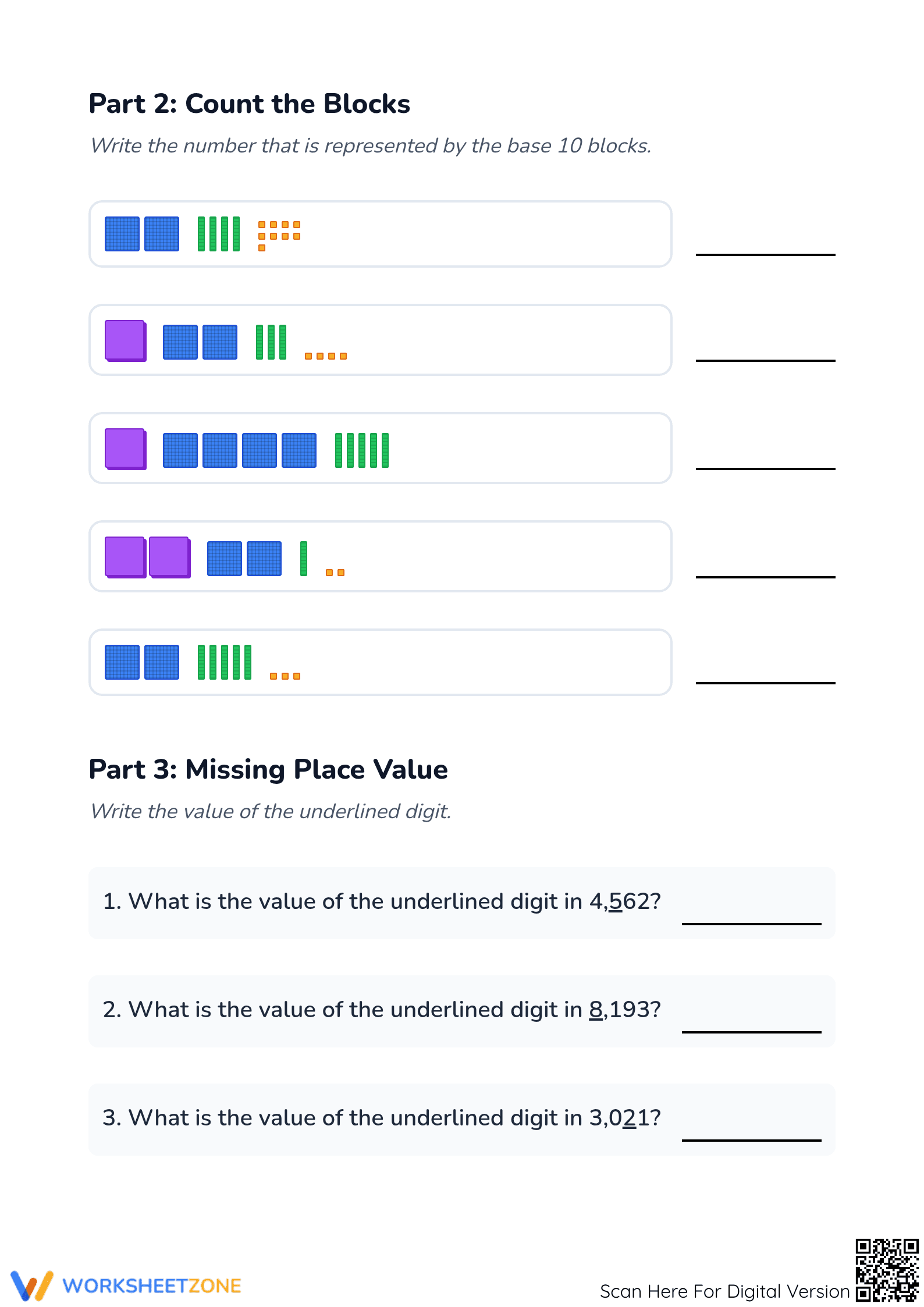
This place value worksheet helps Grade 2-4 students master number representation using visual base 10 blocks. By translating physical models into digits, learners develop a concrete understanding of hundreds, tens, and ones. This practice builds the foundational number sense required for multi-digit arithmetic and complex operations in later elementary grades.
At a Glance
- Grade: 2-4 · Subject: Math
- Standard:
CCSS.MATH.CONTENT.2.NBT.A.1— Understand that three digits represent amounts of hundreds, tens, and ones.- Skill Focus: Base 10 Block Representation
- Format: 3 pages · 30 problems · Answer key included · PDF
- Best For: Independent place value practice and assessment
- Time: 20–30 minutes
Inside this PDF package, you will find three distinct pages of practice, each containing ten unique problems for a total of 30 exercises. Each problem features high-contrast illustrations of base 10 blocks (flats, rods, and units) paired with a clear response box for the numerical value. The structured layout ensures students stay focused, and the included comprehensive answer keys allow for immediate feedback or efficient teacher grading.
The worksheet follows a strategic instructional flow:
- Guided practice: The first problems introduce standard layouts where hundreds, tens, and ones are grouped predictably, establishing a counting rhythm.
- Supported practice: Middle sections vary block quantities, challenging students to distinguish rods from units as volume increases.
- Independent practice: Final tasks require synthesizing counting into a three-digit number without prompts.
This resource is specifically aligned to CCSS.MATH.CONTENT.2.NBT.A.1: "Understand that the three digits of a three-digit number represent amounts of hundreds, tens, and ones." It also supports 3.NBT and 4.NBT standards by reinforcing positional value. These standard codes can be copied directly into lesson plans, IEP goals, or district curriculum mapping tools.
Use this worksheet during the "independent practice" phase of a lesson on place value after students have worked with physical manipulatives. It serves as an excellent bridge between concrete and abstract math. For formative assessment, observe students as they count: those who count individual units instead of recognizing rods indicate a need for more grouping practice. Completion typically takes 25 minutes.
This resource is designed for elementary students in grades 2 through 4 who are developing or reinforcing their understanding of multi-digit numbers. It is particularly effective for English Language Learners (ELLs) and students with IEPs due to the heavy visual scaffolding. This worksheet pairs naturally with an anchor chart displaying hundreds, tens, and ones for quick reference during direct instruction.
According to a ScienceDirect TpT Analysis, visual representation is a critical factor in the efficacy of math manipulatives for early learners. This worksheet utilizes base 10 blocks to ground the abstract concept of place value in a concrete visual format, directly addressing CCSS.MATH.CONTENT.2.NBT.A.1. Research by Fisher & Frey (2014) highlights the "gradual release of responsibility," which this resource mirrors through 30 structured problems moving from simple counting to three-digit identification. By translating visual "flats" and "rods" into numerical digits, learners build mental models necessary for operational fluency. Educational standards from NAEP suggest that students mastering visual place value early demonstrate higher success in multi-digit multiplication. This printable PDF ensures students have access to research-backed practice that is classroom-ready and assessment-aligned for various learning environments. It provides a reliable method for verifying that students can decompose numbers into their constituent units, a skill that serves as the bedrock for all subsequent mathematical achievement.


