


























Views
Downloads


Balanced and Unbalanced Forces Worksheet | Grade 8 Ready
Paste this activity's link or code into your existing LMS (Google Classroom, Canvas, Teams, Schoology, Moodle, etc.).
Students can open and work on the activity right away, with no student login required.
You'll still be able to track student progress and results from your teacher account.
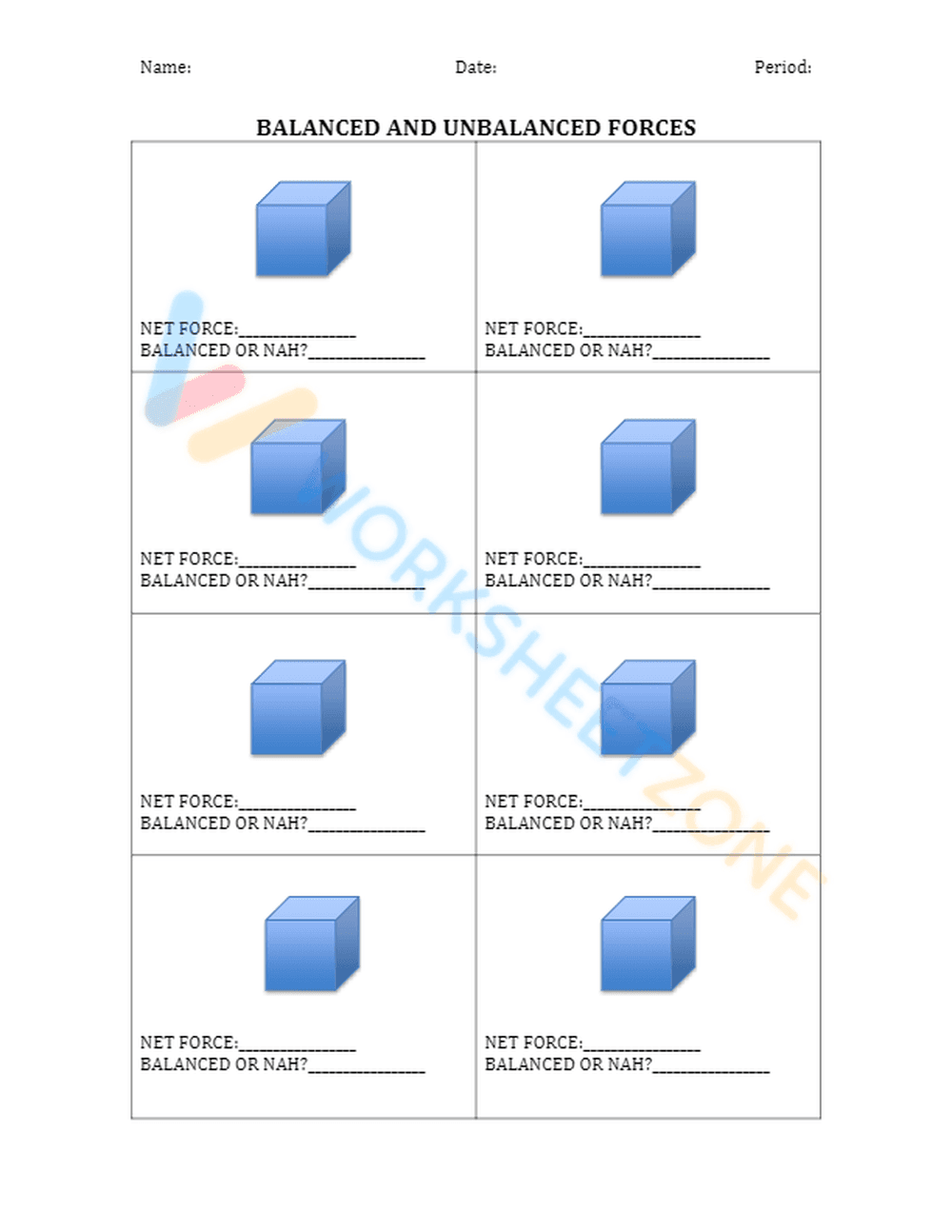
This Grade 8 science worksheet provides essential practice for students learning to calculate net force and distinguish between balanced and unbalanced forces. By analyzing visual diagrams of objects under various physical stresses, learners develop the mathematical and conceptual skills necessary to predict changes in motion. It is a foundational tool for physics mastery.
At a Glance
- Grade: 8 · Subject: Science
- Standard:
MS-PS2-2— Plan an investigation to provide evidence that the change in an object’s motion depends on the sum of the forces- Skill Focus: Net Force Calculation
- Format: 2 pages · 16 problems · Answer key included · PDF
- Best For: Independent practice or quick formative assessment
- Time: 15–20 minutes
What's Inside
This resource contains two pages of structured practice. Each page features eight distinct scenarios where forces are applied to a central object. Students must calculate the numerical net force and then label the system as balanced or unbalanced. The clear, minimalist design minimizes cognitive load, allowing students to focus entirely on the vector addition and conceptual application of Newton's Laws.
Zero-Prep Workflow
- Print: Generate the required number of copies for your section in less than one minute.
- Distribute: Hand out the sheets as a bell-ringer or exit ticket to gauge student understanding of force interactions.
- Review: Grade or peer-review the answers using the included key to provide instant feedback on calculation accuracy.
Total teacher preparation time is under 2 minutes, making this an ideal sub-plan or last-minute review tool.
Standards Alignment
The primary focus is `MS-PS2-2`. This standard requires students to understand that the change in an object's motion is determined by the sum of the forces acting on it and the mass of the object. This worksheet specifically targets the sum of forces component. Both standard codes can be copied directly into lesson plans, IEP goals, or district curriculum mapping tools.
How to Use It
Use this worksheet during the elaborate phase of a 5E lesson cycle. After students have explored force pairs with magnets or spring scales, assign this as independent practice to solidify the math. Alternatively, use it as a formative assessment halfway through a unit to identify students who struggle with vector direction before moving on to acceleration calculations. Expected completion time is 15 to 20 minutes.
Who It's For
This resource is ideal for middle school physical science students and high school physics learners needing a refresher on net force. It is particularly effective for visual learners who benefit from seeing force arrows in relation to an object. Pair this with a PhET simulation on Forces and Motion or a direct instruction lesson on vector addition for a comprehensive learning experience.
According to the RAND AIRS 2024 report on science literacy, structured visual practice is critical for internalizing abstract physical concepts like vector forces. This worksheet aligns with the Fisher & Frey (2014) gradual release of responsibility model by providing a clear, repetitive framework that builds student confidence in calculating net force. By requiring students to categorize forces as balanced or unbalanced, the resource reinforces the conceptual link between zero net force and equilibrium. Research from EdReports 2024 emphasizes that high-quality science materials must bridge the gap between mathematical computation and conceptual understanding. This MS-PS2-2 aligned resource ensures that Grade 8 students can accurately determine the sum of forces acting on an object, a prerequisite skill for mastering Newton’s Second Law. The 16 included tasks provide sufficient data points for teachers to identify specific misconceptions regarding force direction and magnitude.


