


























Views
Downloads

Printable Bacteria Reading Worksheet | Grade 1 ELA
Paste this activity's link or code into your existing LMS (Google Classroom, Canvas, Teams, Schoology, Moodle, etc.).
Students can open and work on the activity right away, with no student login required.
You'll still be able to track student progress and results from your teacher account.
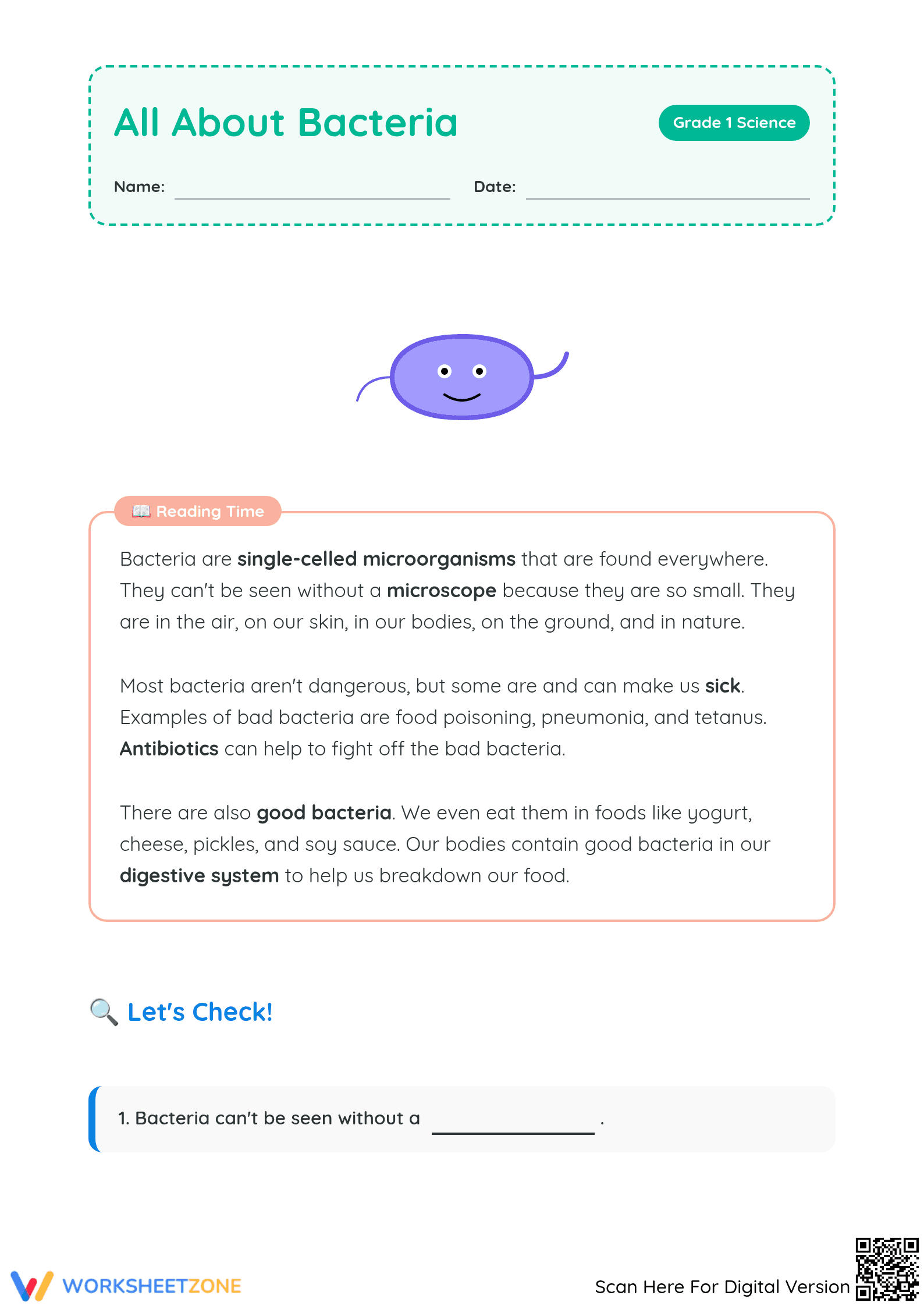
This Grade 1 bacteria worksheet helps students master informational text comprehension through a focused reading passage and structured check-for-understanding tasks. Students will learn to identify key details about microorganisms, distinguish between beneficial and harmful bacteria, and understand how antibiotics function. This resource ensures high engagement while building essential science-based literacy skills in young learners.
At a Glance
- Grade: 1 · Subject: English Language Arts (ELA)
- Standard:
CCSS.ELA-LITERACY.RI.1.1— Ask and answer questions about key details in an informational text- Skill Focus: Identifying key details in a science-themed text
- Format: 2 pages · 6 problems · Answer key included · PDF
- Best For: Independent practice or literacy centers
- Time: 15–20 minutes
What's Inside
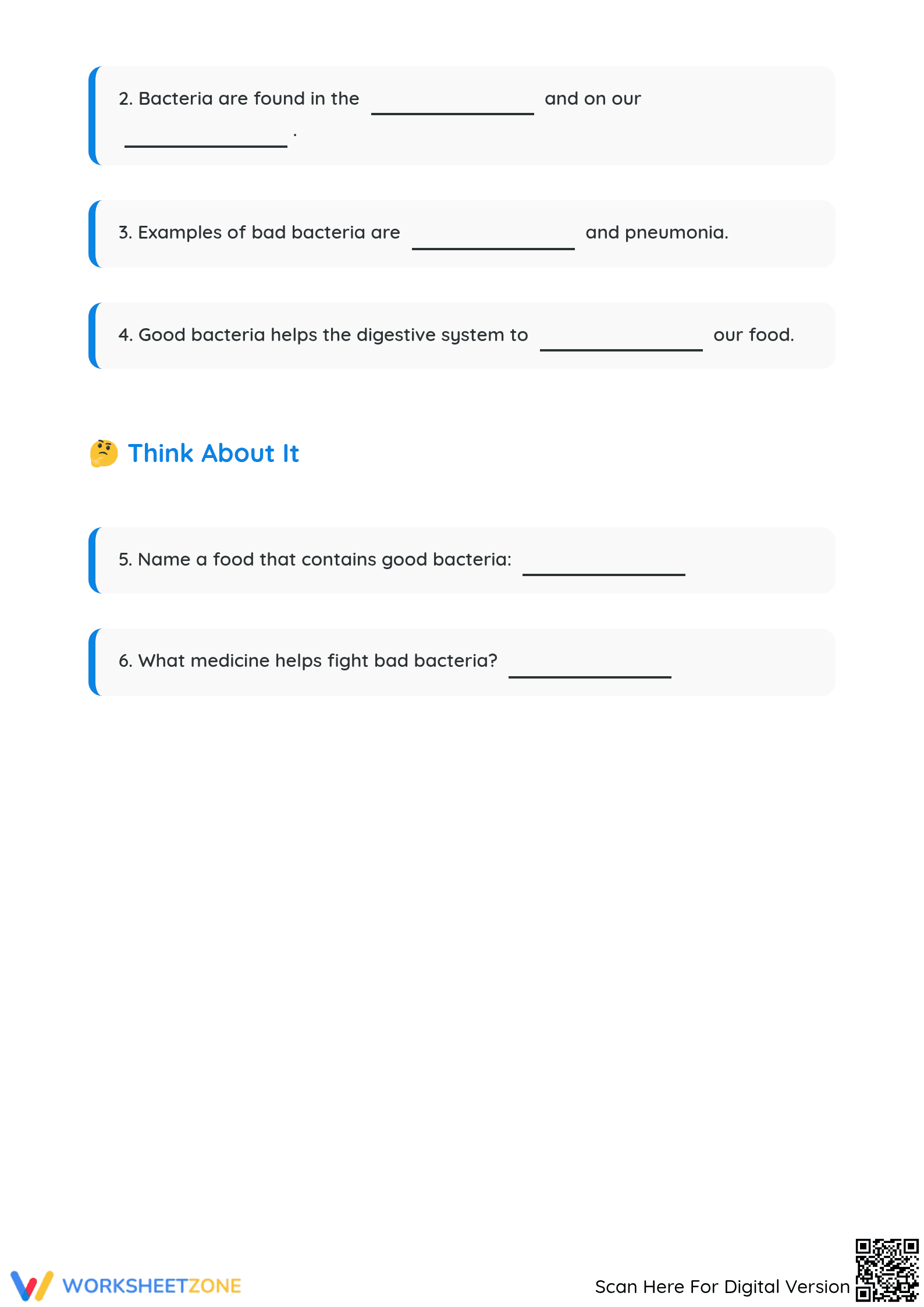
This two-page printable features a clear, age-appropriate reading passage titled "All About Bacteria" with bolded vocabulary terms like "microscope" and "digestive system." The assessment portion includes four fill-in-the-blank sentences that require students to refer back to the text for evidence. Additionally, two "Think About It" short-answer questions challenge students to recall specific examples of good bacteria and medical solutions for infections.
Zero-Prep Workflow
Teachers can implement this zero-prep resource in under two minutes. Simply print the two-page PDF (30 seconds), distribute to students during your literacy or science block (30 seconds), and review the answers using the included key at the end of the session (1 minute). Its self-explanatory layout makes it an ideal candidate for emergency sub plans or quiet morning work routines.
Standards Alignment
The primary alignment for this worksheet is CCSS.ELA-LITERACY.RI.1.1: "Ask and answer questions about key details in a text." It also supports Grade 1 science standards related to health and living things by introducing basic microbiological concepts. This standard code can be copied directly into lesson plans, IEP goals, or district curriculum mapping tools to ensure instructional compliance.
How to Use It
Use this worksheet as a formative assessment during a unit on health or the five senses. After a brief read-aloud of the passage, have students work independently to complete the "Let's Check" section. Observe if students can locate the specific sentence in the text that mentions "microscopes" to gauge their evidence-finding abilities. This activity typically takes 15 to 20 minutes to complete.
Who It's For
This resource is designed for Grade 1 students but serves as an excellent intervention tool for Grade 2 learners who need additional practice with informational text structures. It pairs naturally with an anchor chart about "Text Evidence" or a short video clip showing bacteria under a microscope. English Language Learners benefit from the bolded keywords and predictable sentence frames provided in the tasks.
Educational research emphasized by Fisher & Frey (2014) highlights the importance of using high-interest informational texts to bridge the gap between decoding and deep comprehension in early elementary grades. By focusing on CCSS.ELA-LITERACY.RI.1.1, this worksheet requires students to engage in active evidence-gathering, a process where they find and extract specific facts to answer explicit questions. This method is a proven strategy for improving long-term retention of content-area vocabulary, such as "microorganism" and "antibiotics." According to the NAEP 2022 framework, early exposure to structured informational reading tasks significantly predicts later academic success in middle school science and social studies. This worksheet provides the exact type of "evidence-based answering" practice required by modern standards, ensuring students develop the cognitive habits necessary for analyzing complex non-fiction as they progress through their educational journey.


