




























Views
Downloads
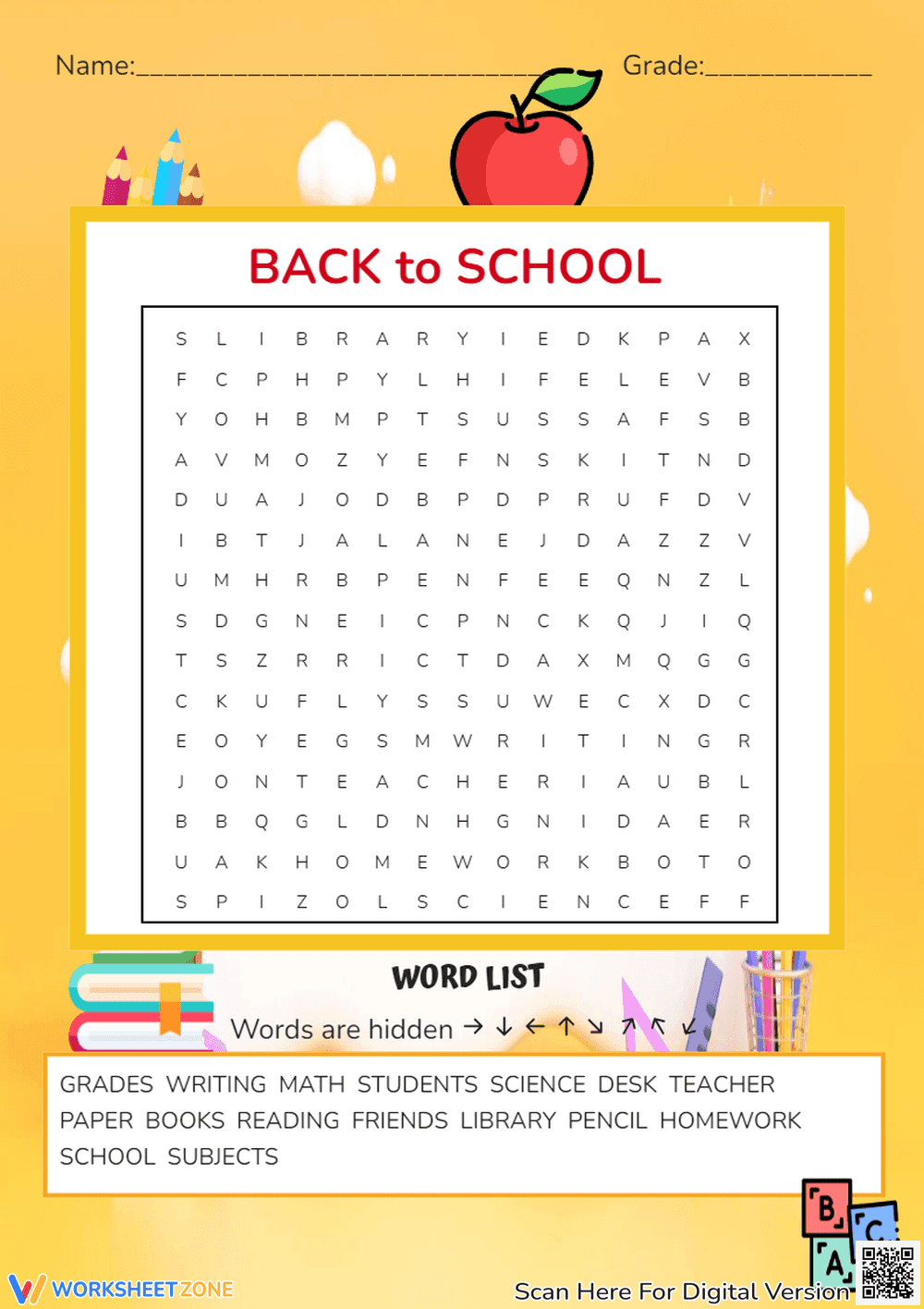

Back to School Word Search | Essential Grade 3-5 Ready

Paste this activity's link or code into your existing LMS (Google Classroom, Canvas, Teams, Schoology, Moodle, etc.).
Students can open and work on the activity right away, with no student login required.
You'll still be able to track student progress and results from your teacher account.
This Back to School word search provides an engaging way for students to re-acclimate to the classroom environment while reinforcing spelling and vocabulary. By identifying 18 school-themed terms, learners strengthen visual scanning skills and letter-pattern recognition. It serves as a perfect icebreaker or quiet-time activity during the busy first week of the new academic year.
At a Glance
- Grade: 3-5 · Subject: ELA & Vocabulary
- Standard:
CCSS.ELA-LITERACY.L.3.6— Acquire and use accurately grade-appropriate conversational, general academic, and domain-specific words- Skill Focus: Visual scanning and spelling
- Format: 1 page · 18 problems · Answer key included · PDF
- Best For: First week icebreaker or morning work
- Time: 15–20 minutes
Inside this resource, you will find a single-page word search puzzle containing 18 hidden words related to the school experience, such as "Library," "Homework," and "Science." The layout includes a clear word bank at the bottom and a grid that supports horizontal, vertical, and diagonal word placement. A comprehensive answer key is provided to allow for quick student self-correction or teacher grading.
The zero-prep workflow for this activity is designed for maximum efficiency. First, print the required number of copies (30 seconds). Next, distribute the sheets to students as they arrive or during a transition (1 minute). Finally, review the completed puzzles or provide the answer key for self-checking (1 minute). Total teacher preparation time is under 3 minutes, making it an ideal sub-plan or emergency filler.
This worksheet aligns with CCSS.ELA-LITERACY.L.3.6, focusing on the acquisition of general academic and domain-specific vocabulary. It also supports CCSS.ELA-LITERACY.RF.3.3 by encouraging students to recognize common spelling patterns in multi-syllabic words. Both standard codes can be copied directly into lesson plans, IEP goals, or district curriculum mapping tools.
Use this worksheet as a "Morning Work" task during the first three days of school to keep students focused while you handle administrative duties. Alternatively, assign it as a formative assessment to observe students' persistence and visual processing speeds. Completion typically takes 15 to 20 minutes depending on the student's familiarity with word search mechanics.
This resource is designed for students in Grades 3 through 5, including English Language Learners who benefit from seeing school-related vocabulary in a low-stakes format. It pairs naturally with a "Back to School" anchor chart or a classroom tour activity where students find the physical objects listed in the word bank.
According to the RAND AIRS 2024 report, supplemental activities that integrate thematic vocabulary help bridge the summer learning gap by re-engaging cognitive pathways associated with word recognition. This worksheet utilizes 18 specific terms to meet the CCSS.ELA-LITERACY.L.3.6 requirement for acquiring domain-specific language. Research from Fisher & Frey (2014) suggests that word-play activities, such as puzzles, reduce academic anxiety during transitions, allowing students to demonstrate mastery of spelling patterns in a non-threatening context. By focusing on high-frequency school terms like "Library" and "Subjects," the resource ensures that Grade 3-5 learners are exposed to the essential lexicon of the classroom. This structured approach to vocabulary reinforcement is a proven method for improving literacy outcomes and building student confidence during the critical first weeks of instruction. The inclusion of an answer key further supports independent learning and immediate feedback loops.


