


























Views
Downloads

Autumn Food Harvest Coloring Page | Essential K-2 Activity
Paste this activity's link or code into your existing LMS (Google Classroom, Canvas, Teams, Schoology, Moodle, etc.).
Students can open and work on the activity right away, with no student login required.
You'll still be able to track student progress and results from your teacher account.
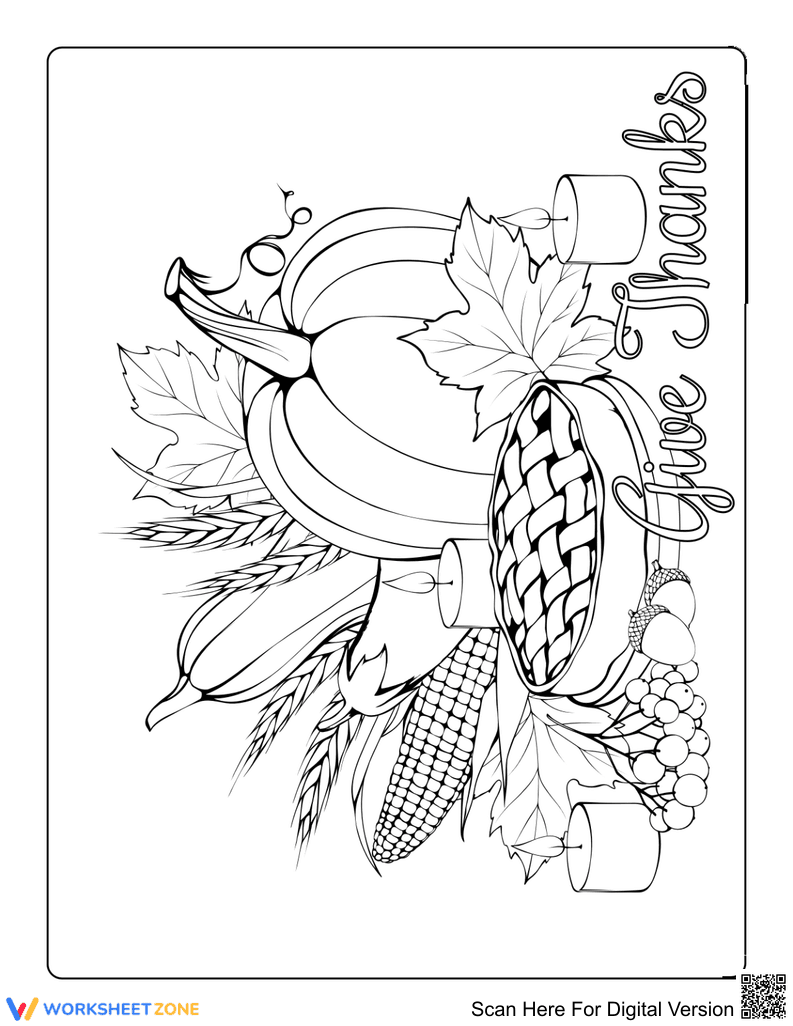
This Autumn Food Harvest coloring page provides Kindergarten students with a high-quality artistic task to develop fine motor control and seasonal vocabulary. By engaging with detailed illustrations of pumpkins, corn, and harvest treats, learners strengthen the hand-eye coordination necessary for early writing while exploring the visual symbols of the fall season.
At a Glance
- Grade: Kindergarten · Subject: English
- Standard:
CCSS.ELA-LITERACY.L.K.5.A— Sort common objects into categories to understand seasonal concepts- Skill Focus: Fine motor development
- Format: 1 page · 1 task · No answer key · PDF
- Best For: Early finishers and seasonal morning work
- Time: 15–20 minutes
This single-page PDF features a detailed, hand-drawn illustration of a classic autumn harvest. The scene includes a large pumpkin, a lattice-crust pie, an ear of corn, wheat stalks, and falling leaves. The complexity of the lines is designed to challenge Kindergarten and Grade 1 students to stay within boundaries, providing a meaningful 1-page activity that requires no additional teacher preparation or materials beyond standard coloring supplies.
The workflow for this resource is designed for maximum efficiency in a busy classroom. First, print the single-page PDF for your entire class, which takes less than 1 minute. Second, distribute the sheets during transition periods or as a quiet morning activity. Third, review the seasonal vocabulary depicted in the image, such as "harvest" and "abundance," as students work. Total teacher preparation time is under 2 minutes, making it an ideal sub plan or emergency filler.
This resource aligns with CCSS.ELA-LITERACY.L.K.5.A, which focuses on sorting common objects into categories to gain a sense of the concepts the categories represent. By identifying and coloring items specific to the autumn harvest, students categorize visual information related to the seasons. This standard code can be copied directly into lesson plans, IEP goals, or district curriculum mapping tools to document seasonal thematic instruction.
Use this worksheet as a formative assessment tool during the first 15 minutes of the school day. Observe student grip and pressure to identify those who may need additional occupational therapy support. Alternatively, assign it as a quiet activity after a read-aloud about Thanksgiving or the harvest. It serves as an excellent bridge between direct instruction on seasons and independent creative expression.
This activity is primarily designed for Kindergarten and Grade 1 students, though it is suitable for any early elementary learner needing fine motor practice. It is particularly effective for English Language Learners (ELLs) who are building basic seasonal vocabulary. Pair this coloring page with a thematic anchor chart about fall foods or a picture book about farm harvests for a complete instructional unit.
Research from Fisher & Frey (2014) emphasizes the importance of purposeful coloring in the early childhood classroom as a precursor to formal writing. Engaging with visual tasks like the Autumn Food Harvest coloring page allows students to practice the precision required for letter formation. This worksheet targets CCSS.ELA-LITERACY.L.K.5.A by requiring students to recognize a specific category of objects—harvest foods—reinforcing conceptual schema. According to the NAEP, students who develop strong fine motor skills in Kindergarten often show higher proficiency in literacy tasks later. By providing 1 structured task, teachers support these developmental milestones without increasing administrative burden. This resource is a reliable tool for integrating art into the ELA curriculum while maintaining a focus on foundational standards and seasonal awareness.


