


























Views
Plays

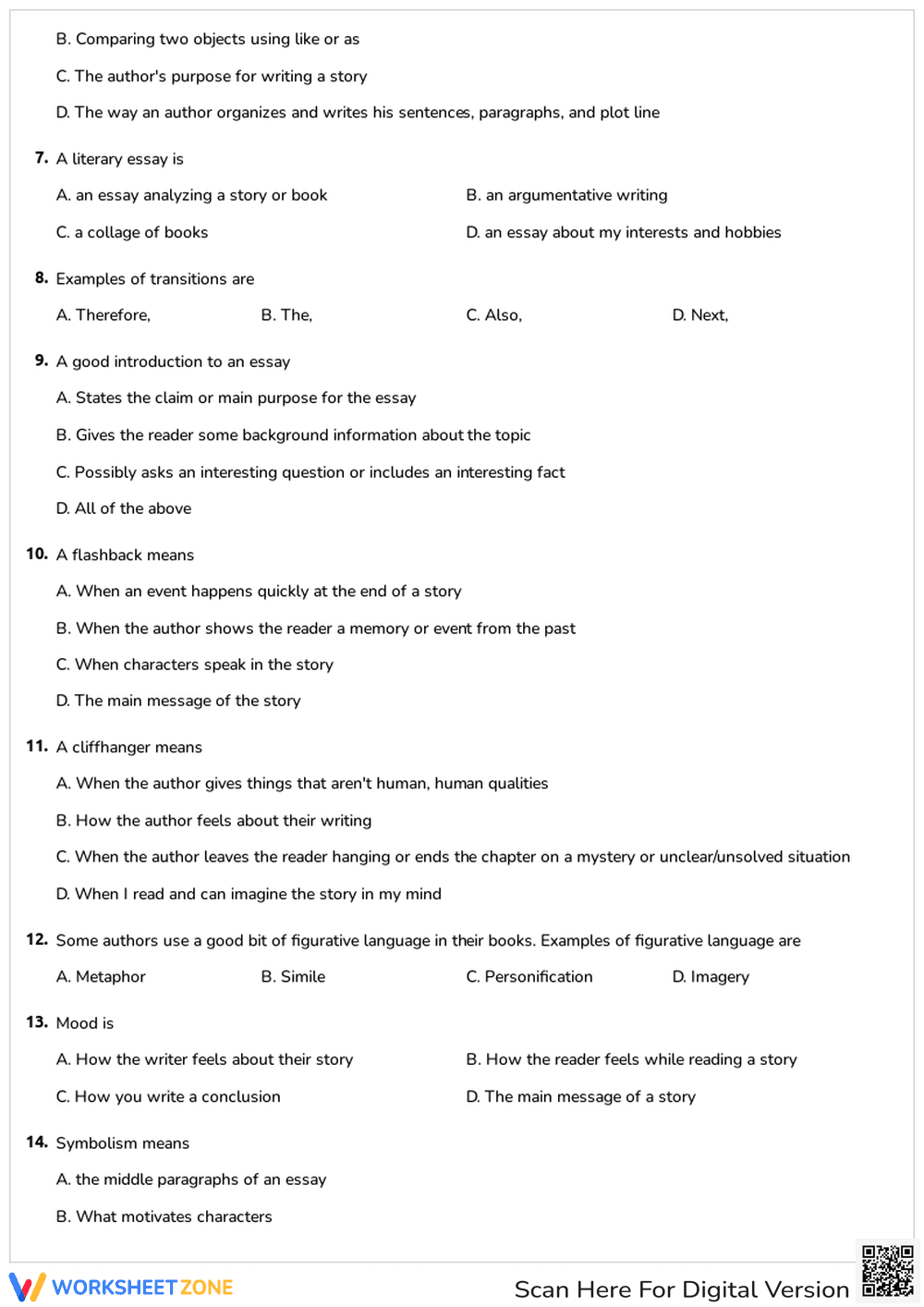


Grade 6 Author's Craft — Printable No-Prep Worksheet
Paste this activity's link or code into your existing LMS (Google Classroom, Canvas, Teams, Schoology, Moodle, etc.).
Students can open and work on the activity right away, with no student login required.
You'll still be able to track student progress and results from your teacher account.
This Grade 6 author's craft pre-assessment worksheet gives students a clear baseline for evaluating literary devices, tone, and essay structure. By tackling these foundational concepts early, educators can identify knowledge gaps and tailor upcoming reading and writing units to ensure students successfully analyze complex texts.
At a Glance
- Grade: 6 · Subject: ELA
- Standard:
CCSS.ELA-LITERACY.RL.6.4— Analyze the impact of word choice on meaning and tone- Skill Focus: Author's Craft and Literary Devices
- Format: 3 pages · 20 problems · Answer key included · PDF
- Best For: Unit pre-assessment and baseline data
- Time: 20–30 minutes
This comprehensive three-page assessment features 20 multiple-choice questions designed to test a wide range of literary concepts. Students will encounter questions covering figurative language, imagery, tone, mood, and structural elements like flashbacks and cliffhangers. The resource also includes questions on literary essay components, such as transitions, introductions, and peer review processes. A complete answer key is provided to make grading fast and objective.
Zero-Prep Workflow
This assessment is designed for immediate classroom implementation:
- Print (1 min): Print the three-page PDF and answer key.
- Distribute (1 min): Hand out at the beginning of a new literary unit.
- Review (5 mins): Use the key to rapidly score the 20 questions for instant data.
With total teacher prep time under two minutes, this resource is an excellent, self-explanatory option for a sub plan.
Standards Alignment
This worksheet aligns to CCSS.ELA-LITERACY.RL.6.4, requiring students to determine the meaning of words and phrases as used in a text, and analyze the impact of specific word choice on meaning and tone. It also supports foundational writing standards by assessing essay structure knowledge. Both standard codes can be copied directly into lesson plans, IEP goals, or district curriculum mapping tools.
How to Use It
Unit Diagnostic: Administer this 20-question quiz before beginning a novel study. Results highlight which literary devices need explicit direct instruction and which concepts are mastered.
Formative Assessment: Use as a mid-unit check. While students work, observe their pacing; if they struggle with essay structure, pause and review transition words. Expected completion time is 20 to 30 minutes.
Who It's For
This resource is primarily designed for 6th-grade ELA students, though it serves as an excellent review for 7th graders or a challenge activity for advanced 5th graders. The straightforward multiple-choice format provides built-in scaffolding for students who struggle with open-ended responses, making it accessible for diverse learners. It pairs perfectly with an introductory anchor chart on figurative language.
Effectively measuring student understanding of literary devices is a critical first step in developing advanced reading comprehension and analytical writing skills. This assessment aligns directly with CCSS.ELA-LITERACY.RL.6.4, focusing on the essential ability to analyze the impact of word choice on meaning and tone. According to Fisher & Frey (2014), utilizing targeted pre-assessments allows educators to activate prior knowledge and strategically plan instructional scaffolds that meet students exactly where they are in their learning journey. By evaluating foundational concepts like imagery, mood, characterization, and essay structure before formal instruction begins, teachers can avoid redundant lessons and focus on the specific gaps in their students' literary toolkits. This targeted approach not only maximizes valuable instructional time but also builds student confidence as they learn to read complex texts and articulate their thinking.


