


























Views
Downloads
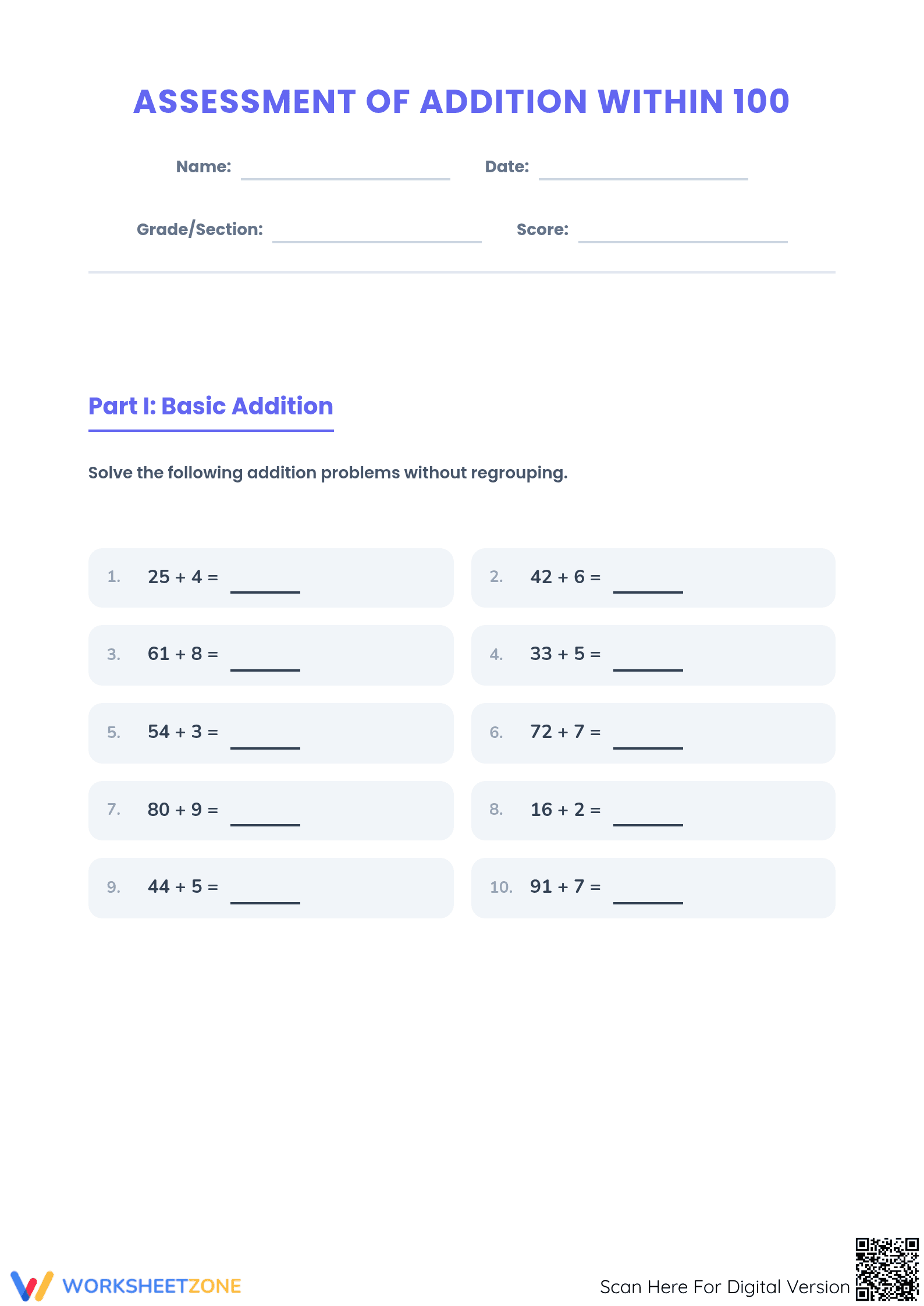
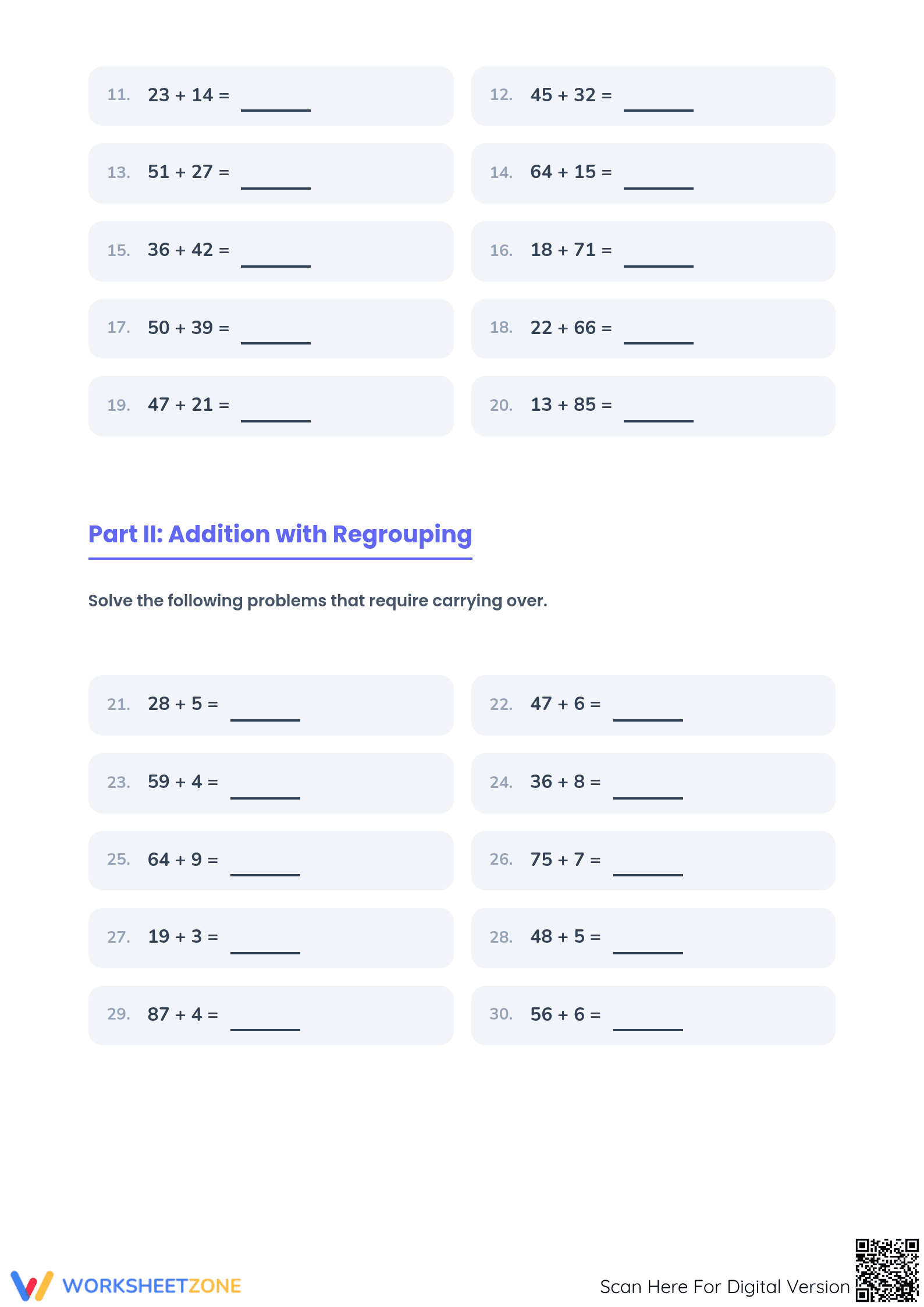
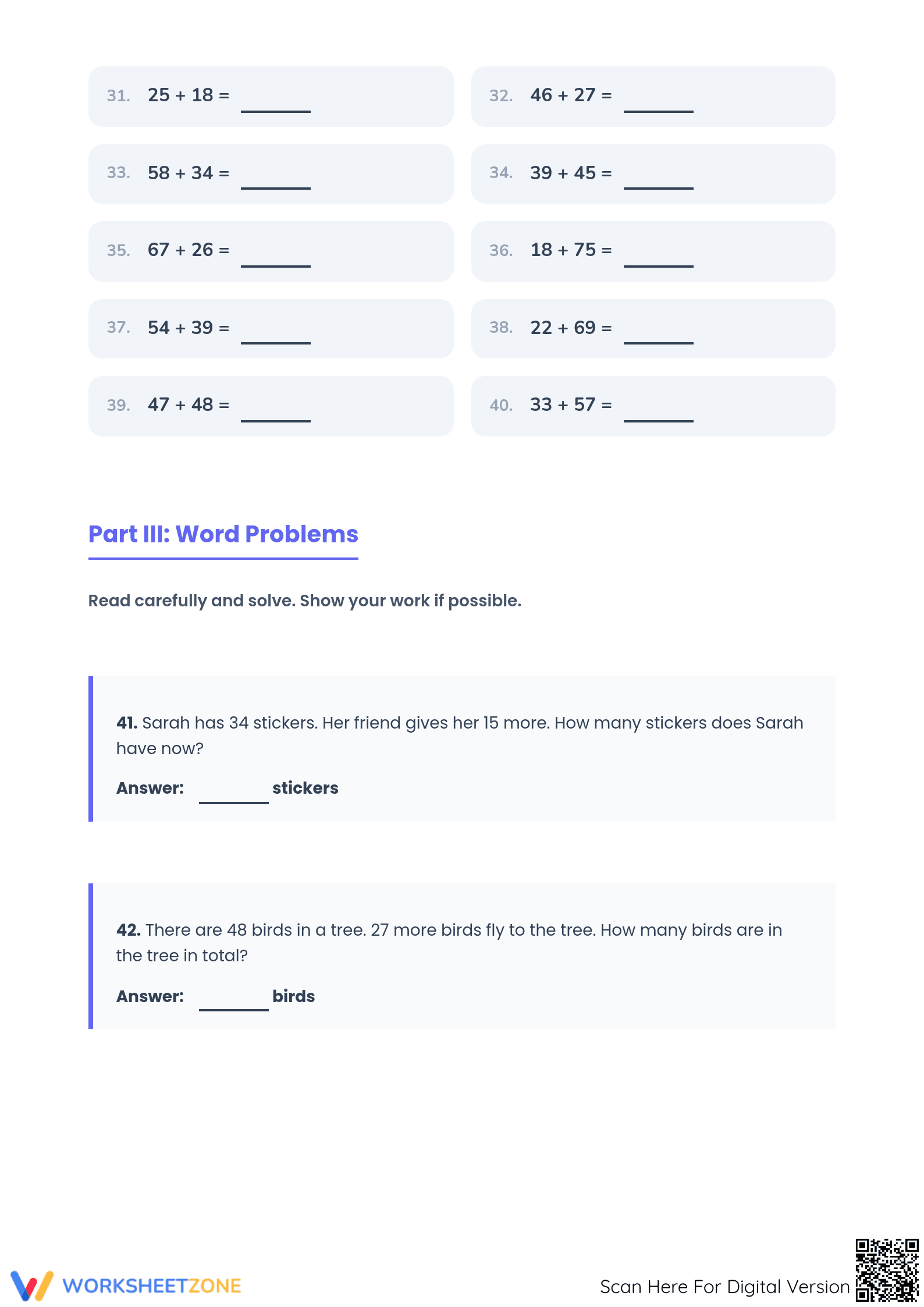
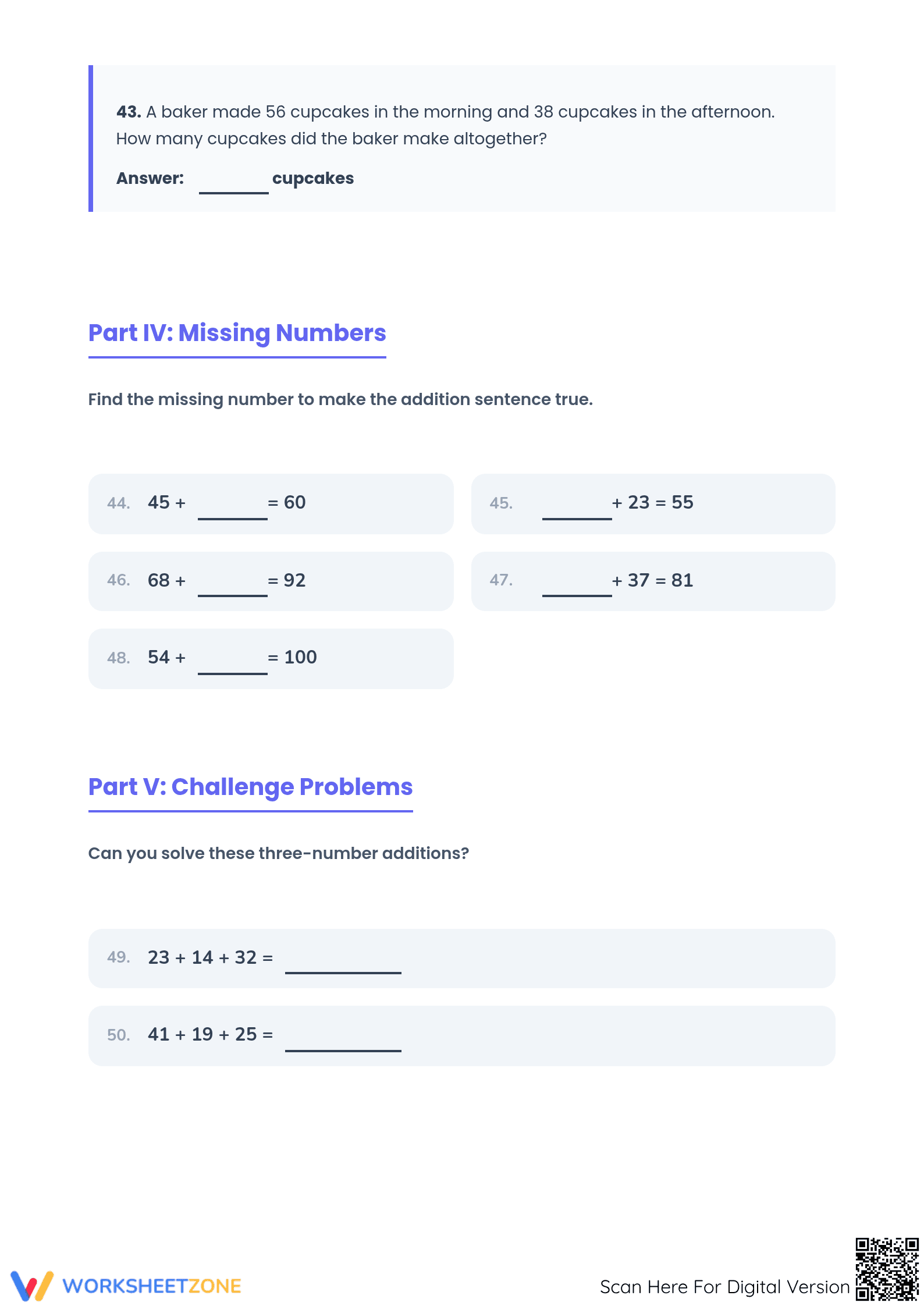

2.NBT.B.5 Worksheet: Addition within 100 — Grade 2 Aligned
Paste this activity's link or code into your existing LMS (Google Classroom, Canvas, Teams, Schoology, Moodle, etc.).
Students can open and work on the activity right away, with no student login required.
You'll still be able to track student progress and results from your teacher account.
Master Grade 2 Addition with a Comprehensive Assessment
This comprehensive assessment tests Grade 2 students' ability to fluently add within 100, aligning directly with core number and operations standards. The worksheet provides a structured evaluation of addition skills, covering problems with and without regrouping, word problems, and challenges designed to confirm mastery of the CCSS.MATH.CONTENT.2.NBT.B.5 standard.
At a Glance
- Grade: 2 · Subject: Math
- Standard:
CCSS.MATH.CONTENT.2.NBT.B.5— Fluently add within 100 using place value strategies.- Skill Focus: Addition within 100, regrouping, word problems
- Format: 4 pages · 50 problems · Answer key included · PDF
- Best For: Summative assessment, unit review, test prep
- Time: 25–40 minutes
What's Inside This Addition Assessment?
This four-page PDF contains a 50-problem assessment broken into five distinct parts. It begins with basic addition and systematically progresses to addition with regrouping, multi-step word problems, and missing number puzzles. The final section includes challenge problems involving three addends. A complete answer key is provided for efficient grading and student review.
Producing Evidence of Mastery
This worksheet is designed to produce clear evidence of mastery for CCSS.MATH.CONTENT.2.NBT.B.5. The tasks are sequenced to isolate different skills: Part I assesses foundational two-digit addition without carrying over, while Parts II-V introduce the complexity of regrouping and application. Teachers can use the final score from the 50 problems as a direct data point for report cards, IEP progress monitoring, or standards-based gradebooks, providing a clear picture of student achievement.
Standards Alignment for Lesson Planning
This assessment is directly aligned with CCSS.MATH.CONTENT.2.NBT.B.5, which requires students to "fluently add and subtract within 100 using strategies based on place value, properties of operations, and/or the relationship between addition and subtraction." It also supports CCSS.MATH.CONTENT.2.OA.A.1, which involves using addition to solve one- and two-step word problems. Both standard codes can be copied directly into lesson plans, IEP goals, or district curriculum mapping tools.
How to Use It in the Classroom
Use this worksheet as a summative assessment at the end of a unit on two-digit addition. It is best administered after students have had ample practice with place value strategies and regrouping. For formative data, observe which section (e.g., regrouping, word problems) students struggle with most. This can inform re-teaching groups. The assessment should take most students between 25 and 40 minutes to complete independently in one session.
Who It's For
This resource is ideal for Grade 2 students who have completed a unit on addition within 100. It can also serve as a pre-assessment for Grade 3 students or a review packet for the beginning of the year. For students needing support, pair this assessment with a place value chart or base-ten blocks. For advanced learners, challenge them to write their own word problems using the equations from the worksheet to extend their learning.
This assessment provides a reliable measure of student proficiency in CCSS.MATH.CONTENT.2.NBT.B.5, a critical gateway skill for arithmetic. By requiring students to fluently add within 100, the worksheet addresses foundational competencies that predict future success in mathematics. Research from the RAND AIRS (2024) report highlights the importance of procedural fluency built upon conceptual understanding, a principle embodied in this worksheet's progression from basic computation to application in word problems. The inclusion of 50 varied problems allows for a stable and accurate snapshot of student ability, minimizing the chance of performance errors skewing the results. The structure of the assessment, moving from simple to complex tasks, aligns with instructional scaffolding principles outlined by Fisher & Frey (2014), making it a valid tool for measuring learning outcomes and informing next steps for instruction.


