


























Views
Downloads


Asian Pacific American Heritage Month Matching | Essential
Paste this activity's link or code into your existing LMS (Google Classroom, Canvas, Teams, Schoology, Moodle, etc.).
Students can open and work on the activity right away, with no student login required.
You'll still be able to track student progress and results from your teacher account.
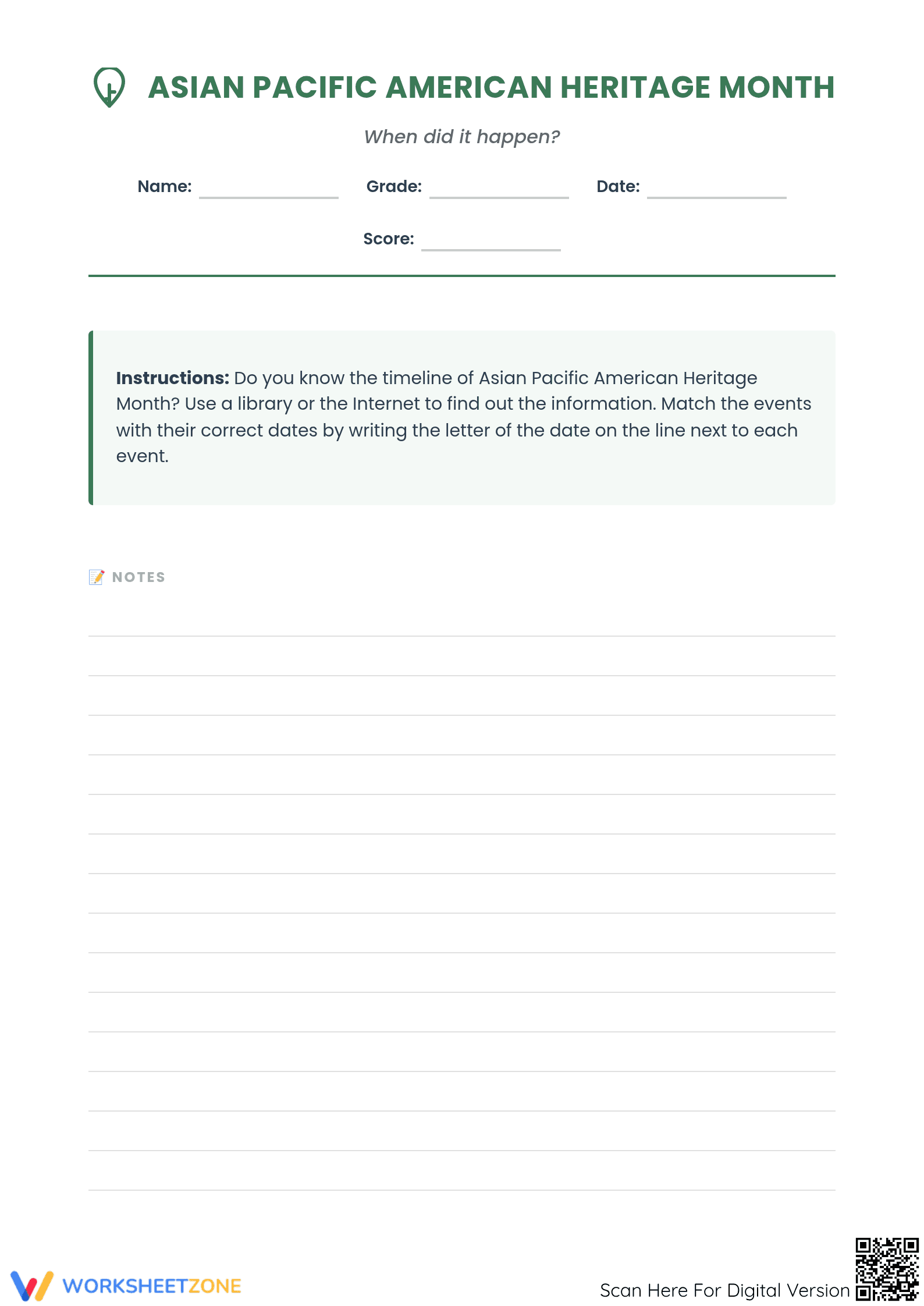
This Asian Pacific American Heritage Month matching worksheet helps students connect significant historical milestones with their specific dates. By researching and identifying key moments like the completion of the Transcontinental Railroad or the first Japanese immigrants' arrival, learners develop a chronological understanding of AAPI history. It is a perfect resource for building research proficiency and cultural awareness.
At a Glance
- Grade: 4-7 · Subject: Math / Social Studies
- Standard:
CCSS.ELA-LITERACY.RI.5.3— Explain relationships between historical events based on specific information- Skill Focus: Historical timeline matching
- Format: 2 pages · 7 problems · Answer key included · PDF
- Best For: Seasonal social studies or research practice
- Time: 15–25 minutes
The resource consists of two high-quality pages. The first page provides clear instructions and a dedicated "Notes" section for students to record findings from their library or internet research. The second page features 7 distinct historical events paired with a bank of 12 possible dates, requiring students to distinguish between similar timeframes to find the correct match.
Zero-Prep Workflow
This worksheet is designed for a zero-prep workflow. Teachers can print the PDF in under 1 minute, distribute it to the class in seconds, and review the answers together in 5 minutes. Because it encourages independent research, it serves as an excellent sub plan or a quiet morning work activity that requires no prior teacher setup. The clear layout ensures students can work autonomously.
Standards Alignment
Aligned primarily to `CCSS.ELA-LITERACY.RI.5.3`, which focuses on explaining the relationships or interactions between two or more individuals or events in a historical text. It also supports CCSS.ELA-LITERACY.W.5.7 by requiring students to conduct short research projects. Both standard codes can be copied directly into lesson plans, IEP goals, or district curriculum mapping tools.
How to Use It
Use this worksheet during the first week of May to introduce Asian Pacific American Heritage Month. It works best during the "independent practice" phase of a social studies lesson. A formative assessment tip: observe which students struggle to differentiate between the 1843 dates, as this indicates a need for closer attention to detail in chronological reading. Expected completion time is 20 minutes.
Who It's For
This activity is ideal for general education students in grades 4 through 7, as well as ELL students who benefit from the structured matching format. It pairs naturally with a classroom timeline poster or a digital encyclopedia. The inclusion of a notes section allows for easy differentiation for students who need more writing space or guided research prompts.
Research by Fisher & Frey (2014) emphasizes that "gradual release of responsibility" is most effective when students are given structured tasks that require active information retrieval. This worksheet applies that principle by tasking students with matching 7 historical events to dates, reinforcing the CCSS.ELA-LITERACY.RI.5.3 standard. By requiring students to use external sources to verify dates, the activity moves beyond rote memorization into the practice of active inquiry. According to the NAEP frameworks, students who engage with chronological text structures demonstrate higher retention of historical facts compared to those who read isolated snippets. This resource provides the necessary scaffolding for middle-grade learners to organize complex historical data into a coherent timeline. The 2-page layout ensures that students have ample space for both research notes and final answers, supporting cognitive load management during multi-step tasks.


