


























Views
Downloads

Essential Living and Non-Living Things Worksheet | Grade 1
Paste this activity's link or code into your existing LMS (Google Classroom, Canvas, Teams, Schoology, Moodle, etc.).
Students can open and work on the activity right away, with no student login required.
You'll still be able to track student progress and results from your teacher account.
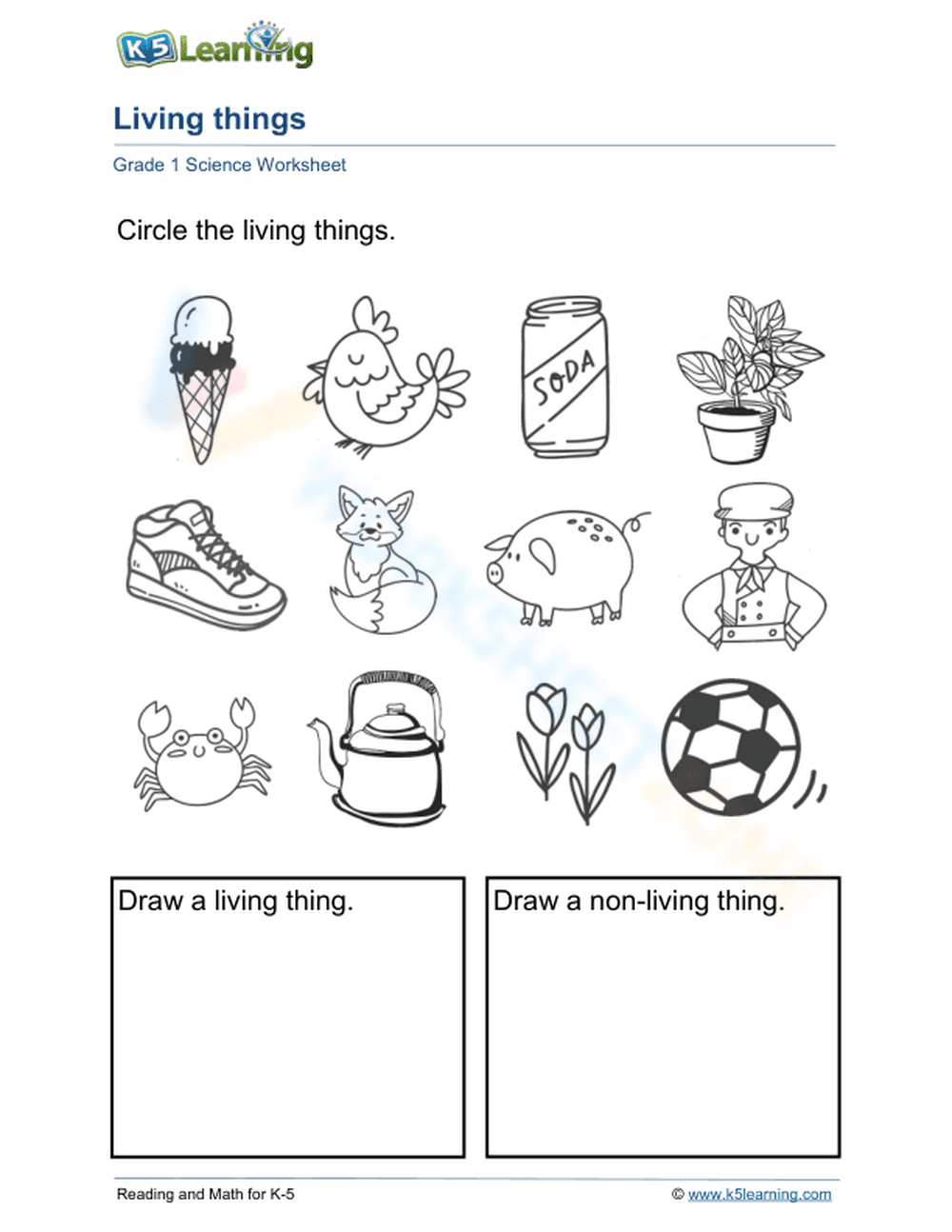
This Grade 1 science worksheet provides a clear and engaging way for students to master the foundational concept of distinguishing between living and non-living things. By identifying biological characteristics through visual identification and creative drawing, learners develop the observational skills necessary for early scientific inquiry and classification.
At a Glance
- Grade: 1 · Subject: Science
- Standard:
1-LS1-1— Distinguish between living and non-living things based on observable characteristics- Skill Focus: Living vs. Non-Living Identification
- Format: 1 page · 14 problems · Answer key included · PDF
- Best For: Independent science center or quick assessment
- Time: 15–20 minutes
This single-page PDF features 12 illustrated items ranging from animals and plants to everyday household objects, challenging students to circle only those that are living. Below the identification section, two drawing prompts encourage students to synthesize their knowledge by illustrating one example of each category. The layout is clean and minimalist, reducing cognitive load while providing space for drawings.
Zero-Prep Workflow
This resource is designed for immediate classroom implementation with teacher preparation under two minutes. First, print the single-page document directly from your viewer. Second, distribute the copies to students with no additional instruction required beyond the simple written cues. Third, review student work using a visual check-sheet or allow for peer review to foster scientific discussion. Its print-and-go nature makes it an ideal choice for emergency sub plans or transition periods.
Standards Alignment
The worksheet aligns primarily with the Next Generation Science Standard 1-LS1-1, which focuses on understanding the structures and processes of living organisms. By identifying living things, students begin to recognize that organisms have specific needs and characteristics that distinguish them from inanimate objects. This standard code can be copied directly into lesson plans, IEP goals, or district curriculum mapping tools.
How to Use It
Use this worksheet as a formative assessment after a direct instruction lesson on the characteristics of life. During the activity, walk around the room and observe if students are correctly identifying the plants and animals versus the manufactured items like the soda can or soccer ball. The worksheet typically takes 15 to 20 minutes to complete, making it a perfect exit ticket to gauge student understanding before moving on to plant structures.
Who It's For
This activity is perfectly suited for first-grade students, but it can also serve as an effective reinforcement tool for kindergarteners or a review for second graders. It is highly beneficial for English Language Learners due to its heavy reliance on visual cues rather than dense text. Pair this resource with a local nature walk or a classroom plant observation project to provide a concrete real-world connection to biology.
Research from Fisher & Frey (2014) indicates that visual scaffolds allow students to categorize information into binary frameworks. Distinguishing between living and non-living entities is the primary gateway to understanding biological diversity. This Grade 1 science activity utilizes standard 1-LS1-1 to build critical classification skills through 14 distinct tasks. By combining identification with generative drawing, the worksheet moves students from passive recognition to active application of scientific criteria. Educators can rely on this structured practice to ensure students meet the NAEP science framework requirements for identifying life cycles and organism traits. The resource provides a standardized, repeatable method for verifying that young learners can successfully apply biological definitions to a variety of familiar and unfamiliar objects in their environment.


