


























Views
Downloads


Ascending Order Two-Digit Numbers | Essential Math Practice
Paste this activity's link or code into your existing LMS (Google Classroom, Canvas, Teams, Schoology, Moodle, etc.).
Students can open and work on the activity right away, with no student login required.
You'll still be able to track student progress and results from your teacher account.
This math resource focuses on the fundamental skill of ordering two-digit numbers from smallest to largest. Students develop a strong sense of number magnitude and place value through repetitive, structured practice. By mastering ascending order, learners build the necessary foundation for more complex operations like rounding and estimation in later grades.
At a Glance
- Grade: 2-4 · Subject: Math
- Standard:
CCSS.MATH.CONTENT.2.NBT.A.4— Compare and order numbers based on meanings of the digits in each place- Skill Focus: Ascending order (smallest to largest)
- Format: 5 pages · 20 problems · Answer key included · PDF
- Best For: Independent practice or morning work
- Time: 15–25 minutes
What's Inside
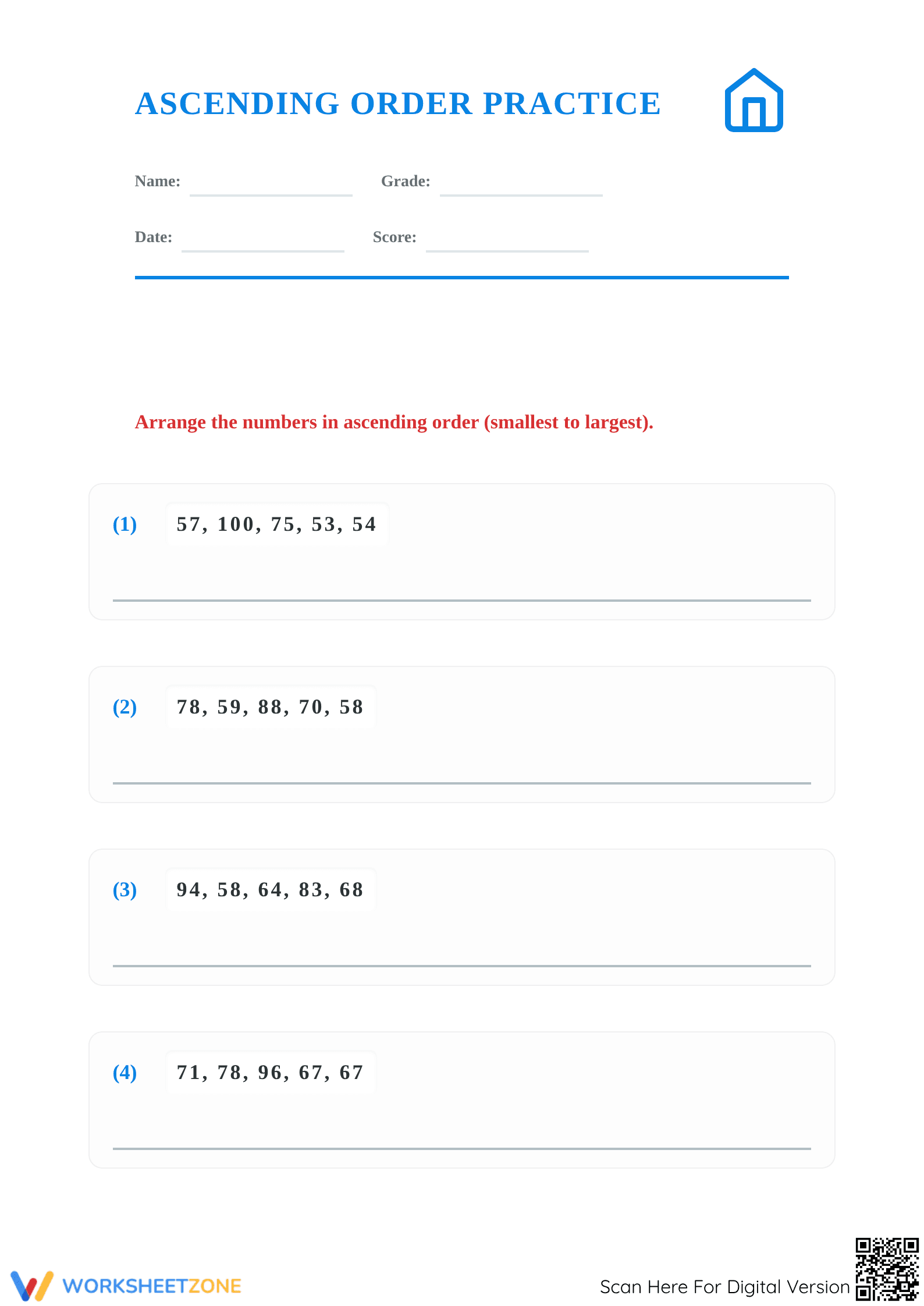
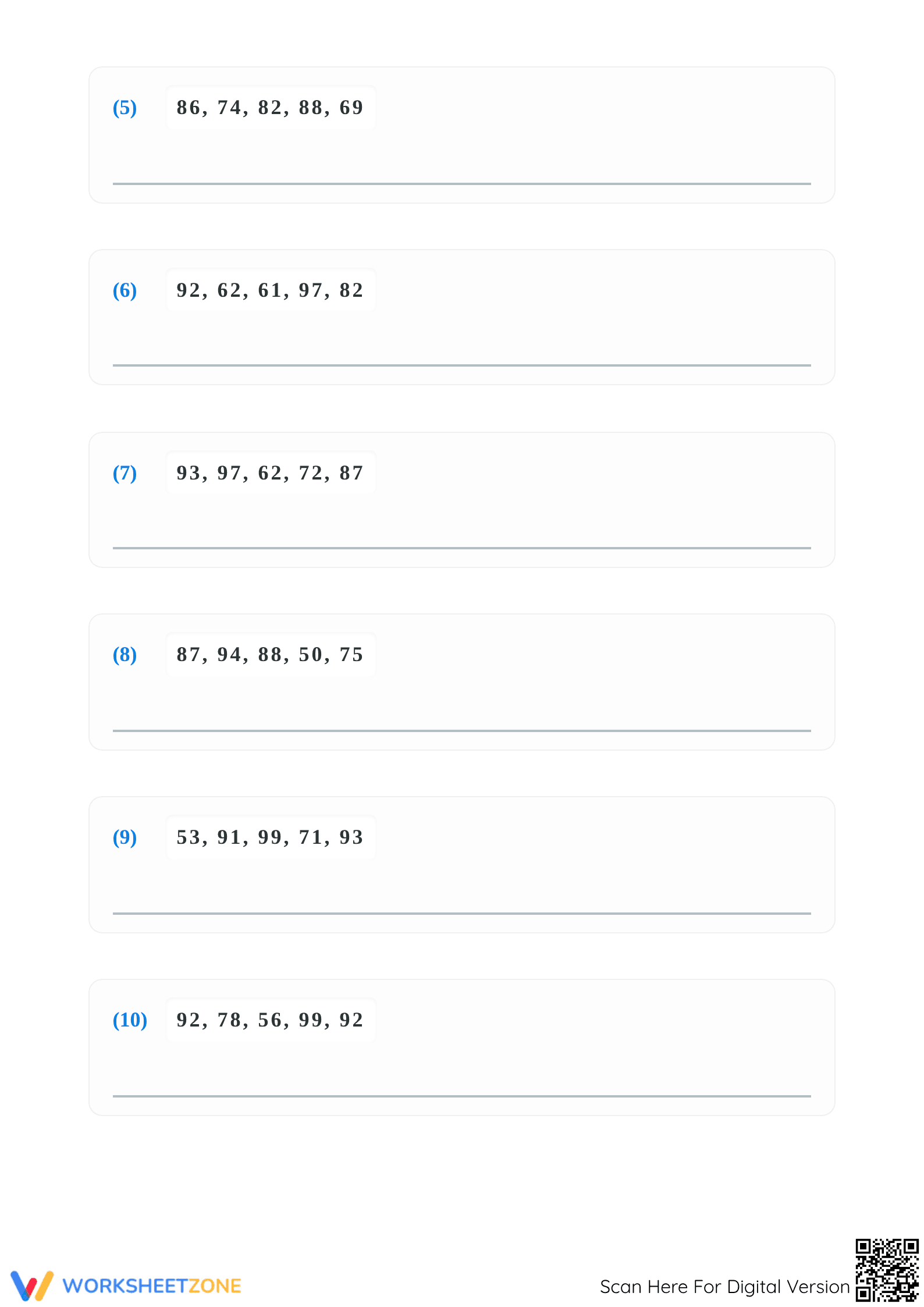
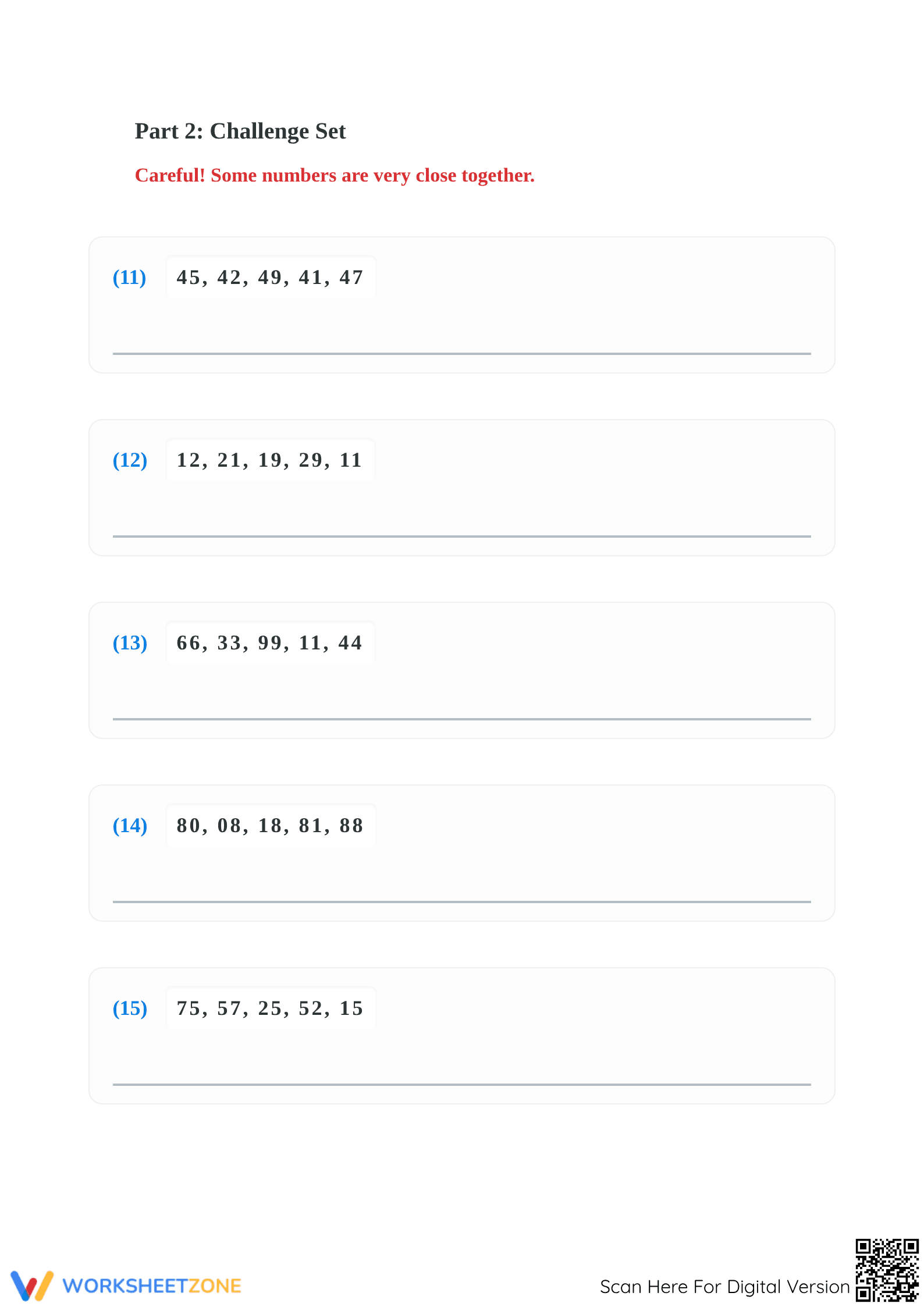
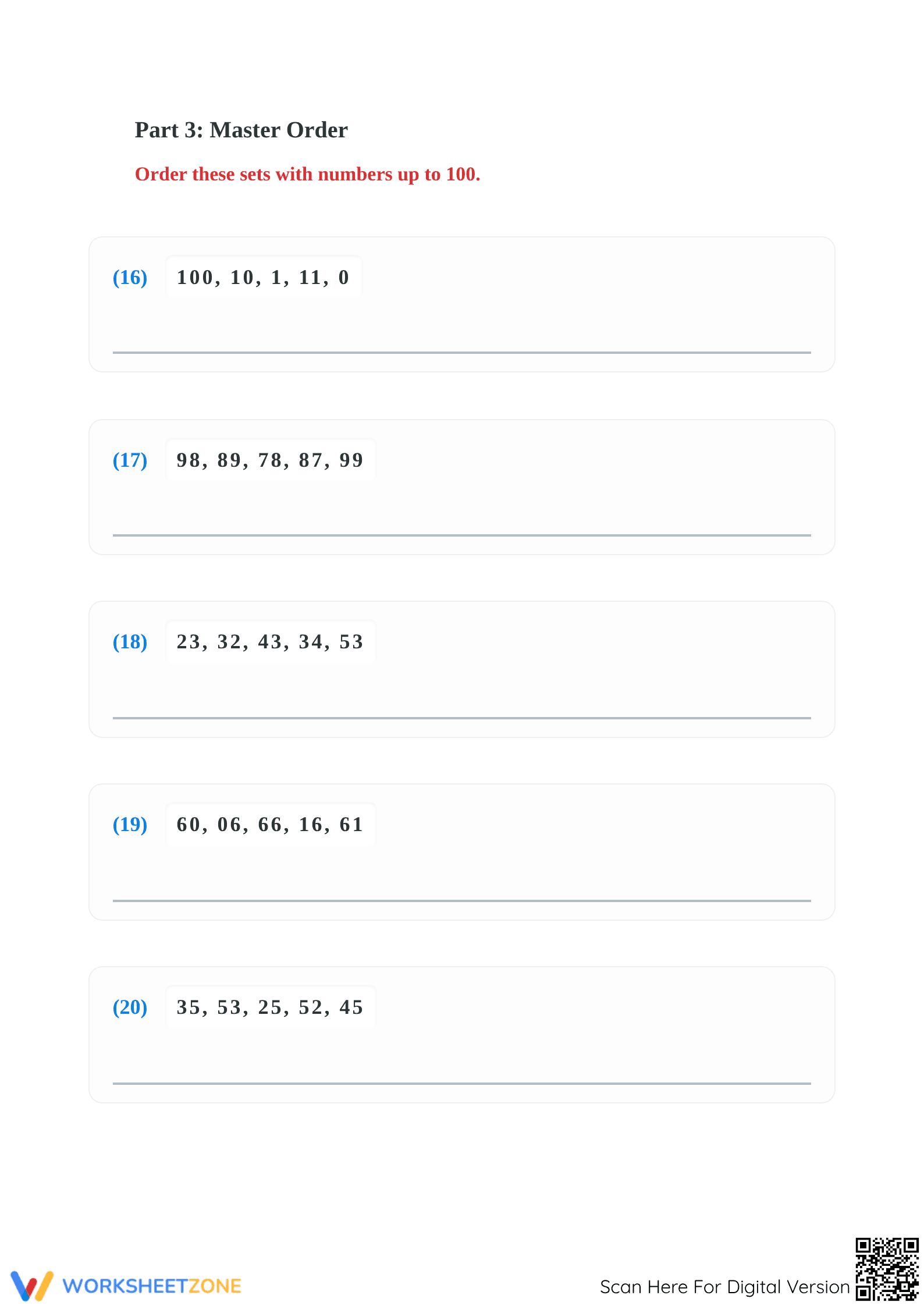
This comprehensive 5-page PDF contains 20 unique number sets designed to test a student's ability to sequence values. The worksheet is divided into three distinct sections: basic practice, a challenge set, and a master order section. Each page features large, clear fonts and dedicated lines for student responses. A full answer key is provided for rapid grading or student self-correction.
Skill Progression
- Guided Practice: The first 10 problems provide widely spaced numbers (e.g., 57, 100, 75) to help students identify clear differences in magnitude.
- Supported Practice: The "Challenge Set" introduces 5 problems where numbers are numerically close (e.g., 45, 42, 49), requiring students to look closely at the ones digit.
- Independent Practice: The final "Master Order" section includes 5 problems with mixed ranges, including zero and one hundred, to ensure total mastery of the two-digit number line.
This structure follows the gradual release of responsibility model, moving from simple discrimination to high-precision ordering.
Standards Alignment
This worksheet is primarily aligned to `CCSS.MATH.CONTENT.2.NBT.A.4`: "Compare two three-digit numbers based on meanings of the hundreds, tens, and ones digits." While focused on two-digit sets, it serves as the essential prerequisite for three-digit comparison. This standard code can be copied directly into lesson plans, IEP goals, or district curriculum mapping tools.
How to Use It
Use this worksheet during the "You Do" phase of a lesson on place value. It works exceptionally well as a formative assessment after a mini-lesson on the "greater than" and "less than" concepts. Teachers should observe students as they work through the Challenge Set; students who struggle with numbers like 41 and 42 likely need additional intervention regarding the value of the ones place. Expect completion within 20 minutes.
Who It's For
This resource is designed for Grade 2 students first learning to sequence, but it serves as an excellent remedial tool for Grade 3 and 4 students who lack fluency in number sense. It pairs naturally with a physical number line or a hundreds chart for students requiring additional visual scaffolding during the independent work phase.
Fisher & Frey (2014) emphasize the importance of the gradual release of responsibility model in mathematics instruction. This worksheet applies that framework by moving from basic sets to a "Challenge Set" where numbers are numerically close, requiring finer discrimination of place value. Research from the NAEP indicates that students who master number sequencing in early elementary grades show significantly higher proficiency in multi-digit addition and subtraction. This resource provides 20 targeted opportunities to solidify these mental number line concepts. By utilizing the CCSS.MATH.CONTENT.2.NBT.A.4 standard, teachers can ensure that students are not just memorizing sequences but are actively comparing the values of tens and ones digits. This systematic approach to number sense is a critical component of mathematical fluency and prepares students for the increased complexity of third and fourth-grade curriculum standards.


