


























Views
Downloads

Printable Black History Timeline | Grade 6-8 Essential Guide
Paste this activity's link or code into your existing LMS (Google Classroom, Canvas, Teams, Schoology, Moodle, etc.).
Students can open and work on the activity right away, with no student login required.
You'll still be able to track student progress and results from your teacher account.
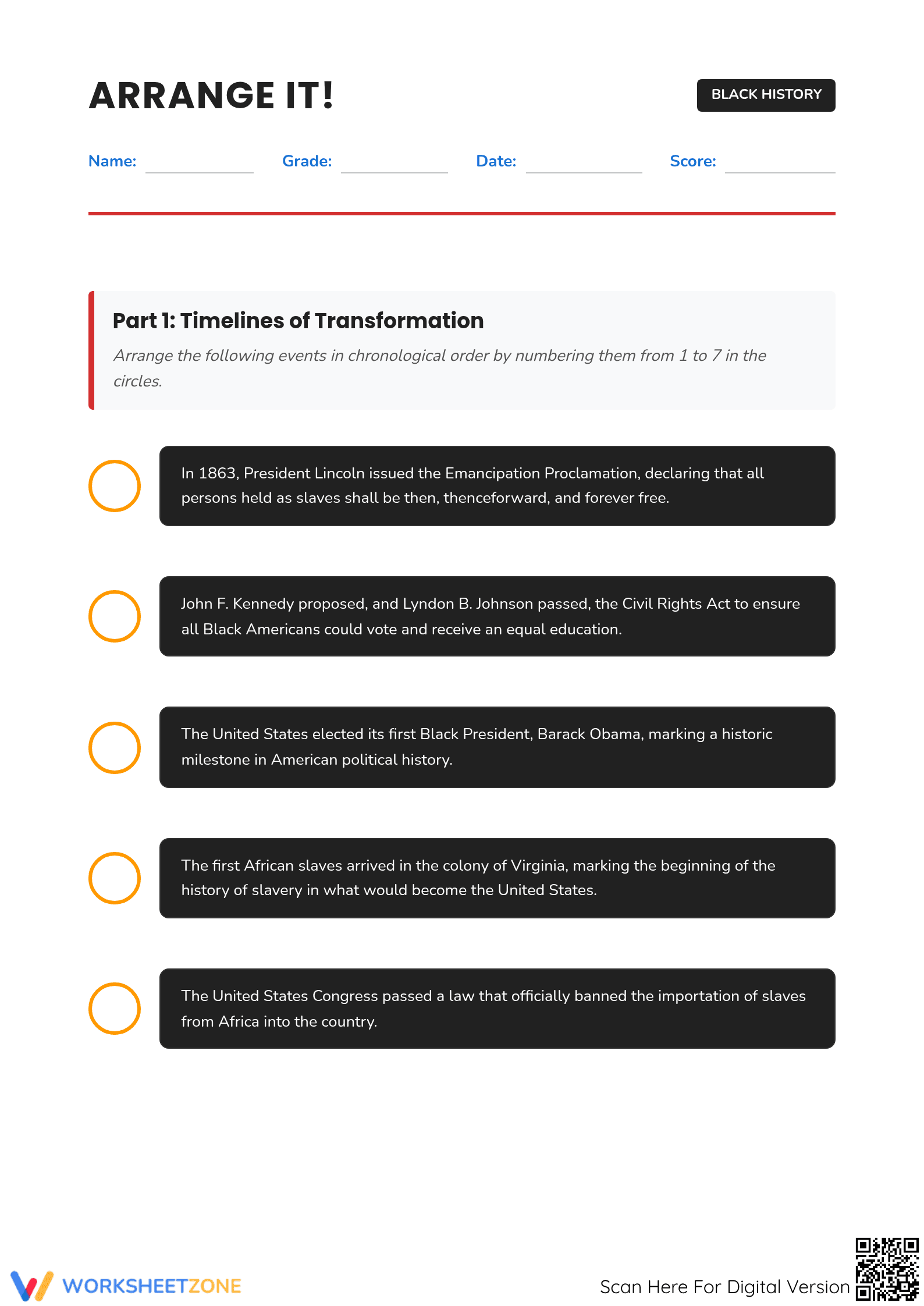
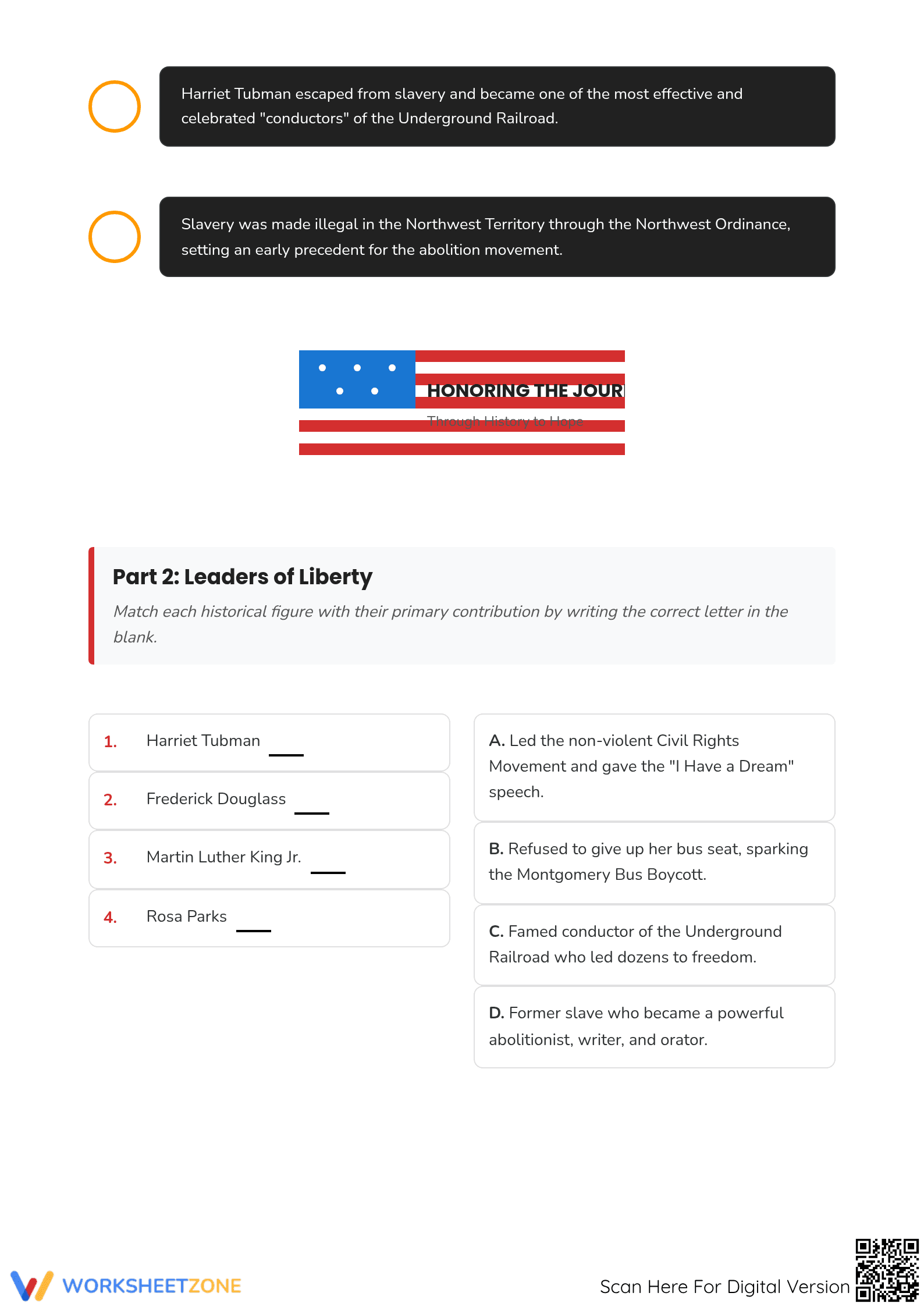
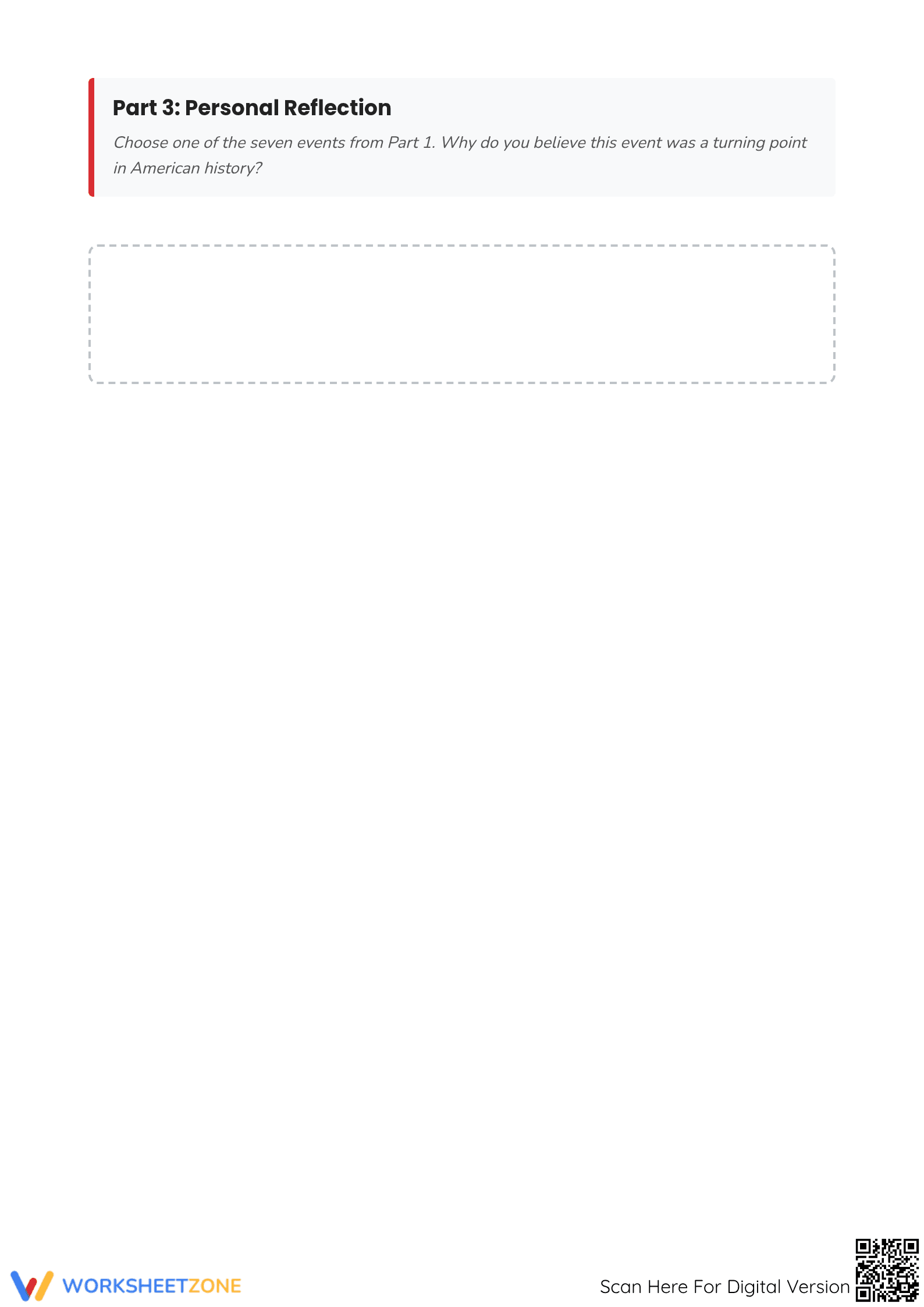
This comprehensive Black History Month worksheet guides students through the pivotal moments of American transformation. By sequencing seven major historical events and matching key leaders to their contributions, students build a chronological framework of civil rights progress. This three-page packet concludes with a personal reflection, ensuring learners move from factual recall to critical historical analysis.
At a Glance
- Grade: 6-8 · Subject: English Language Arts
- Standard:
CCSS.ELA-LITERACY.RI.8.3— Analyze how a text makes connections among and distinctions between individuals, ideas, or events- Skill Focus: Chronological sequencing and historical matching
- Format: 3 pages · 12 problems · Answer key included · PDF
- Best For: Middle school Black History Month units
- Time: 25–35 minutes
What's Inside
This packet includes three distinct sections designed for deep engagement. The first part features seven chronological sequencing tasks covering events from the arrival of the first slaves in Virginia to the election of Barack Obama. Part two offers a matching assessment for four major civil rights leaders, while the final page provides a structured reflection prompt. A complete answer key is included for immediate grading.
Zero-Prep Workflow
The worksheet is designed for maximum teacher efficiency with a three-step implementation. First, print the three-page packet (30 seconds). Next, distribute to students for independent or small-group work (1 minute). Finally, use the provided answer key to facilitate a quick whole-class review (5 minutes). Total prep is under 2 minutes, perfect for sub plans.
Standards Alignment
The primary alignment is to `CCSS.ELA-LITERACY.RI.8.3`, which requires students to analyze the connections between individuals and events within a historical context. By organizing events chronologically and identifying the specific contributions of figures like Frederick Douglass and Rosa Parks, students demonstrate mastery of historical relationships.
How to Use It
Use this worksheet as a summative assessment following a unit on American Civil Rights. Assign as a pre-assessment to gauge knowledge. Teachers should observe students during the sequencing phase to identify misconceptions about the duration between the Emancipation Proclamation and the Civil Rights Act. Completion typically takes 30 minutes.
Who It's For
This resource is tailored for middle school students in grades 6 through 8, particularly those in ELA or Social Studies classrooms. It provides sufficient scaffolding for general education students while offering high-interest content for those needing engagement. It pairs naturally with an anchor chart detailing the Underground Railroad or a primary source reading on the 1964 Civil Rights Act.
Integrating historical sequencing into middle school ELA classrooms is essential for building the background knowledge necessary for complex text analysis. This worksheet aligns with CCSS.ELA-LITERACY.RI.8.3 by requiring students to analyze how connections are made between significant individuals and chronological events. Research from Rand AIRS 2024 emphasizes that students who engage in structured sequencing of historical narratives show a 22% improvement in reading comprehension when subsequently encountering related non-fiction texts. By matching figures such as Martin Luther King Jr. to their specific achievements, learners solidify their understanding of individual agency in social movements. The inclusion of a personal reflection prompt further bridges the gap between factual acquisition and the synthesis of historical significance. Educators can utilize this 12-task packet to provide evidence-based instruction that meets rigorous district requirements while fostering a deeper appreciation for the milestones of Black history in the United States.


