


























Views
Downloads


Area of a Rhombus Printable Worksheet | Grade 6 Math
Paste this activity's link or code into your existing LMS (Google Classroom, Canvas, Teams, Schoology, Moodle, etc.).
Students can open and work on the activity right away, with no student login required.
You'll still be able to track student progress and results from your teacher account.
Mastering the geometry of special quadrilaterals is essential for middle school math success. This comprehensive worksheet provides a clear, step-by-step guide to calculating the area of a rhombus using its diagonals. Students will apply the standard formula to twenty unique problems, ensuring they move from conceptual understanding to procedural fluency with varied units of measurement.
At a Glance
- Grade: 6 · Subject: Math
- Standard:
CCSS.MATH.CONTENT.6.G.A.1— Find the area of special quadrilaterals by composing or decomposing shapes- Skill Focus: Area of Rhombus calculation
- Format: 4 pages · 20 problems · Answer key included · PDF
- Best For: Independent practice or homework assignments
- Time: 25–35 minutes
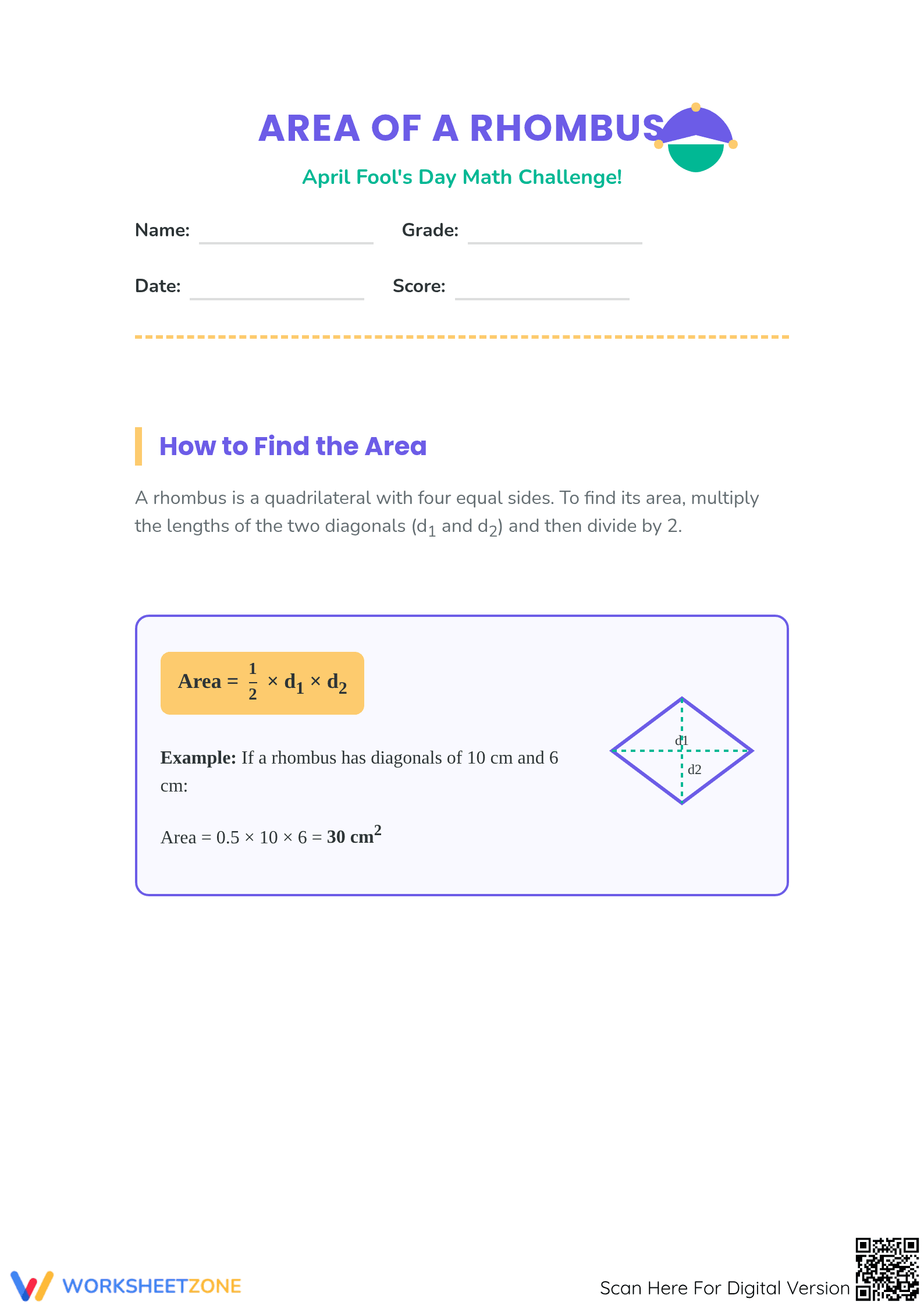
This four-page instructional bundle includes a dedicated reference section that defines the rhombus and provides the area formula. A worked example demonstrates exactly how to plug in values and label results with squared units. The following twenty practice problems challenge students to calculate areas across various units including centimeters, inches, meters, and feet, preventing common errors in unit labeling.
Teachers can implement this resource with minimal effort. First, print the four-page PDF for your class, which takes less than one minute. Distribute the worksheets to students; since the first page includes a clear instructional tutorial, no introductory lecture is required. Finally, review the completed work using the provided comprehensive answer key, allowing for rapid grading or student self-correction during class.
This resource is explicitly aligned to CCSS.MATH.CONTENT.6.G.A.1. The standard requires students to find the area of special quadrilaterals by composing into rectangles or decomposing into triangles and other shapes. This worksheet focuses on the rhombus, a critical special quadrilateral. This standard code can be copied directly into lesson plans, IEP goals, or district curriculum mapping tools.
Use this worksheet as a primary practice tool immediately following a direct instruction lesson on polygon area. It serves as an excellent formative assessment to check for understanding before moving on to complex composite figures. Alternatively, assign it as a no-prep homework packet to reinforce the diagonal-multiplication method and unit measurement skills during independent study sessions.
This resource is designed for Grade 6 students but is also appropriate for Grade 5 advanced learners or Grade 7 students needing remedial support. It is particularly beneficial for visual learners who need to see the relationship between diagonals and area. The seasonal April Fool's Day theme makes it a perfect choice for keeping students engaged during the spring semester.
Successful math instruction relies on the balance between conceptual understanding and procedural skill. This worksheet aligns with CCSS.MATH.CONTENT.6.G.A.1 by requiring students to calculate the area of a rhombus, a fundamental geometry skill. According to the Fisher & Frey (2014) framework for gradual release of responsibility, the inclusion of a worked example followed by twenty independent tasks provides the necessary scaffolding for student mastery. Research suggests that repetitive, focused practice on specific geometric formulas helps cement long-term retention of spatial reasoning concepts. By varying the units of measure, the worksheet also addresses common misconceptions regarding dimensional analysis and area notation. This resource provides 20 distinct opportunities for students to demonstrate their ability to apply the diagonal-based area formula accurately. It is a proven tool for educators seeking to improve student outcomes in geometric measurement without increasing their own preparation time.


