




























Views
Downloads




Printable Area Explorer: Creating Shapes Math Worksheet

Paste this activity's link or code into your existing LMS (Google Classroom, Canvas, Teams, Schoology, Moodle, etc.).
Students can open and work on the activity right away, with no student login required.
You'll still be able to track student progress and results from your teacher account.
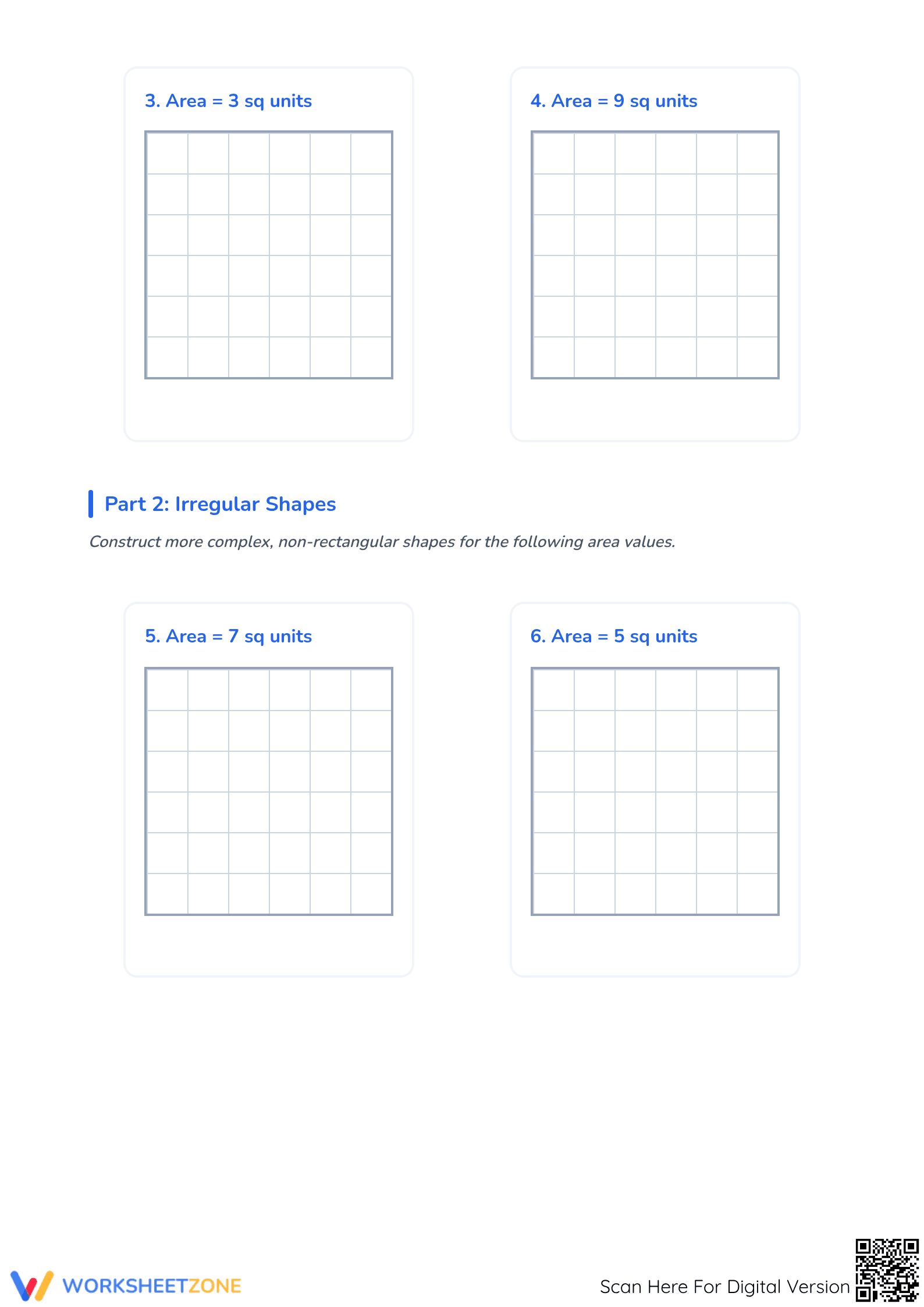
This printable Area Explorer worksheet helps Grade 3 students master the concept of measurement by physically constructing shapes on a grid. By translating numerical area values into visual geometries, learners develop a concrete understanding of spatial reasoning and unit square relationships. It is a foundational tool for early geometric fluency and mastery.
At a Glance
- Grade: 3-5 · Subject: Math
- Standard:
3.MD.C.6— Measure areas by counting unit squares to create specific closed shapes.- Skill Focus: Geometric Area Construction
- Format: 5 pages · 16 problems · Answer key included · PDF
- Best For: Independent practice and geometric concept reinforcement.
- Time: 20–30 minutes
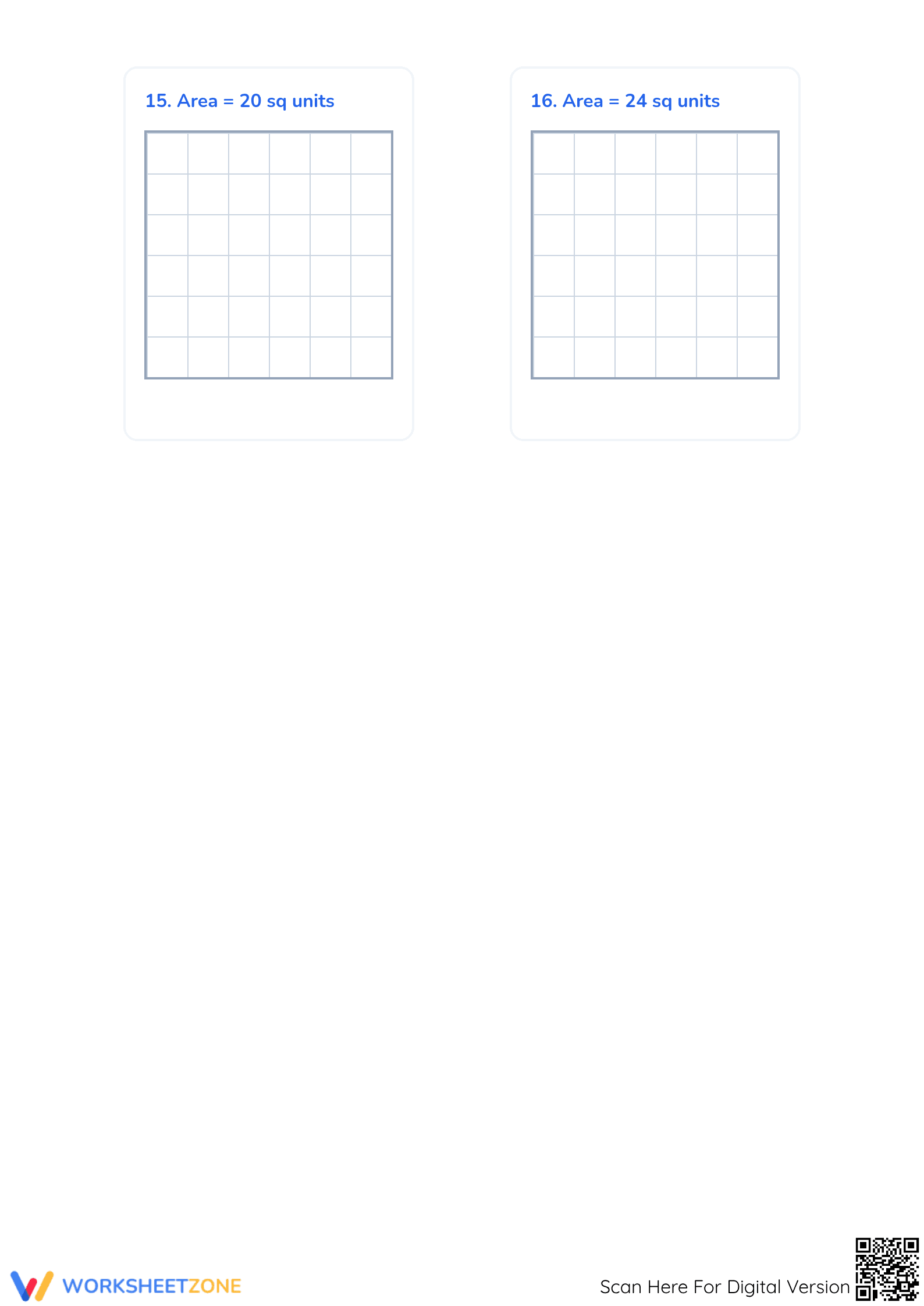
This 5-page PDF contains 16 distinct area construction challenges across three complexity levels: Basic, Irregular, and Master Challenge. Each page provides clear, spacious grids for student drawing. The set includes a full answer key showing possible shape configurations, making it easy for students to self-check their spatial accuracy.
Zero-Prep Workflow
Integrating this resource into your math block is efficient. Step 1: Print the 5-page packet (30 seconds). Step 2: Distribute to students for independent or center-based work (1 minute). Step 3: Review solutions using the provided visual answer key for immediate feedback (1 minute). Total teacher prep time is under three minutes.
Standards Alignment
Aligned to 3.MD.C.6, students measure areas by counting unit squares (square cm, square m, square in, square ft, and improvised units). This worksheet specifically focuses on the inverse: creating a closed shape that covers exactly a specified area. This standard code can be copied directly into lesson plans, IEP goals, or district curriculum mapping tools.
How to Use It
Use this as a 'Day 1' introduction to area after students understand unit squares but before they learn the length-times-width formula. For formative assessment, observe if students struggle with 'islands' (non-closed shapes) or overlapping squares. Completion typically takes 25 minutes during a small-group rotation or as a standalone homework assignment.
Who It's For
Designed for elementary students in Grades 3 through 5, this resource is particularly effective for visual learners and students requiring tactile-visual spatial practice. It pairs naturally with physical unit cubes or transparent grid overlays to bridge the gap between concrete manipulation and abstract paper-and-pencil representation.
According to the NAEP Mathematics Framework, early exposure to spatial visualization and area partitioning is a critical predictor of later success in higher-level geometry and measurement. This Area Explorer resource directly addresses these cognitive milestones by requiring students to synthesize numerical constraints with spatial execution. Research highlighted by Fisher & Frey (2014) emphasizes the importance of guided practice where students transition from simple rectangular constructions to complex, irregular polygons to solidify their understanding of additive area properties. By providing 16 varied tasks across five pages, this worksheet ensures students move beyond rote counting to active geometric creation. Standard 3.MD.C.6 serves as the anchor for this development, ensuring students can accurately relate unit squares to defined spatial boundaries. This evidence-based approach to area mastery provides the scaffolding necessary for students to eventually grasp the area formula with deep conceptual clarity rather than mechanical memorization.


