


























Views
Downloads

Printable Wood Properties Science Worksheet | Grade 3-4
Paste this activity's link or code into your existing LMS (Google Classroom, Canvas, Teams, Schoology, Moodle, etc.).
Students can open and work on the activity right away, with no student login required.
You'll still be able to track student progress and results from your teacher account.
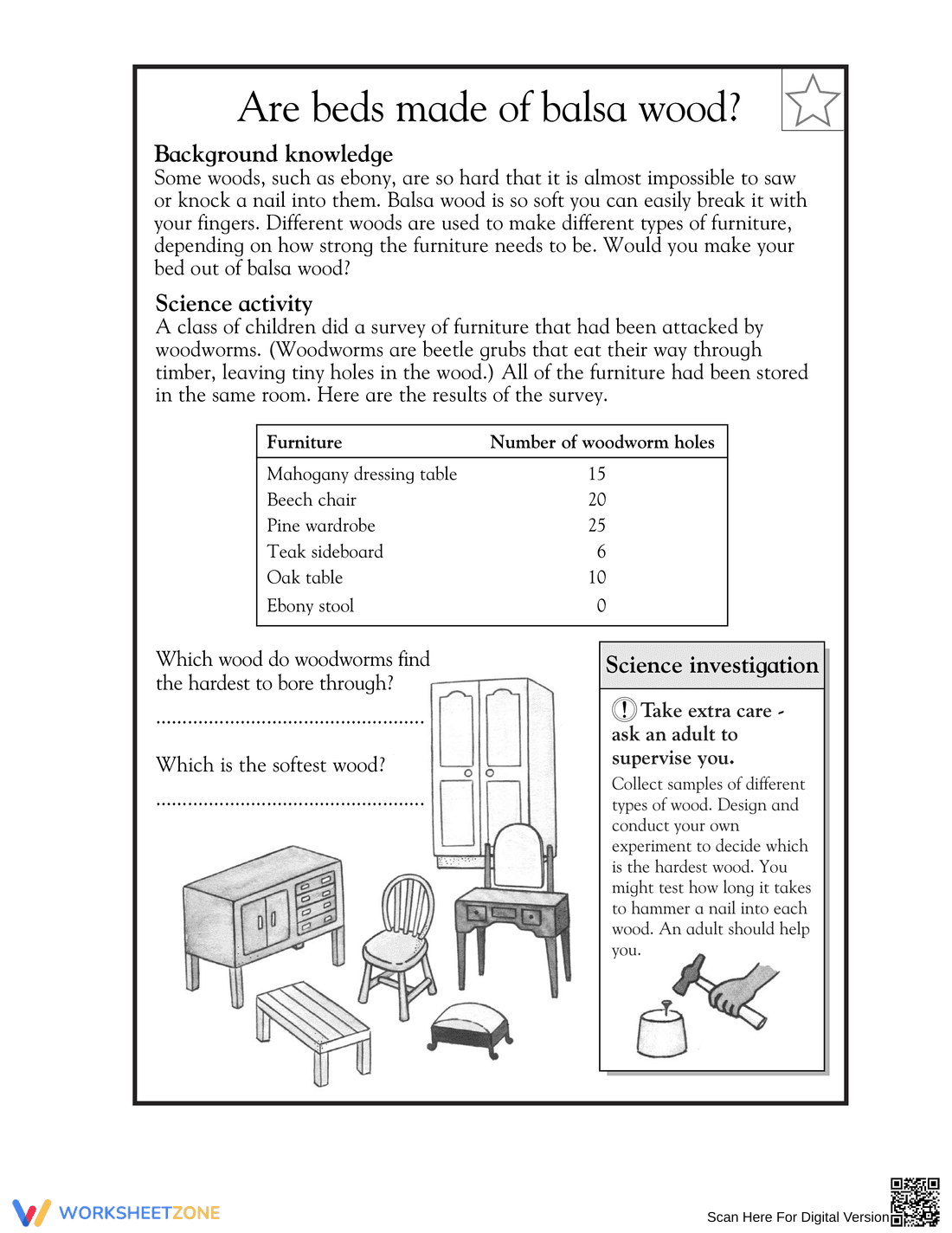
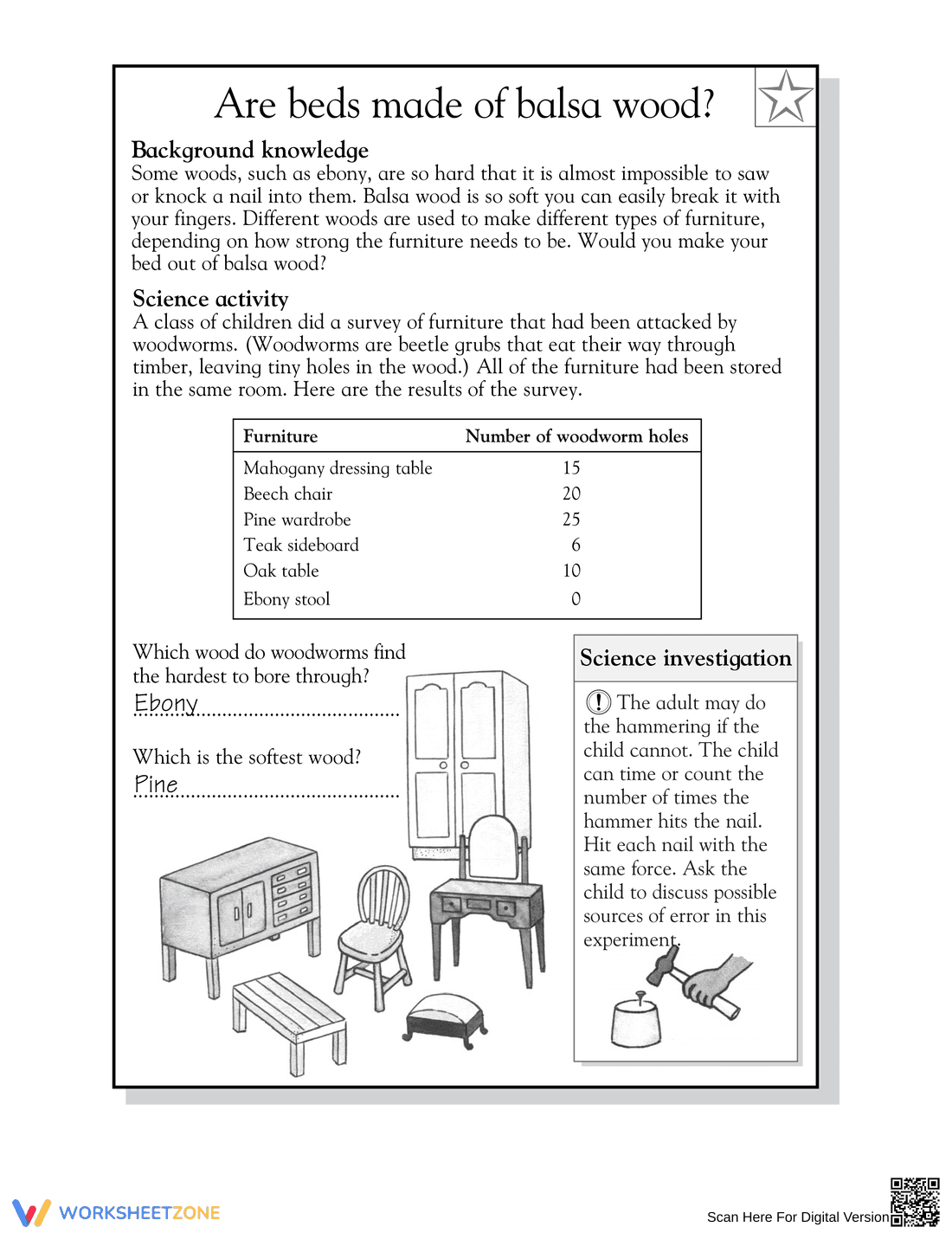
This Grade 3-4 science worksheet helps students master material properties by analyzing real-world data about wood hardness. Students interpret a survey of woodworm activity to draw evidence-based conclusions. By connecting biological interactions with physical characteristics, learners develop the analytical skills necessary for scientific inquiry.
At a Glance
- Grade: 3-4 · Subject: Science
- Standard:
3-5-ETS1-3— Plan and carry out fair tests to identify material properties- Skill Focus: Data analysis and material properties
- Format: 1 page · 3 tasks · Answer key included · PDF
- Best For: Independent practice or small group science
- Time: 20–30 minutes
What's Inside
This resource features a "Background Knowledge" section comparing ebony and balsa wood to establish a baseline for density. The core activity presents a data table listing six furniture types and woodworm holes. Students complete 3 tasks: identifying the hardest wood, identifying the softest wood, and outlining a "Science Investigation" to test properties using simple tools.
Zero-Prep Workflow
The zero-prep workflow for this resource is designed for maximum efficiency in busy classrooms. Teachers can follow these three simple steps to implement the lesson:
- Print: Generate copies of the single-page PDF in under 30 seconds for your entire class.
- Distribute: Hand out the worksheets with zero prior teacher setup or material gathering required.
- Review: Utilize the included answer key for a quick five-minute progress check or student self-correction.
This streamlined process makes it an ideal choice for substitute lesson plans or end-of-unit reviews.
Standards Alignment
This resource is directly aligned to the NGSS standard `3-5-ETS1-3`, which requires students to plan and carry out fair tests to identify aspects of a model that can be improved. Additionally, it supports CCSS Math standard `3.MD.B.3` by requiring students to interpret data presented in a categorical table. Both standard codes can be copied directly into lesson plans or IEP goals.
How to Use It
Use this worksheet during the "Explain" phase of a 5E science lesson on material properties. After introducing density, have students work independently to solve the woodworm puzzle as a formative assessment. Teachers should observe if students can correctly correlate a higher number of holes with "softer" wood. This activity typically takes 20 to 30 minutes to complete.
Who It's For
This worksheet is designed for third and fourth-grade students transitioning from observational science to data-driven analysis. It provides necessary scaffolding for English Language Learners through clear background text and visual cues. It pairs naturally with a physical collection of wood samples or a digital anchor chart detailing the Mohs scale of hardness.
Scientific literacy in the elementary years depends on the ability to translate raw data into conceptual understanding. This worksheet addresses NGSS standard 3-5-ETS1-3 by challenging students to use woodworm infestation rates as a proxy for material hardness. According to Fisher & Frey (2014), the use of "Background Knowledge" sections combined with data interpretation tasks supports the gradual release of responsibility, moving students from guided reading to independent experimental design. By requiring students to plan a "fair test" using hammers and nails, the resource bridges the gap between theoretical properties and physical evidence. Research from the NAEP indicates that students who engage in regular data-modeling activities show significantly higher proficiency in scientific reasoning. This 1-page PDF provides a structured environment for Grade 3-4 learners to practice these essential skills while maintaining a low-barrier entry for classroom implementation.


