


























Views
Downloads


Essential April Fools' Day Newspaper Report | Grades 3-12
Paste this activity's link or code into your existing LMS (Google Classroom, Canvas, Teams, Schoology, Moodle, etc.).
Students can open and work on the activity right away, with no student login required.
You'll still be able to track student progress and results from your teacher account.
This comprehensive April Fools' Day Newspaper Report worksheet guides students through the complete journalistic process of creating a fictional prank story. By blending creative narrative with formal informational structures, students learn to organize ideas effectively while engaging in a high-interest holiday activity. It is the perfect tool for developing descriptive writing and structural organization skills.
At a Glance
- Grade: 3–12 · Subject: ELA
- Standard:
W.5.3— Write narratives to develop imagined experiences using effective technique and clear event sequences- Skill Focus: Newspaper Report Structure
- Format: 3 pages · 13 tasks · Answer key not included · PDF
- Best For: Creative writing and journalistic structure practice
- Time: 45–60 minutes
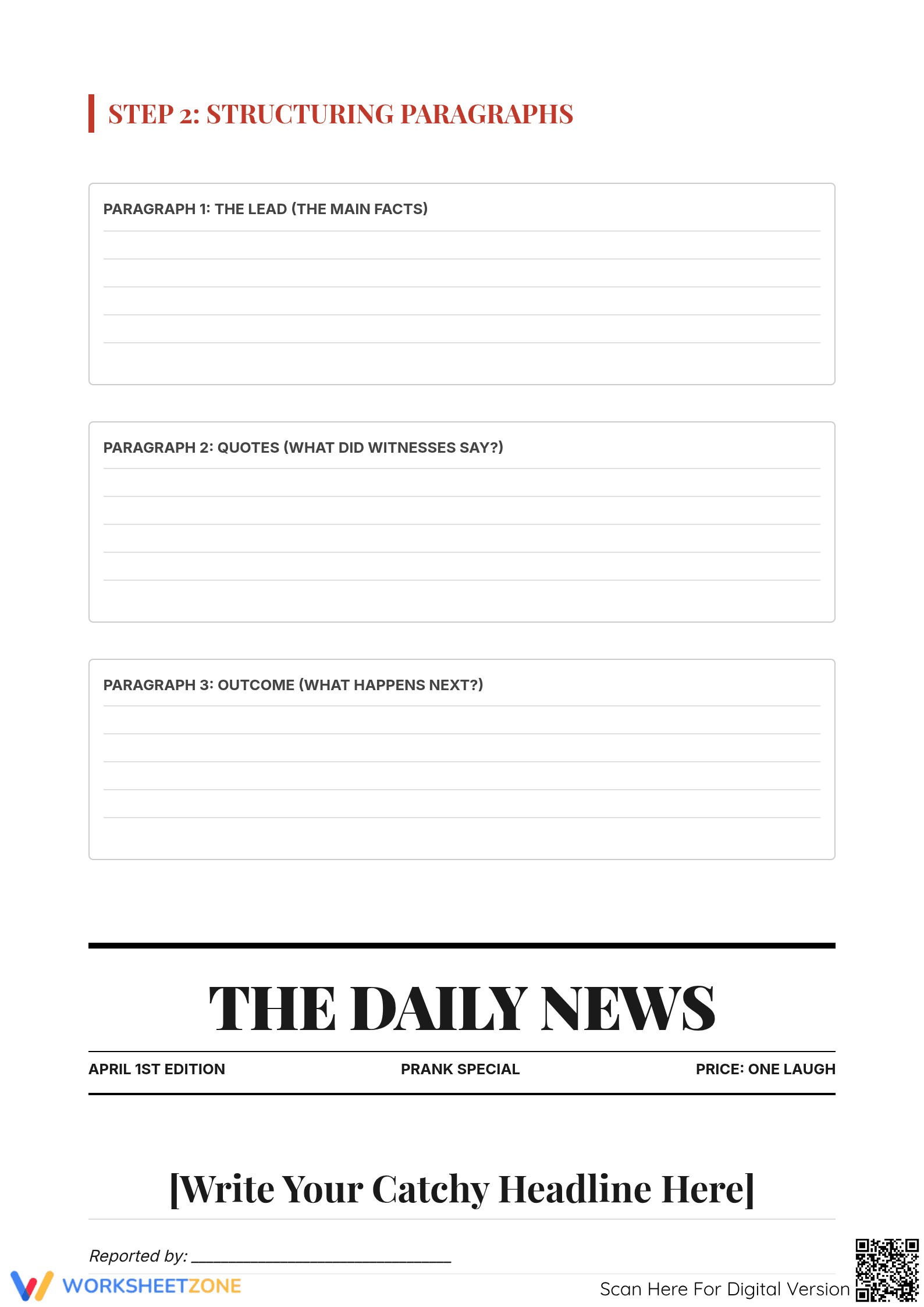
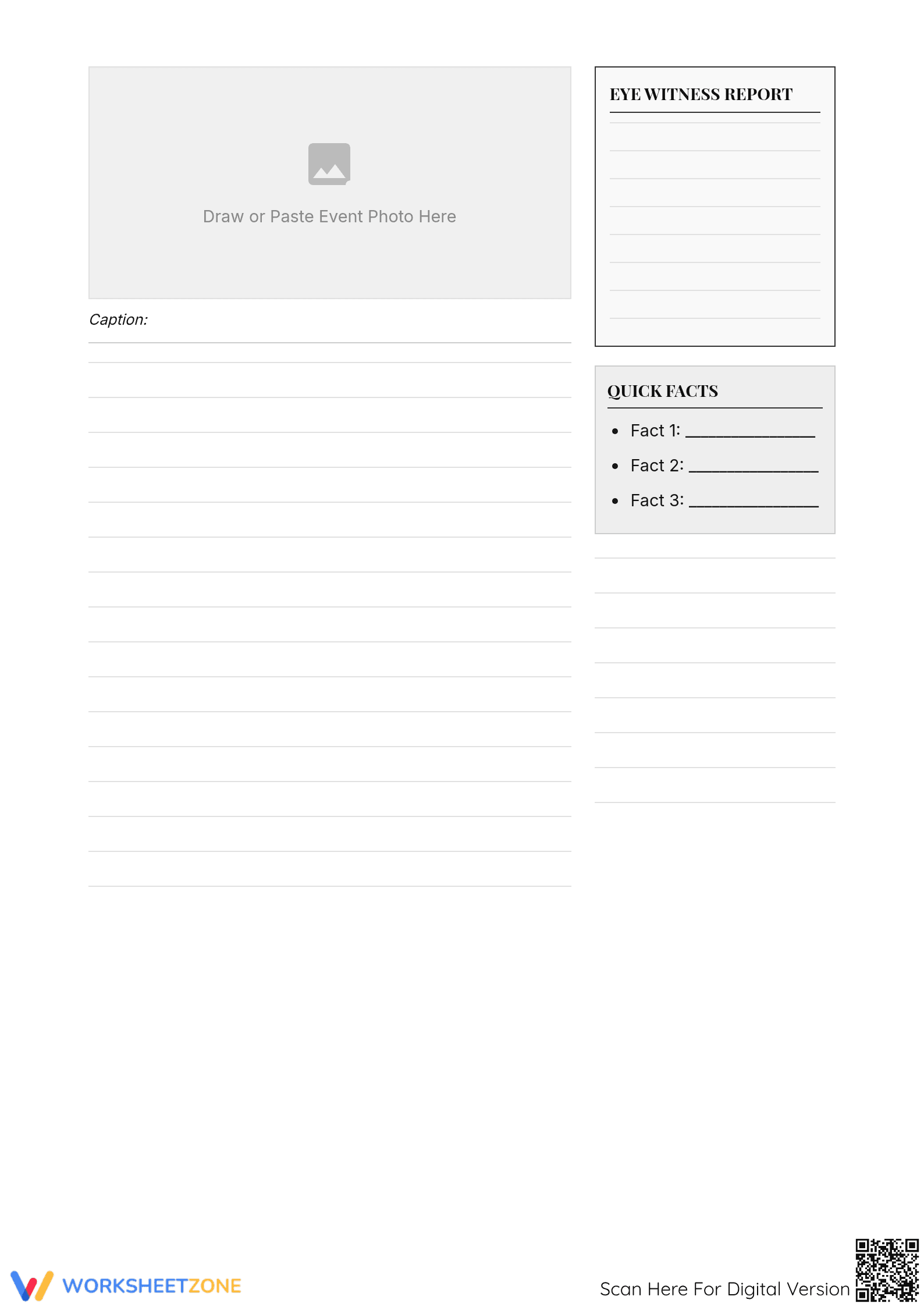
This three-page instructional packet provides a scaffolded approach to creative journalism. Page one features a robust planning organizer covering the "5 Ws" and "How." Page two transitions into paragraph structuring with dedicated spaces for lead facts, witness quotes, and outcomes. The final page offers a professional newspaper layout template, including a photo box, caption space, and an "Eye Witness" sidebar.
The worksheet follows a clear three-step release of responsibility. Guided Planning uses six graphic organizers to help students brainstorm headlines and character details. Supported Drafting provides structural prompts for three paragraphs, ensuring logical flow. Finally, Independent Publishing challenges students to synthesize their work into a formatted report. This scaffolded approach ensures mastery of journalistic narrative.
Aligned primarily with `CCSS.ELA-LITERACY.W.5.3`, this resource focuses on establishing a situation and organizing an event sequence that unfolds naturally. It also supports `W.5.2` by requiring students to develop a topic with facts and details. Both standard codes can be copied directly into lesson plans, IEP goals, or district curriculum mapping tools.
Use this as a standalone creative writing project on April 1st or as a concluding assessment for a unit on journalism. For a formative check, observe how students transition from their "Who/What/Where" notes to their lead paragraph on page two. Students typically require 50 minutes to move from initial brainstorming to the final polished draft.
Designed for elementary through high school learners, this worksheet is ideal for mixed-ability classrooms. The clear visual scaffolds support English Language Learners (ELL) while the open-ended nature of the prank story allows advanced writers to experiment with complex irony. Pair this with a local newspaper or digital news article to analyze real-world report structures.
The April Fools' Day Newspaper Report leverages high-interest creative writing to reinforce core ELA-LITERACY standards, particularly W.5.3. By utilizing a newspaper format, students are required to master the inverted pyramid structure, a key component of effective communication. Fisher & Frey (2014) emphasize that scaffolded planning documents, like the three-page sequence provided here, are critical for moving students from disorganized thoughts to structured, coherent narratives. Their research on the Gradual Release of Responsibility highlights how initial brainstorming boxes reduce the cognitive load of drafting complex paragraphs. Furthermore, incorporating "Eye Witness" quotes encourages students to practice dialogue and perspective-taking, which are essential skills for narrative development according to NAEP writing frameworks. This printable resource ensures that students remain engaged while meeting rigorous academic demands for evidence-based storytelling. It provides a structured, publication-ready output that serves as a tangible artifact of student mastery in journalistic writing.


