


























Views
Downloads



Printable Grade 1 Antonyms Word Scramble: Essential Guide
Paste this activity's link or code into your existing LMS (Google Classroom, Canvas, Teams, Schoology, Moodle, etc.).
Students can open and work on the activity right away, with no student login required.
You'll still be able to track student progress and results from your teacher account.
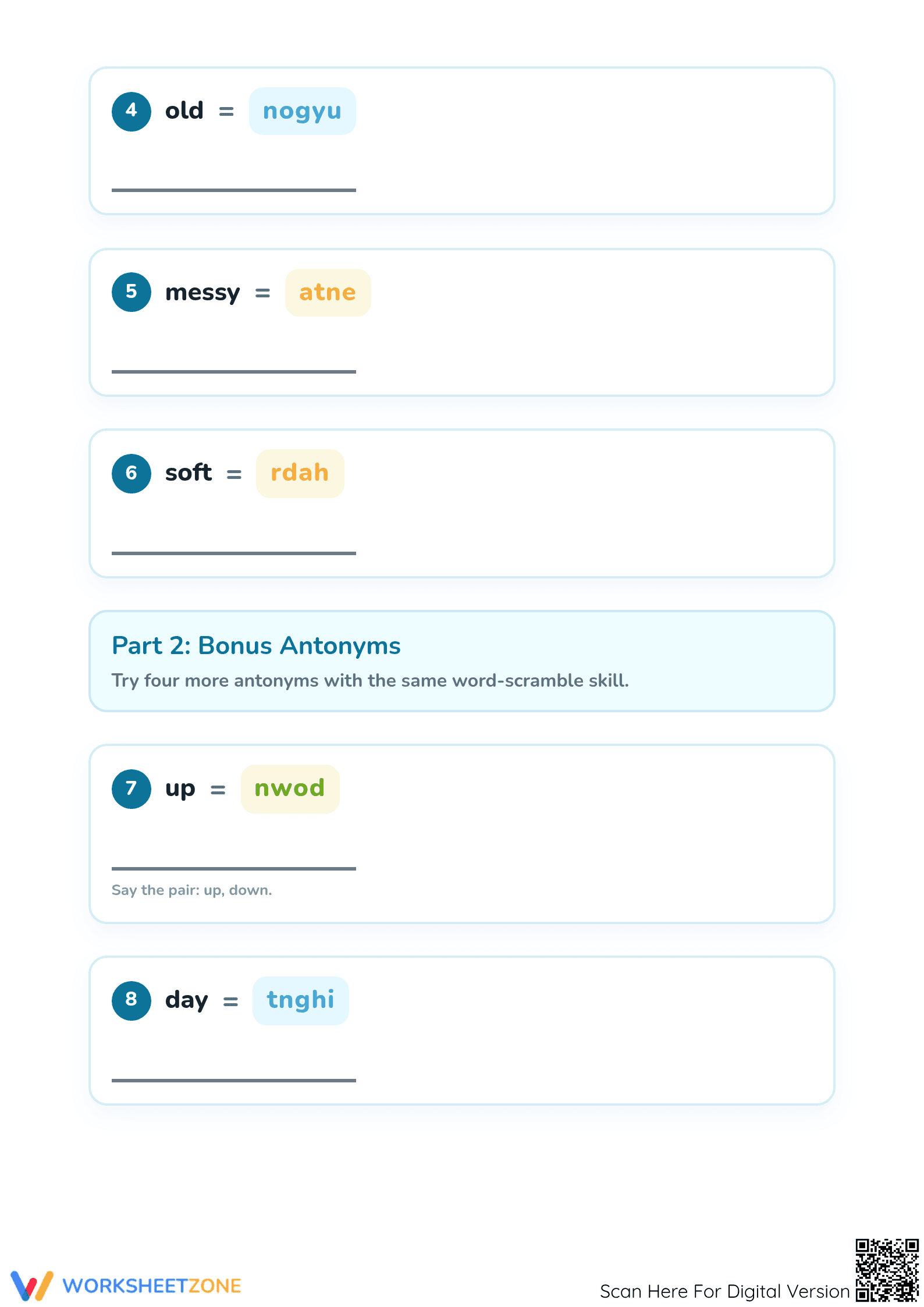
This Grade 1 antonyms worksheet helps young learners master opposite word relationships through a fun unscrambling challenge. By identifying and writing the correct antonym, students strengthen their lexical reasoning and spelling simultaneously. This resource ensures students can accurately recognize word pairs like sink/afloat and happy/sad, fostering a deeper understanding of language nuances.
At a Glance
- Grade: 1 · Subject: English Language Arts (ELA)
- Standard:
CCSS.ELA-LITERACY.L.1.5— Demonstrate understanding of word relationships and nuances in word meanings- Skill Focus: Antonyms and Word Scrambling
- Format: 3 pages · 10 problems · Answer key included · PDF
- Best For: Vocabulary practice and independent lexical centers
- Time: 15–20 minutes
The worksheet spans three pages and contains 10 distinct antonym unscrambling tasks. Each problem presents a target word (e.g., "old") paired with a scrambled version of its opposite (e.g., "nogyu"). Students must unscramble the letters to reveal the antonym ("young") and write it on the provided line. The layout is clean and spacious, featuring large text suitable for first-grade writers. A comprehensive answer key is included for quick teacher or parent grading.
Zero-Prep Workflow
This resource is designed for a seamless print-and-go experience. Step 1: Print the 3-page PDF in seconds. Step 2: Distribute to students for a morning work session or vocabulary center (approx. 1 minute). Step 3: Review student work using the visual answer key or facilitate a whole-class reading of the unscrambled pairs (approx. 5 minutes). Total teacher preparation time is under 2 minutes, making it an ideal choice for busy classrooms or unexpected substitute teacher plans.
Standards Alignment
The primary alignment is CCSS.ELA-LITERACY.L.1.5, which requires students to demonstrate understanding of word relationships. By manipulating scrambled letters to form antonyms, students engage in deep cognitive processing of word meanings. Supporting standards include CCSS.ELA-LITERACY.RF.1.3 for decoding and spelling conventions. Both standard codes can be copied directly into lesson plans, IEP goals, or district curriculum mapping tools.
How to Use It
Incorporate this worksheet as a formative assessment after a direct instruction lesson on "opposites." During the activity, circulate the room and observe students' ability to recognize common letter patterns in the scrambles—this is a key indicator of orthographic awareness. It also works exceptionally well as a low-stakes homework assignment to reinforce vocabulary taught in class. Expected completion time ranges from 15 to 20 minutes depending on individual reading speed.
Who It's For
This worksheet is specifically tailored for Grade 1 students but is also appropriate for Kindergarteners seeking an extra challenge or Grade 2 students needing a vocabulary refresher. It supports English Language Learners (ELL) by providing clear word pairings. For best results, pair this resource with a visual anchor chart displaying common antonyms to provide a scaffolded reference for students as they work through the unscrambling puzzles.
Effective vocabulary instruction in early childhood emphasizes the active manipulation of words to cement meaning and relationships. This Grade 1 antonyms worksheet aligned to CCSS.ELA-LITERACY.L.1.5 follows the "word study" approach supported by Fisher & Frey (2014), which highlights the importance of student agency in discovering word patterns. By unscrambling opposites, students are not merely memorizing lists but are actively constructing their lexical schema through problem-solving. Research from the RAND AIRS 2024 report indicates that structured practice with word relationships significantly improves long-term reading comprehension and fluency. This specific task design—combining antonym identification with a scramble—requires students to engage both semantic and orthographic memory systems. This dual-encoding process is a proven method for increasing word retention and helping students transition from simple decoding to meaningful reading. Teachers can confidently utilize this resource to meet core ELA standards while providing high-quality, research-backed instructional materials for their learners.


