




























Views
Downloads
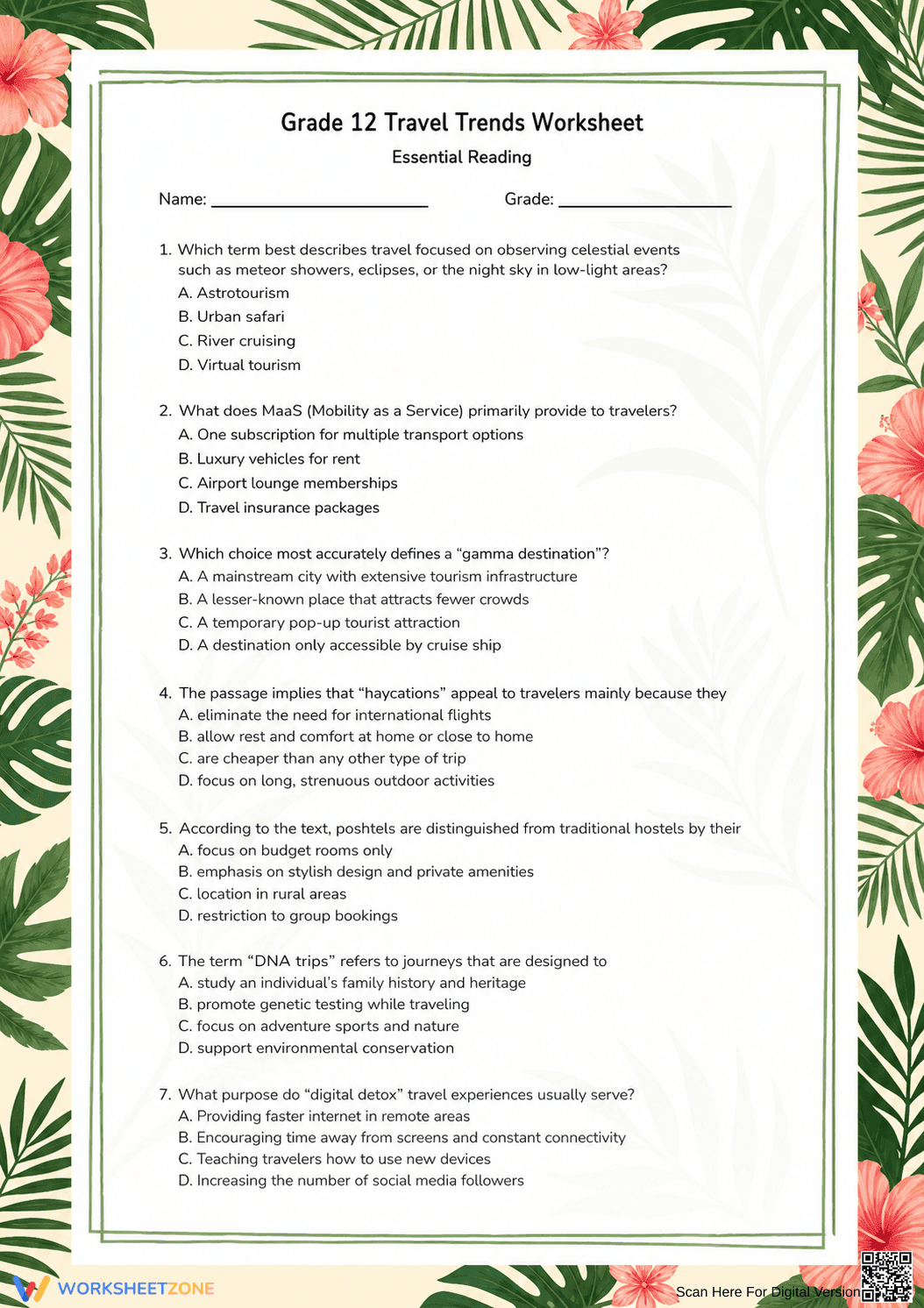

Grade 12 Travel Trends — Printable No-Prep Worksheet

Paste this activity's link or code into your existing LMS (Google Classroom, Canvas, Teams, Schoology, Moodle, etc.).
Students can open and work on the activity right away, with no student login required.
You'll still be able to track student progress and results from your teacher account.
This Grade 12 informational text worksheet challenges students to analyze modern travel phenomena through rigorous reading comprehension. By evaluating details about emerging tourism sectors, learners strengthen their ability to cite evidence and interpret complex vocabulary. It provides a structured way to assess understanding of contemporary trends.
At a Glance
- Grade: 12 · Subject: ELA
- Standard:
CCSS.ELA-LITERACY.RI.11-12.1— Cite strong textual evidence to support analysis of explicit text- Skill Focus: Reading Comprehension & Vocabulary
- Format: 1 page · 7 problems · Answer key included · PDF
- Best For: Quick assessment or sub plans
- Time: 15–20 minutes
This single-page PDF features seven multiple-choice questions testing literal and inferential comprehension. Content focuses on modern travel concepts like Astrotourism and Gamma destinations. Each question includes four options to require careful reading. A full answer key is provided for rapid grading.
Zero-Prep Workflow
- Print (1 minute): Generate the single-page document in seconds for your entire class.
- Distribute (1 minute): Hand out the worksheet as a bell-ringer or independent practice activity.
- Review (5 minutes): Use the included key to provide immediate feedback and check for understanding.
This resource requires under two minutes of total teacher prep time, making it an ideal solution for unexpected absences or transition periods in a high school setting.
Standards Alignment
The primary focus is CCSS.ELA-LITERACY.RI.11-12.1, which requires students to cite strong and thorough textual evidence to support analysis of what the text says explicitly as well as inferences drawn from the text. By selecting the correct descriptions for terms like "poshtels" and "DNA trips," students demonstrate mastery of evidence-based reading. Both standard codes can be copied directly into lesson plans, IEP goals, or district curriculum mapping tools.
How to Use It
Use this worksheet as a formative assessment after a unit on modern sociology or global economics. It works effectively as a silent starter to settle the class while the teacher takes attendance. As students work, observe their process of elimination strategies to gauge their inferencing skills. Alternatively, assign it as a homework task to reinforce vocabulary acquisition. Completion typically takes 15 to 20 minutes depending on the student's reading speed and familiarity with the topic.
Who It's For
This resource is tailored for Grade 12 students preparing for college-level reading demands. It is also highly effective for advanced ESL or ELL students who need exposure to specialized modern English vocabulary. The clear layout ensures that students remain focused on the text analysis task without unnecessary distractions. Pair this worksheet with a longer informational article on global tourism to provide a comprehensive lesson on the subject.
According to research by Fisher & Frey (2014), using complex informational texts paired with targeted text-dependent questions is essential for developing the literacy skills required for post-secondary success. This worksheet aligns with those findings by requiring students to engage with sophisticated, non-fiction content that mirrors real-world reading tasks. By focusing on CCSS.ELA-LITERACY.RI.11-12.1 to cite strong textual evidence to support analysis of explicit text, the resource ensures that Grade 12 learners are practicing the specific skill of evidence-based analysis, which is a key predictor of performance on standardized assessments. The inclusion of seven distinct tasks allows for a reliable measure of student proficiency without overwhelming the learner. This structured approach to reading comprehension supports the gradual release of responsibility model, moving students toward independent mastery of informational text analysis. Such targeted practice is a cornerstone of effective secondary ELA instruction and prepares students for the rigors of academic and professional environments.


