


























Views
Downloads

Grade 1 Animal Classification — Printable Science Worksheet
Paste this activity's link or code into your existing LMS (Google Classroom, Canvas, Teams, Schoology, Moodle, etc.).
Students can open and work on the activity right away, with no student login required.
You'll still be able to track student progress and results from your teacher account.
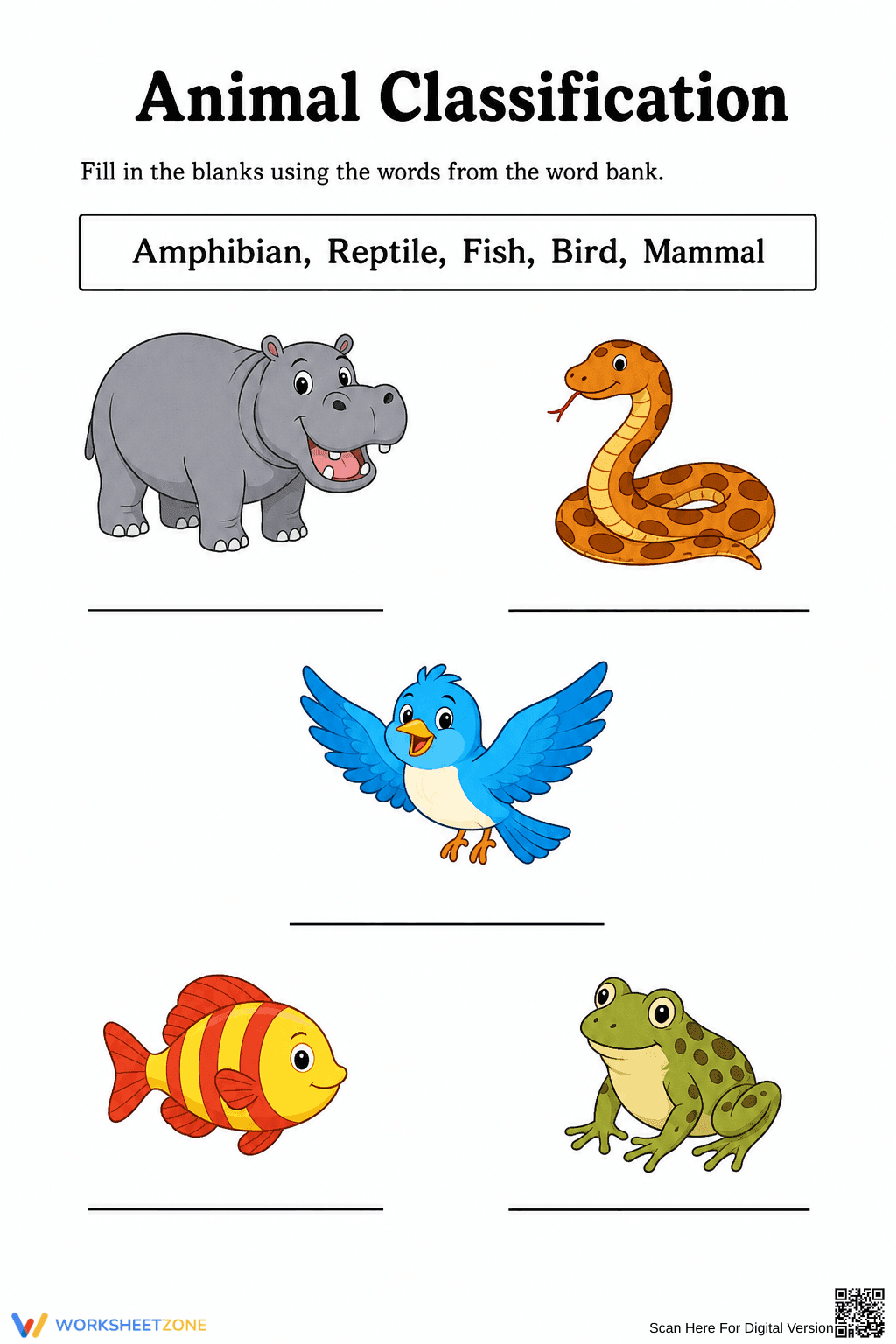
This Grade 1 animal classification worksheet helps students identify and categorize different animal groups. By using a provided word bank, young learners will match five distinct animals to their correct biological class, including mammals, reptiles, birds, fish, and amphibians, building foundational science vocabulary. This activity ensures students recognize physical traits that define specific animal families.
At a Glance
- Grade: 1 · Subject: Science
- Standard:
1-LS1-1— Identify and categorize animals by external traits- Skill Focus: Animal Classification
- Format: 1 page · 5 problems · Answer key included · PDF
- Best For: Independent practice or morning work
- Time: 10–15 minutes
What's Inside
Inside this single-page resource, educators will find a straightforward matching activity for early readers. The worksheet features five full-color illustrations of common animals: a hippopotamus, a snake, a bird, a fish, and a frog. A clear word bank provides the five target classification terms. Students select the correct term and write it on the blank line beneath the corresponding animal image.
Zero-Prep Workflow
This resource is designed for a zero-prep workflow, making it ideal for any busy teacher.
- Print (1 minute): Download the PDF and print the required copies. The layout ensures high-quality printing in grayscale.
- Distribute (1 minute): Hand out the worksheets and pencils. The prominent word bank means students have all the information they need.
- Review (3 minutes): Quickly go over the answers as a class, asking students to point out visual clues that helped them choose the correct category.
With prep time under two minutes, this activity is highly suitable for emergency sub plans or science centers.
Standards Alignment
This activity aligns with primary science frameworks, supporting 1-LS1-1 by encouraging students to observe how animals use external parts and traits to fit into biological categories. Recognizing these physical differences is the first step in understanding animal diversity. Standard codes can be copied directly into lesson plans, IEP goals, or curriculum mapping tools.
How to Use It
This worksheet serves as excellent independent practice immediately following direct instruction on animal groups. Teachers can assign it as morning work to reinforce a previous science lesson. As an observation tip, watch how students use the word bank; crossing out words indicates strong test-taking strategies. The expected completion time is 10 to 15 minutes.
Who It's For
This resource is designed for first-grade general education students, though it serves as a review for second graders or an extension for advanced kindergarteners. For students needing differentiation, teachers can pre-teach vocabulary or read the word bank aloud. It pairs naturally with introductory science anchor charts detailing differences between animal classes.
Early exposure to scientific categorization impacts long-term vocabulary retention. Structured visual matching tasks help young learners bridge the gap between everyday observations and formal terminology. This worksheet supports cognitive development by requiring students to apply vocabulary to visual stimuli. Aligning with 1-LS1-1, the activity ensures students categorize animals by external traits rather than memorizing facts. The word bank reduces cognitive overload, allowing focus on classification rather than spelling. This targeted approach ensures early learners build the schema to tackle complex life science topics later, fostering confidence and scientific literacy.


