


























Views
Downloads
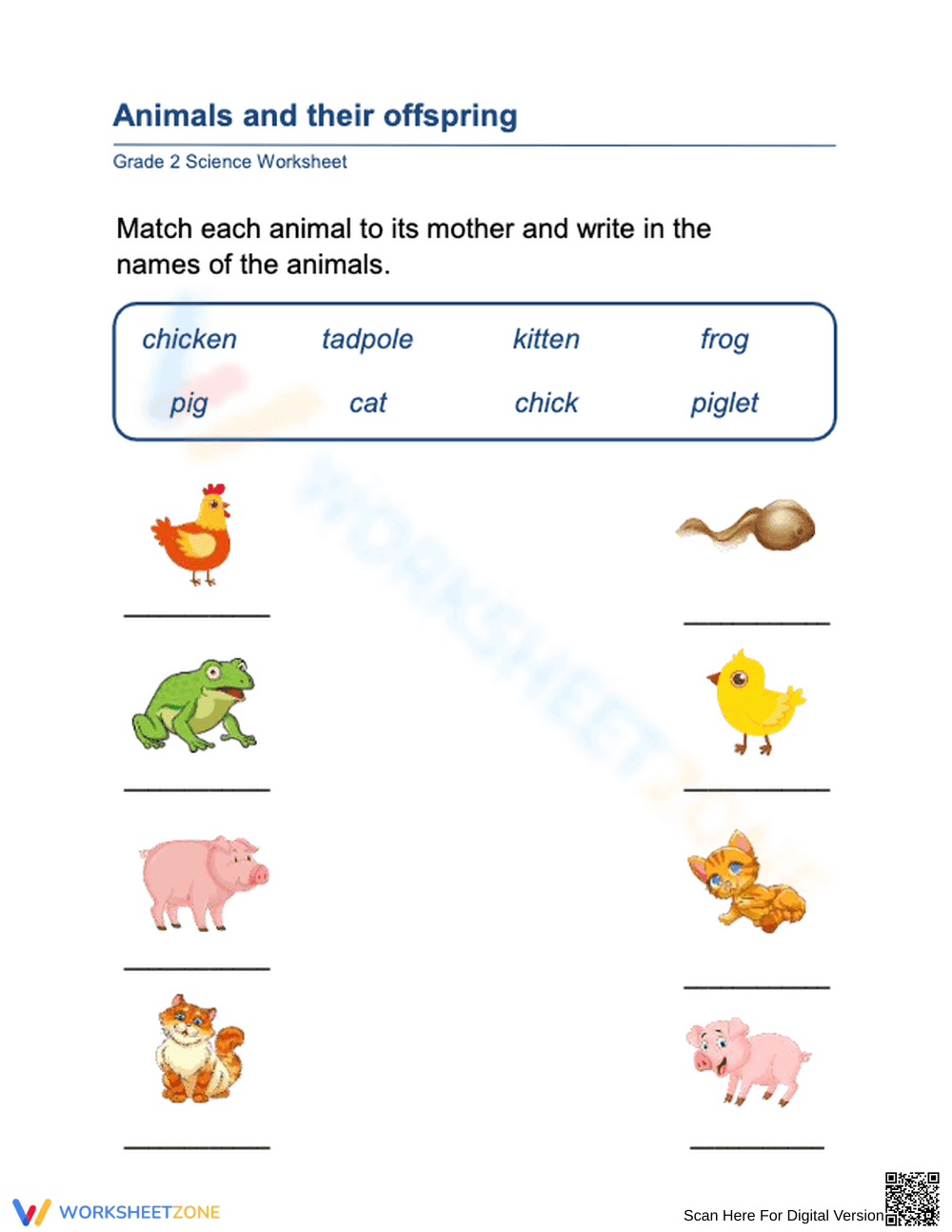

Essential Grade 1 Animals and Offspring Matching Worksheet
Paste this activity's link or code into your existing LMS (Google Classroom, Canvas, Teams, Schoology, Moodle, etc.).
Students can open and work on the activity right away, with no student login required.
You'll still be able to track student progress and results from your teacher account.
Help students master the connection between parents and their young with this focused matching activity. This worksheet enables first graders to identify physical characteristics that link adult animals to their offspring, reinforcing life science concepts. By completing the pairing tasks, learners build observation skills essential for early scientific inquiry.
At a Glance
At a Glance
- Grade: 1 · Subject: Science
- Standard:
1-LS3-1— Make observations that young animals are like, but not exactly like, their parents- Skill Focus: Parent-offspring identification and naming
- Format: 2 pages · 8 items · Answer key included · PDF
- Best For: Independent practice or quick formative assessment
- Time: 10–15 minutes
What's Inside
This two-page PDF includes a student worksheet and a corresponding answer key for rapid grading. The layout features eight high-quality illustrations of common animals (cat, pig, frog, chicken) and their young (kitten, piglet, tadpole, chick). A word bank is provided to support vocabulary and spelling, while lines under each image encourage students to practice handwriting as they label their matches.
Zero-Prep Workflow
Teachers can implement this resource in under two minutes. First, print the single-sided student page (30 seconds). Next, distribute the sheets for a 10-minute independent work block or morning warm-up. Finally, use the included answer key to review results with the class or check for accuracy in seconds. This streamlined design makes it an ideal addition to emergency sub plans.
Standards Alignment
This activity is directly aligned with `1-LS3-1`, requiring students to observe that young animals are like, but not exactly like, their parents. By matching tadpoles to frogs and kittens to cats, students observe the trait similarities that define biological inheritance. Both standard codes can be copied directly into lesson plans, IEP goals, or district curriculum mapping tools.
How to Use It
Use this worksheet during the 'Explain' phase of a life cycle lesson. After discussing how babies look like their parents, provide the worksheet as guided practice to solidify the concept. For a formative assessment tip, observe whether students correctly identify the tadpole-frog pair, as this represents complex metamorphosis. This task pairs well with direct instruction. Expected completion time is 12 minutes.
Who It's For
This resource is designed for Grade 1 students but works for Kindergarten enrichment or Grade 2 review. It supports English Language Learners through visual cues and the structured word bank. Pair this activity with a life cycle reading passage or a classroom anchor chart to provide a multi-modal learning experience for all students in the science classroom.
Early life science instruction in the primary grades relies heavily on visual literacy and the ability to categorize natural phenomena. According to Fisher & Frey (2014), the use of scaffolds like word banks and visual matching tasks significantly enhances the transition from guided to independent practice for young learners. This worksheet aligns with these evidence-based strategies by providing structured support for identifying parent-offspring relationships. By focusing on the 1-LS3-1 standard, the resource addresses the core scientific practice of making evidence-based observations. Students move beyond simple identification to recognizing the patterns of similarity and change that characterize biological inheritance. The inclusion of an answer key ensures that feedback is immediate, a critical factor in student retention. This comprehensive approach supports diverse learners in achieving mastery over the essential vocabulary and concepts required for future units on animal behavior and environmental survival.


