


























Views
Downloads
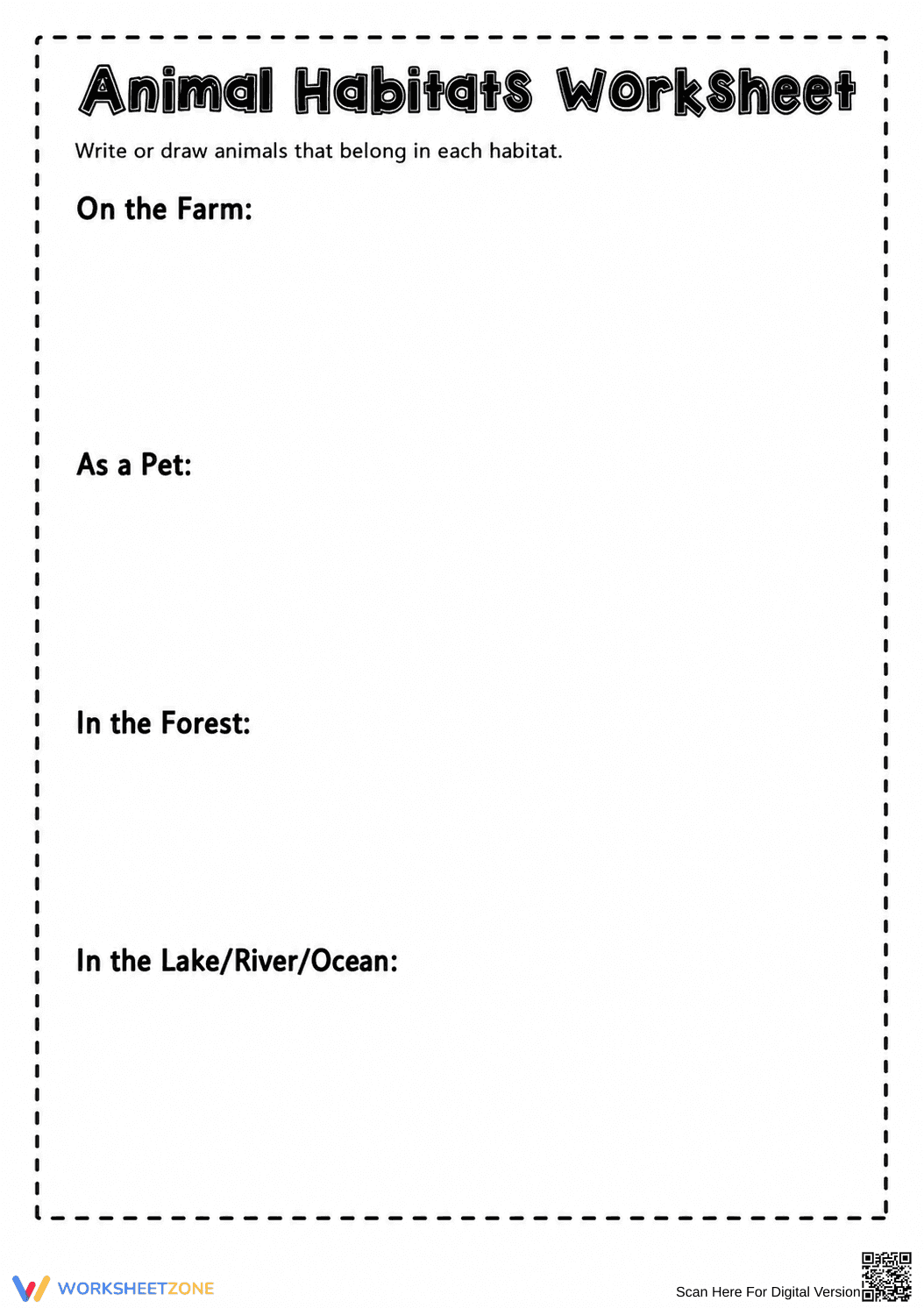

Grade 4 Animal Habitats — Printable No-Prep Worksheet
Paste this activity's link or code into your existing LMS (Google Classroom, Canvas, Teams, Schoology, Moodle, etc.).
Students can open and work on the activity right away, with no student login required.
You'll still be able to track student progress and results from your teacher account.
This Grade 4 science worksheet helps students categorize animals by their natural environments. By sorting organisms into locations like farms, forests, and oceans, learners connect animal characteristics to survival needs. Use this resource to build ecosystem vocabulary and reinforce foundational biology concepts.
At a Glance
- Grade: 4 · Subject: Science
- Standard:
4-LS1-1— Categorize animals by their natural habitats- Skill Focus: Animal Classification
- Format: 1 page · 4 problems · Answer key included · PDF
- Best For: Independent practice
- Time: 15–20 minutes
This single-page printable features four categorization zones: "On the Farm," "As a Pet," "In the Forest," and "In the Lake/River/Ocean." Students generate lists or draw pictures of organisms belonging in each environment. The open-ended format encourages critical thinking, while the sample answer key provides a baseline for assessing responses.
Zero-Prep Workflow
This resource requires under two minutes of teacher preparation.
- Print (1 min): Download the PDF file and print a class set directly from your computer.
- Distribute (30 sec): Hand out the pages quickly during science block transitions or morning routines.
- Review (30 sec): Read the brief instructions aloud, noting that students can choose to write words or draw animals.
Because it requires no special materials or complex setup, this worksheet functions perfectly as an emergency sub plan or independent morning work.
Standards Alignment
This activity aligns with 4-LS1-1: Construct an argument that plants and animals have internal and external structures that function to support survival, behavior, and reproduction. It also supports fifth-grade ecosystem standards by introducing how animals interact within specific environments. Both standard codes can be copied directly into lesson plans, IEP goals, or district curriculum mapping tools.
How to Use It
Deploy this worksheet immediately after introducing basic biomes or animal classification during direct instruction. It works exceptionally well as an independent practice station or a quick formative assessment to check for understanding. As an observation tip, ask students to verbally justify their choices as you walk around the room—for example, asking why a frog belongs in the lake category rather than the forest. Expect completion within a 15 to 20 minute timeframe.
Who It's For
Designed primarily for fourth-grade science students, this resource offers natural differentiation built right into the instructions. Advanced learners can be challenged to list exotic animals or write detailed descriptions, while students needing extra support can simply draw pictures of familiar creatures. Pair this worksheet with a visual anchor chart detailing global biomes to provide additional vocabulary support for English language learners.
Effective science instruction requires students to actively organize and classify information about the natural world to build lasting comprehension. Aligning directly with 4-LS1-1, this resource prompts learners to categorize animals by their natural habitats, reinforcing the critical relationship between an organism and its environment. According to a ScienceDirect TpT Analysis, structured categorization tasks significantly improve long-term retention of biological concepts by forcing students to retrieve and apply prior knowledge rather than passively consuming facts. When students actively sort animals into distinct environmental categories, they build stronger cognitive schemas regarding ecosystem dynamics and survival structures. This foundational skill not only prepares them for more complex ecological studies in middle school but also develops essential critical thinking and scientific reasoning abilities. By integrating these targeted classification exercises into weekly classroom routines, educators can ensure a deeper, more resilient understanding of core life science principles across diverse learner populations.


