


























Views
Downloads
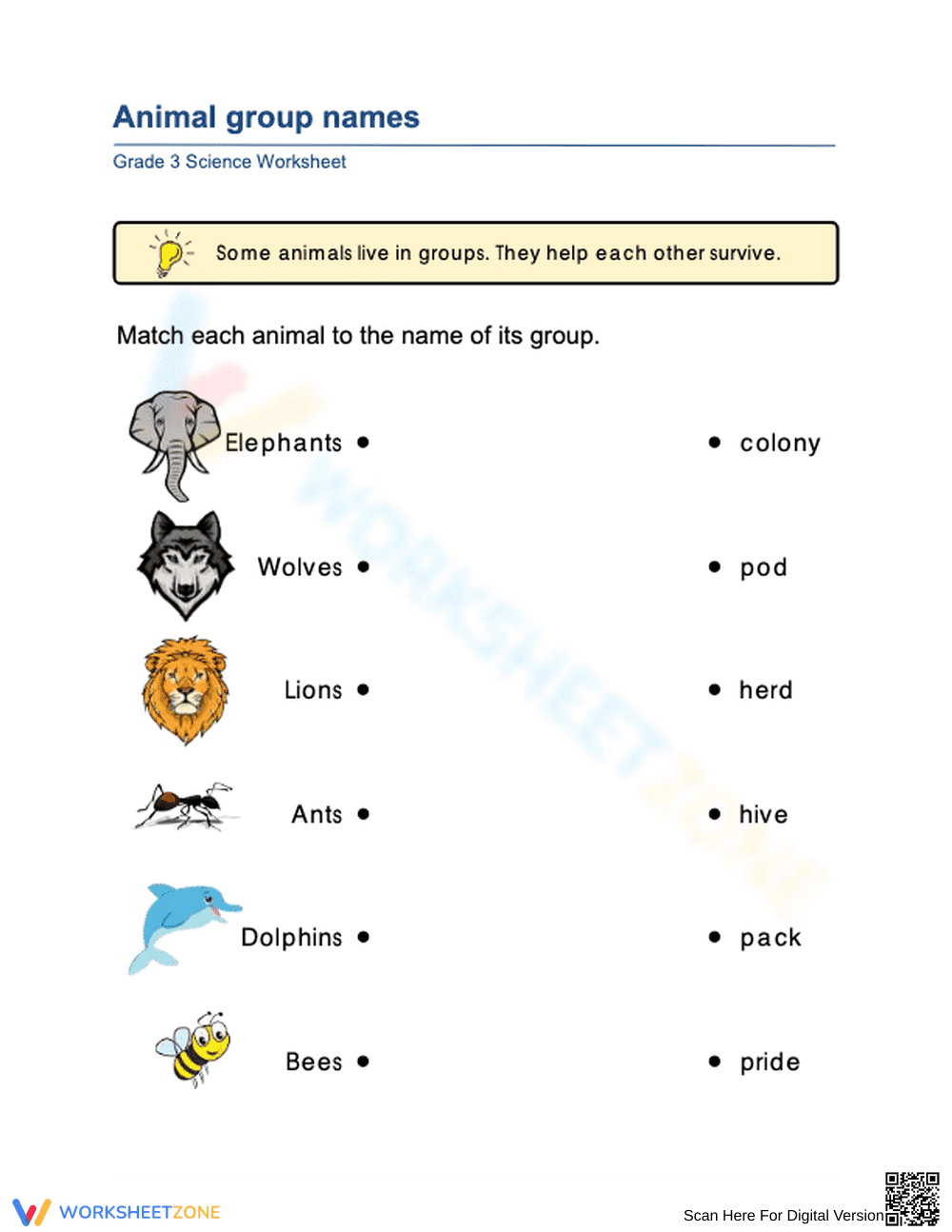

Printable Animal Group Names Worksheet | Grade 3 Science
Paste this activity's link or code into your existing LMS (Google Classroom, Canvas, Teams, Schoology, Moodle, etc.).
Students can open and work on the activity right away, with no student login required.
You'll still be able to track student progress and results from your teacher account.
This animal group names worksheet helps Grade 3 students identify collective nouns and understand social structures in the animal kingdom. By matching specific species to their unique group designations, learners explore how animals cooperate to ensure mutual survival. It is an essential tool for building biological vocabulary and foundational ecosystem concepts in elementary science.
At a Glance
- Grade: 3 · Subject: Science
- Standard:
3-LS2-1— Construct an argument that some animals form groups that help members survive- Skill Focus: Animal collective nouns and group survival
- Format: 2 pages · 6 problems · Answer key included · PDF
- Best For: Independent practice or quick science warm-ups
- Time: 10–15 minutes
What's Inside
This resource features a high-quality two-page PDF document, including a student worksheet and a corresponding answer key for rapid grading. The layout presents six distinct animals—including elephants, wolves, and dolphins—alongside a list of collective nouns like "pod," "pride," and "colony." Engaging illustrations provide visual scaffolding, reinforcing the connection between organisms and their social groups.
Zero-Prep Workflow
This worksheet is designed for maximum efficiency with a total teacher prep time of under 2 minutes. First, print the student sheet (30 seconds) and distribute it as a bell-ringer or exit ticket (1 minute). Finally, use the included answer key to review results or for self-correction (1 minute). Its clear instructions make it an ideal choice for substitute plans.
Standards Alignment
The primary alignment is 3-LS2-1, which requires students to construct an argument that some animals form groups that help members survive. By identifying that bees live in a "hive" or ants in a "colony," students understand the organizational complexity required for cooperative foraging. This standard code can be copied directly into lesson plans, IEP goals, or district curriculum mapping tools.
How to Use It
Use this worksheet as a formative assessment during a unit on animal behavior. It works best during independent practice after discussing why animals stay together. For a quick observation tip, note which students struggle with aquatic versus terrestrial group names to identify vocabulary gaps. Most students will successfully complete the matching task within 10 to 15 minutes.
Who It's For
This printable is tailored for Grade 3 and Grade 4 students exploring life science. It provides excellent support for English Language Learners (ELL) through visual cues and one-to-one matching. This resource pairs naturally with an anchor chart about animal social structures or a non-fiction passage about apex predators like wolves or lions.
Research from RAND AIRS 2024 emphasizes that structured vocabulary acquisition in science significantly improves long-term retention of ecosystem dynamics. This Grade 3 worksheet targets the 3-LS2-1 standard by requiring students to recognize that species like bees, ants, and elephants do not live in isolation. Understanding collective nouns serves as a cognitive bridge to more complex biological arguments about cooperative defense. Studies from ScienceDirect TpT Analysis suggest that visual matching tasks reduce cognitive load, allowing students to focus on the semantic relationship between the animal and its group name. By mastering these foundational terms, learners are better prepared for NAEP-aligned assessments that demand evidence-based reasoning about how group membership increases the probability of individual survival within varied habitats.


