




























Views
Downloads
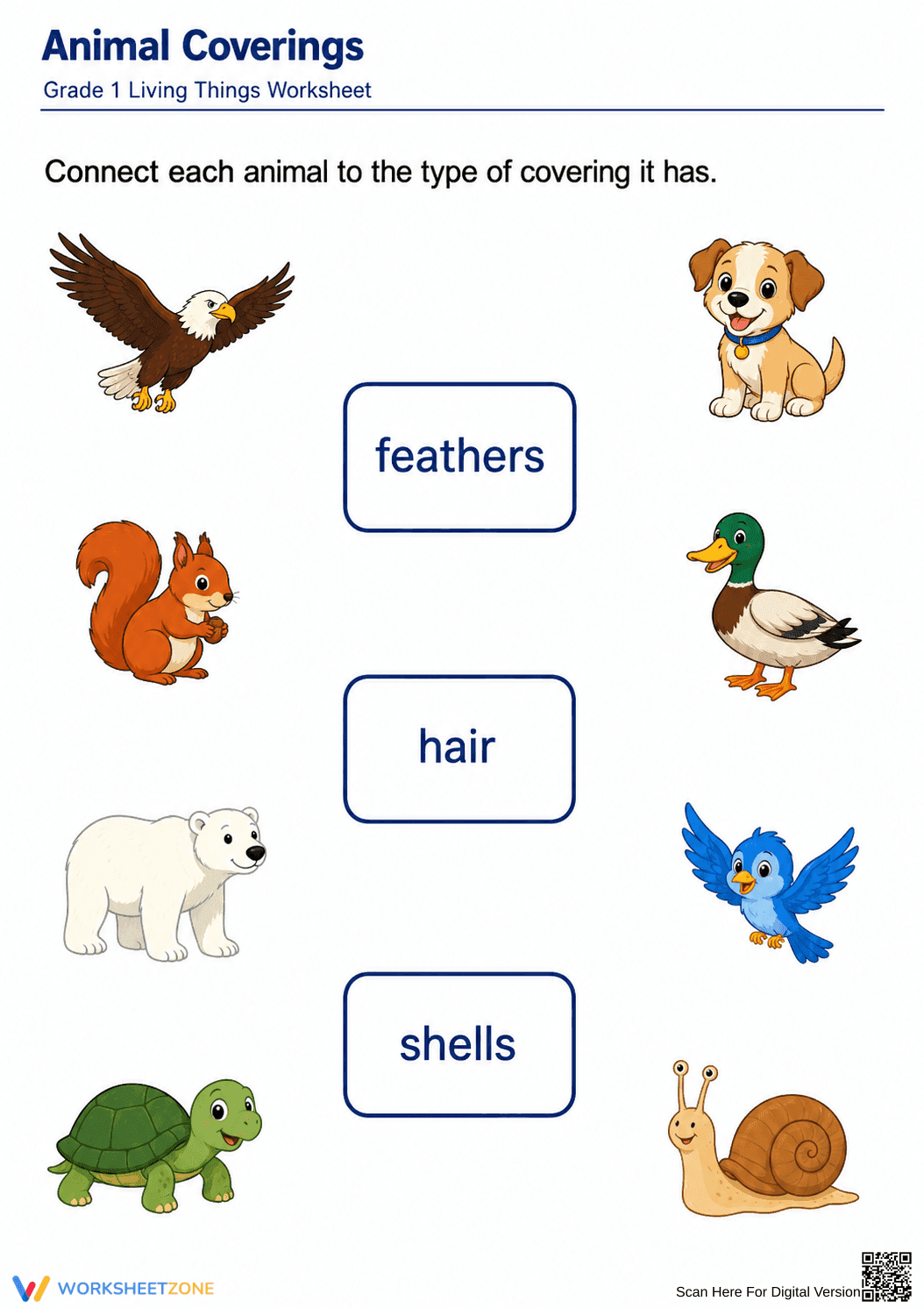

Grade 1 Animal Coverings — Printable No-Prep Worksheet

Paste this activity's link or code into your existing LMS (Google Classroom, Canvas, Teams, Schoology, Moodle, etc.).
Students can open and work on the activity right away, with no student login required.
You'll still be able to track student progress and results from your teacher account.
This Grade 1 science worksheet helps students identify and categorize how different organisms protect themselves. By connecting eight diverse animals to their specific body coverings—hair, feathers, or shells—learners develop essential classification skills. This activity builds a foundational understanding of biological structures and how external parts help living things survive.
At a Glance
- Grade: 1 · Subject: Science
- Standard:
1-LS1-1— Identify external parts of animals that help them survive- Skill Focus: Animal body coverings (hair, feathers, shells)
- Format: 1 page · 8 problems · Answer key included · PDF
- Best For: Independent practice or science centers
- Time: 10–15 minutes
What's Inside
This high-quality printable features a single-page layout designed for maximum clarity. It includes eight animal illustrations arranged around three central category boxes for hair, feathers, and shells. The matching task requires students to draw lines connecting each animal to its correct covering. An answer key is included to facilitate quick grading.
Zero-Prep Workflow
Minimize administrative burden with this efficient resource. First, print the single-page PDF for your entire class in seconds. Second, distribute the worksheets during your science unit; the intuitive format requires under one minute of teacher explanation. Finally, review the work using the included answer key. Total teacher preparation time is under two minutes, making it an ideal choice for busy mornings or sub plans.
Standards Alignment
The worksheet is strictly aligned to 1-LS1-1: Use materials to design a solution to a human problem by mimicking how plants and/or animals use their external parts to help them survive, grow, and meet their needs. Students learn the structural differences between hair, feathers, and shells. Both standard codes can be copied directly into lesson plans, IEP goals, or district curriculum mapping tools.
How to Use It
Use this worksheet as a formative assessment after an introductory lesson on animal traits. Alternatively, place it in a science center for independent practice. During the activity, observe if students can distinguish between hair and feathers to check visual discrimination. Most first graders will complete the tasks in approximately 12 minutes, allowing for a swift transition to a group discussion about how coverings provide protection, warmth, or camouflage in nature.
Who It's For
This resource is tailored for Grade 1 students but works well for kindergarten enrichment or Grade 2 review. It is particularly effective for English Language Learners (ELLs) due to the heavy reliance on visual cues and simple vocabulary. Pair this worksheet with a short informational text or an anchor chart showing animal body parts to provide a comprehensive learning experience for visual learners.
The effective use of visual classification tasks in early childhood science is supported by Fisher & Frey (2014), who emphasize that gradual release of responsibility begins with clear, scaffolded independent practice. This Animal Coverings worksheet targets the 1-LS1-1 standard by requiring students to analyze the physical structures—specifically hair, feathers, and shells—that enable animals to thrive in various environments. Research indicates that connecting visual representations to specific biological categories strengthens long-term retention of scientific concepts. By providing eight distinct examples ranging from avian to aquatic life, the resource ensures a broad exposure to the diversity of living things. Such structured practice is essential for developing the cognitive frameworks necessary for more advanced studies. This 1-page PDF serves as a reliable tool for teachers seeking evidence-based resources that align with national standards while maintaining student engagement through accessible, visually-driven tasks.


