


























Views
Downloads

Animal Camouflage Worksheet | Grade 1 Essential Science
Paste this activity's link or code into your existing LMS (Google Classroom, Canvas, Teams, Schoology, Moodle, etc.).
Students can open and work on the activity right away, with no student login required.
You'll still be able to track student progress and results from your teacher account.
This Grade 1 science worksheet helps students understand the fundamental concept of animal camouflage by matching creatures to their natural environments. By identifying color patterns and habitat features, learners discover how physical traits aid survival. It provides a clear, visual introduction to biological adaptations through engaging illustrations and vocabulary practice.
At a Glance
- Grade: 1 · Subject: Science
- Standard:
1-LS1-1— Use materials to design a solution to a human problem by mimicking how plants/animals use their external parts to help them survive, grow, and meet their needs.- Skill Focus: Animal Camouflage & Habitat Matching
- Format: 2 pages · 8 tasks · Answer key included · PDF
- Best For: Introduction to animal adaptations and survival
- Time: 15–20 minutes
What's Inside
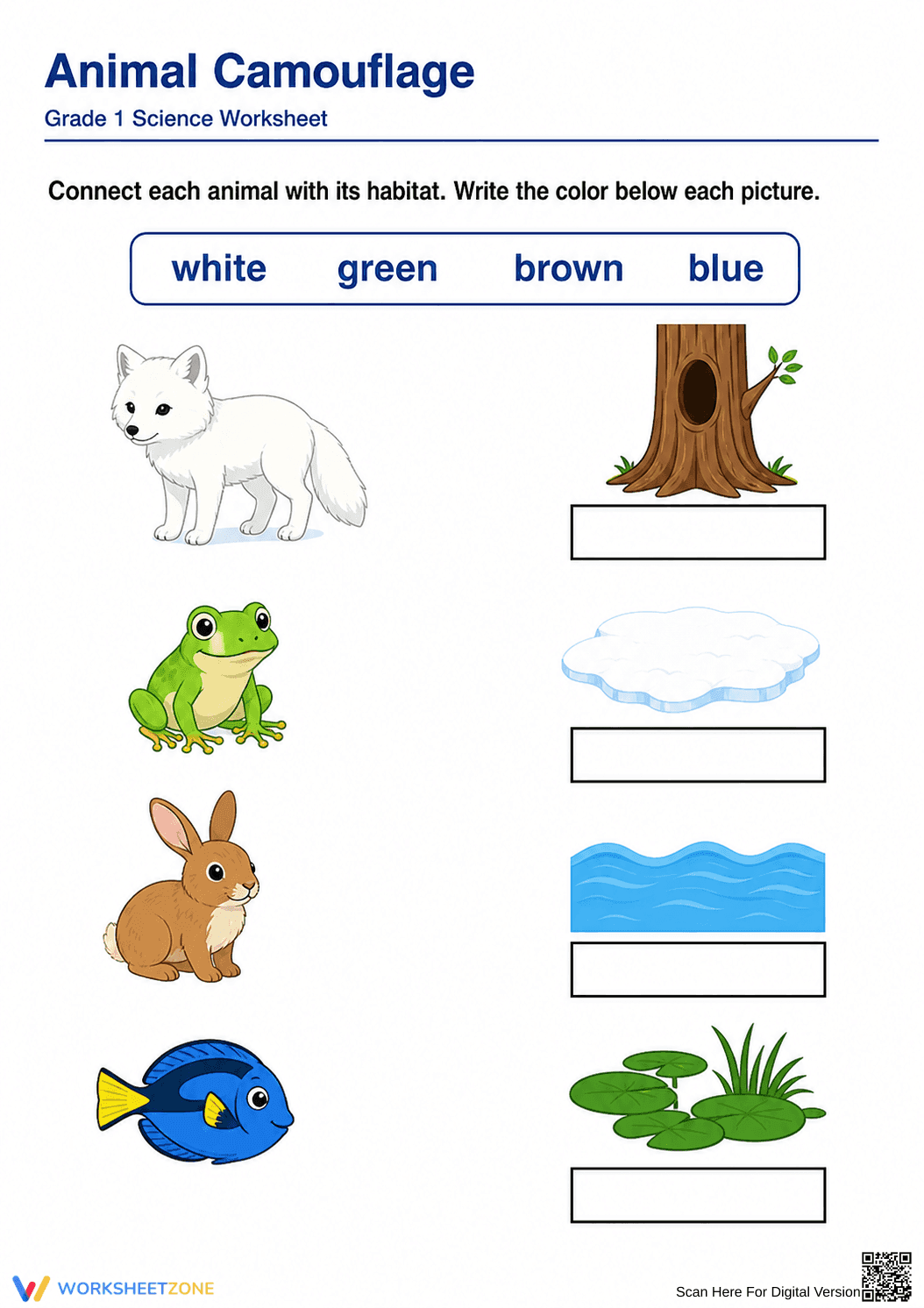
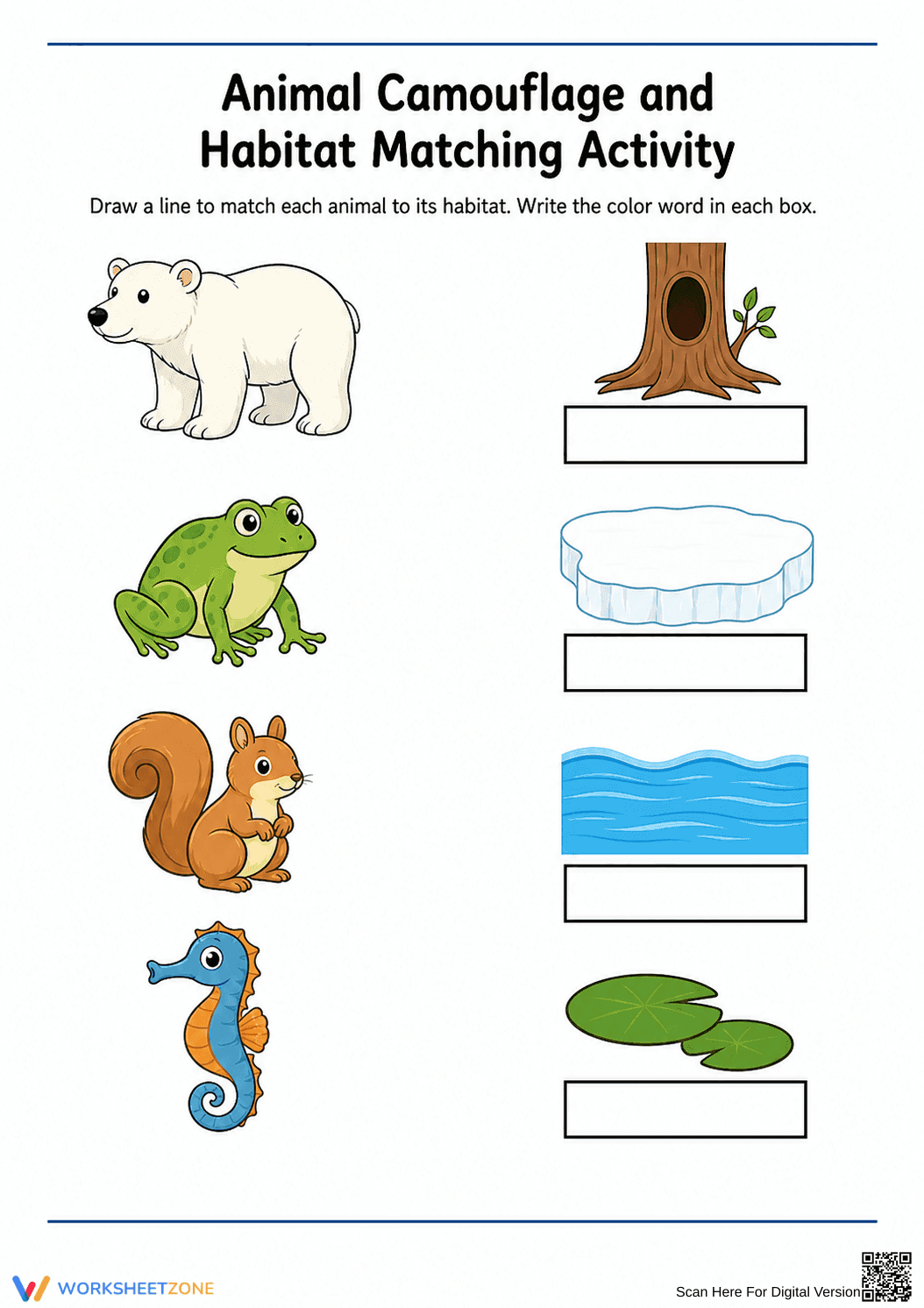
This resource contains two distinct pages of matching activities. Each page features four animals (such as a polar bear, frog, and seahorse) and four corresponding habitat scenes. Students are required to draw connecting lines and utilize a provided word bank to label the dominant camouflage colors. The layout is clean, with high-contrast illustrations suitable for both color and grayscale printing, ensuring accessibility for all classroom settings.
Zero-Prep Workflow
- Print: Select the desired page and print enough copies for your group in under 30 seconds.
- Distribute: Hand out the sheets along with pencils or crayons; no additional materials are required.
- Review: Use the included answer key to check student work or project the page for a whole-class discussion. Total teacher preparation time is under 2 minutes, making it an ideal choice for emergency sub plans or quick morning work.
Standards Alignment
The primary focus is `1-LS1-1`, which requires students to observe how animals use their external parts to survive. By matching a white fox to the snow or a green frog to lily pads, students demonstrate an understanding of how color serves as a protective structure. Both standard codes can be copied directly into lesson plans, IEP goals, or district curriculum mapping tools.
How to Use It
Use this activity during the "Explore" phase of a 5E lesson cycle on life science. After a brief discussion about why animals hide, assign the worksheet to assess student ability to pair visual traits with environmental contexts. It also serves as an excellent formative assessment tool; observe if students can explain why the brown rabbit belongs in the woods to gauge their grasp of the concept. Completion typically takes 15 to 20 minutes.
Who It's For
This resource is tailored for first-grade students but is also appropriate for kindergarteners developing fine motor skills and color recognition. It supports English Language Learners (ELLs) through the use of a word bank and clear visual cues. Pair this worksheet with a read-aloud about animal defenses or a nature walk to look for local examples of camouflage.
This Grade 1 science resource aligns with the 1-LS1-1 standard by focusing on the relationship between animal traits and environmental survival. Research by Fisher & Frey (2014) emphasizes that visual matching tasks combined with vocabulary reinforcement help young learners build the schema necessary for complex biological reasoning. By identifying specific colors like "white," "green," and "brown" in the context of habitats, students move from simple observation to understanding the functional purpose of animal adaptations. This worksheet provides 8 specific tasks that bridge the gap between basic identification and scientific inquiry. The inclusion of a word bank supports literacy development alongside core science content, ensuring that students can accurately communicate their findings. Such structured practice is essential for mastery in early elementary science, providing a foundation for future studies in ecology and evolutionary biology.


