




























Views
Downloads




Printable Conjunctions Worksheet | Grade 3 ELA Essential

Paste this activity's link or code into your existing LMS (Google Classroom, Canvas, Teams, Schoology, Moodle, etc.).
Students can open and work on the activity right away, with no student login required.
You'll still be able to track student progress and results from your teacher account.
This Grade 3 English Language Arts worksheet provides focused practice on the four primary coordinating conjunctions: and, but, or, and so. Students will improve their sentence fluency and grammatical precision by applying these connectors in three distinct formats. By the end of this activity, learners will demonstrate a clear understanding of how conjunctions link ideas and create complex sentence structures.
At a Glance
- Grade: 3 · Subject: English Language Arts
- Standard:
CCSS.ELA-LITERACY.L.3.1.H— Use coordinating and subordinating conjunctions to connect words and phrases- Skill Focus: Coordinating Conjunctions (and, but, or, so)
- Format: 4 pages · 25 problems · Answer key included · PDF
- Best For: Small group grammar practice or homework
- Time: 20–30 minutes
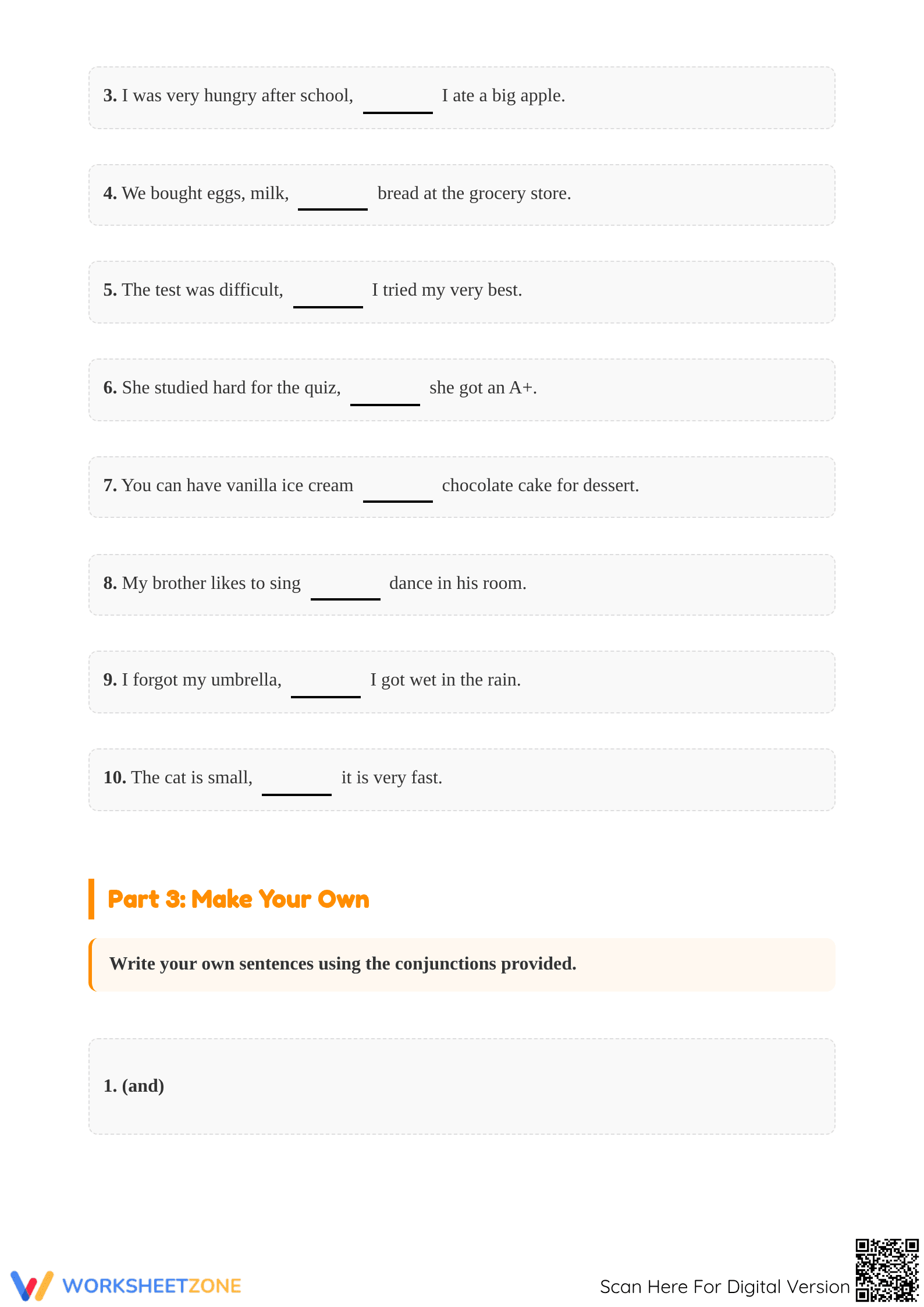
This comprehensive 4-page PDF contains three strategically designed parts to move students from recognition to application. Part 1 features a narrative cloze activity titled "Grandma's Rocking Chair," where students must select the correct conjunction to maintain logical flow. Part 2 offers 10 isolated sentence-level practice items to reinforce choice based on context. Finally, Part 3 challenges students to construct four original sentences using each conjunction independently. A full answer key is provided for efficient grading.
Skill Progression
- Guided Practice (The Story): Students work within a narrative framework, using 11 blanks to see how conjunctions create cause-and-effect or additive relationships in a continuous text.
- Supported Practice (Sentence Choice): 10 discrete items allow students to focus on the semantic differences between contrasting (but) and alternative (or) connections.
- Independent Practice (Original Writing): 4 open-ended prompts require students to generate their own context, proving they can synthesize the skill for use in their own narrative or informational writing.
This gradual release approach transitions learners from simple identification to sophisticated sentence construction through the "I Do, We Do, You Do" methodology.
Standards Alignment
The primary focus of this resource is CCSS.ELA-LITERACY.L.3.1.H, which requires students to "use coordinating and subordinating conjunctions." While specifically targeting coordinating conjunctions, this practice directly supports Producing simple, compound, and complex sentences. Both standard codes can be copied directly into lesson plans, IEP goals, or district curriculum mapping tools.
How to Use It
Incorporate this worksheet during the "guided practice" phase of a grammar lesson after introducing conjunction functions. It works exceptionally well as a diagnostic tool before a larger writing project to ensure students aren't overusing "and" or creating run-on sentences. For a formative assessment observation, check if students can explain why they chose "but" over "so" in Part 2. Completion usually takes 25 minutes.
Who It's For
This resource is designed for general education third graders, though it serves as an excellent intervention tool for fourth-grade students who struggle with sentence boundaries. It can be paired naturally with a mentor text that demonstrates rich sentence variety or a classroom anchor chart detailing conjunction meanings.
According to the RAND AIRS 2024 report on literacy instruction, explicit grammar practice embedded in contextualized reading tasks significantly improves a student's ability to produce complex syntactic structures in independent writing. This worksheet targets the specific plain-English skill of using coordinating conjunctions like "and," "but," "or," and "so" to link ideas logically. By aligning with CCSS.ELA-LITERACY.L.3.1.H, the resource provides the necessary repetition required for mastery of sentence-level mechanics. Fisher & Frey (2014) emphasize that such scaffolds are vital for transitioning elementary learners from simple sentences to the compound structures required for middle school readiness. The inclusion of a narrative cloze activity ensures that conjunctions are not viewed as isolated vocabulary words but as essential tools for narrative cohesion and clarity within a text.


