


























Views
Downloads
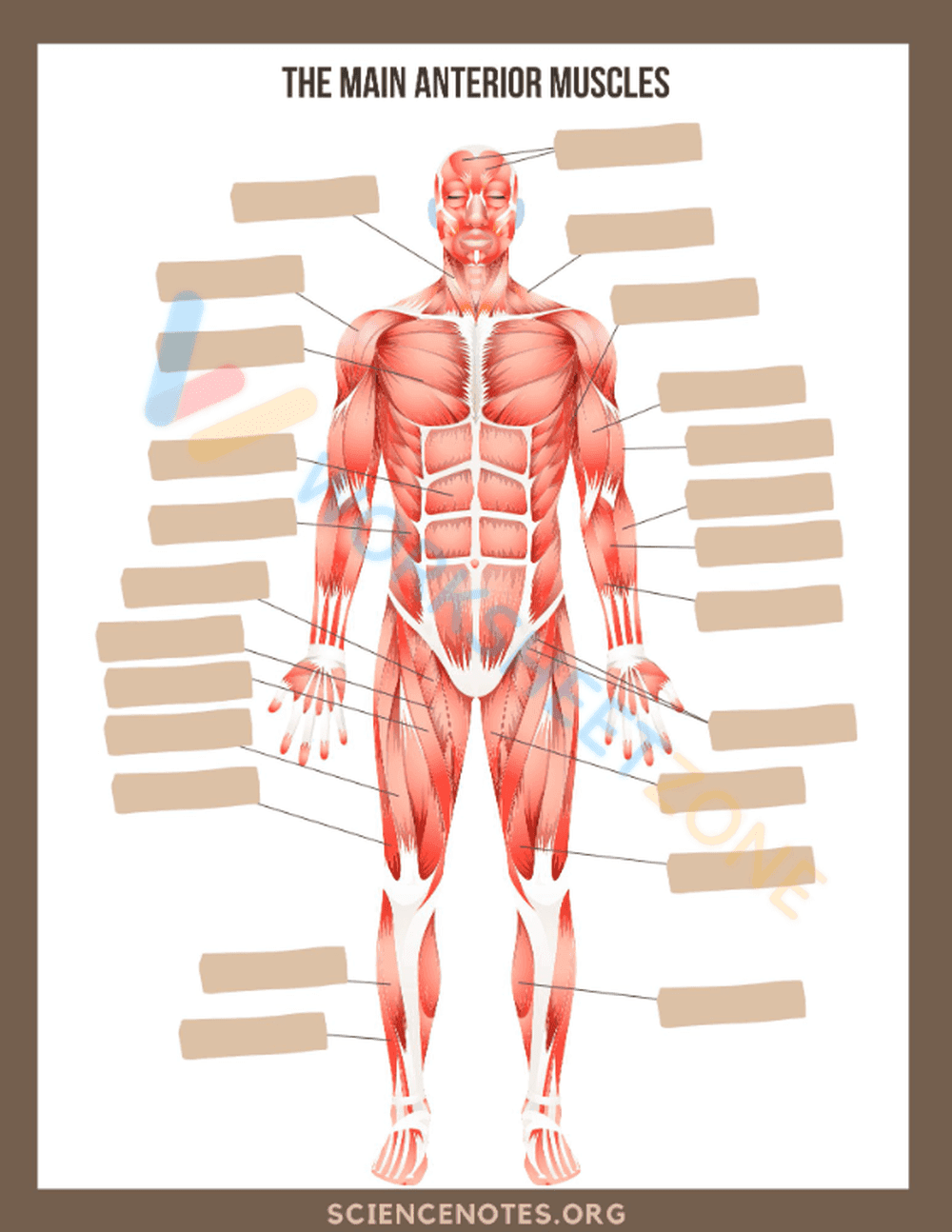

Grade 4-6 Anterior Muscles — Printable No-Prep Worksheet
Paste this activity's link or code into your existing LMS (Google Classroom, Canvas, Teams, Schoology, Moodle, etc.).
Students can open and work on the activity right away, with no student login required.
You'll still be able to track student progress and results from your teacher account.
This Grade 4-6 anatomy worksheet helps students identify and label the major anterior muscles of the human body. By engaging with a detailed anatomical diagram, learners develop a concrete understanding of the muscular system's structure. This resource provides a clear visual guide for students to master biological terminology and physiological locations.
At a Glance
- Grade: 4-6 · Subject: Science
- Standard:
4-LS1-1— Identify internal and external structures that support survival and growth- Skill Focus: Muscular system identification
- Format: 1 page · 22 problems · Answer key included · PDF
- Best For: Anatomy unit review or assessment
- Time: 15–25 minutes
What's Inside
This single-page PDF features a high-quality medical illustration of the human muscular system from the anterior perspective. It contains 22 distinct labeling tasks pointing to major muscle groups, including the pectorals, abdominals, quadriceps, and deltoids. The layout is clean and professional, providing ample space for student handwriting within the designated label boxes to ensure clarity during review.
Zero-Prep Workflow
- Print: Generate the required number of copies for your class in under one minute.
- Distribute: Hand out the diagrams as a bell-ringer activity or a quiet individual assessment.
- Review: Use the included answer key for rapid grading or to facilitate a whole-class peer-review session.
This streamlined workflow makes it an ideal choice for substitute teacher folders or last-minute review sessions before a unit test.
Standards Alignment
This resource aligns with 4-LS1-1, which requires students to construct an argument that plants and animals have internal and external structures that function to support survival, growth, behavior, and reproduction. By identifying specific muscle groups, students gain the vocabulary necessary to explain how the muscular system facilitates movement and protection. Both standard codes can be copied directly into lesson plans, IEP goals, or district curriculum mapping tools.
How to Use It
Use this worksheet during the "Explain" phase of a 5E lesson cycle after students have explored muscle models or digital simulations. It serves as an excellent formative assessment to gauge student retention of anatomical terms. For a collaborative approach, have students work in pairs to locate the muscles on their own bodies while filling out the diagram, which typically takes 20 minutes.
Who It's For
This worksheet is designed for upper elementary and middle school students in Grades 4, 5, and 6 studying life science or biology. It is particularly effective for visual learners who benefit from spatial associations between terms and physical locations. It pairs naturally with a muscular system anchor chart or a short instructional video on human physiology.
According to the NAEP Science Framework, understanding the organization of living systems is a fundamental component of biological literacy. This worksheet addresses the need for precise anatomical vocabulary, which Fisher & Frey (2014) identify as a critical factor in developing disciplinary literacy within the sciences. By requiring students to map 22 specific anterior muscles, the activity reinforces the relationship between structure and function as outlined in the 4-LS1-1 standard. Research from the RAND AIRS 2024 report suggests that high-quality visual aids in science instruction significantly improve the retention of complex biological systems among diverse learners. This resource provides the structured practice necessary for students to move from basic recognition to mastery of the human muscular system, ensuring they are prepared for more advanced physiological studies in later grades.


