


























Views
Downloads
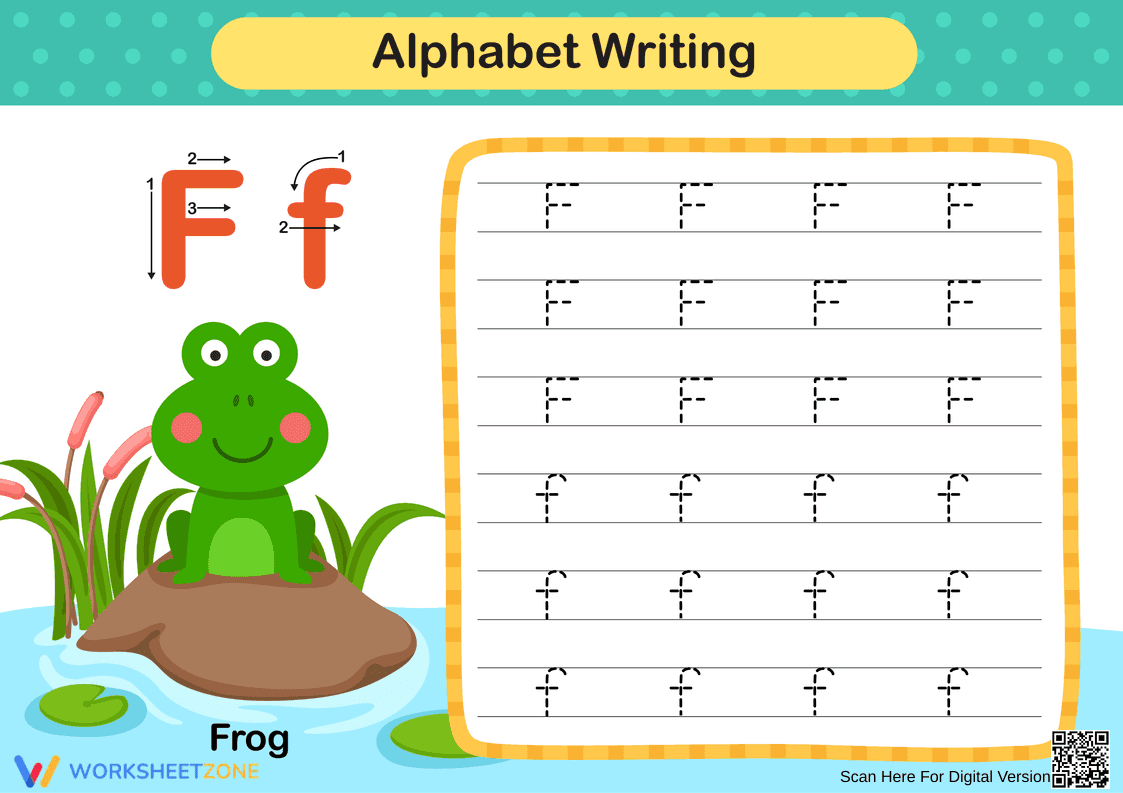

Alphabet Writing F Worksheet | Essential Grade K Practice
Paste this activity's link or code into your existing LMS (Google Classroom, Canvas, Teams, Schoology, Moodle, etc.).
Students can open and work on the activity right away, with no student login required.
You'll still be able to track student progress and results from your teacher account.
This Alphabet Writing F worksheet provides foundational handwriting practice for early learners. By focusing on the specific motor movements required for the letter F, students develop the muscle memory necessary for fluent writing. This resource ensures that children transition from simple recognition to active production of both uppercase and lowercase forms through guided repetition.
At a Glance
- Grade: Kindergarten · Subject: ELA
- Standard:
CCSS.ELA-LITERACY.L.K.1.A— Print many upper- and lowercase letters accurately and legibly- Skill Focus: Letter F formation
- Format: 1 page · 24 problems · Answer key included · PDF
- Best For: Morning work or literacy centers
- Time: 10–15 minutes
This single-page PDF features 24 distinct tracing opportunities designed for small hands. The top of the page includes a large visual guide for both uppercase "F" and lowercase "f" with numbered arrows indicating the correct stroke order. Below the instructional header, students find three rows dedicated to uppercase "F" and three rows for lowercase "f," all set on primary ruled lines to assist with letter height and baseline placement.
This resource is designed for immediate classroom integration with a zero-prep workflow. Printing takes less than 30 seconds for a full class set. Distribution is instantaneous during literacy rotations or as a quiet-time activity. Reviewing student work takes approximately 1 minute per group, as the clear tracing paths allow for quick visual assessment of pencil grip and stroke direction. Total teacher prep time is under 2 minutes.
The primary alignment for this resource is CCSS.ELA-LITERACY.L.K.1.A, which requires students to "Print many upper- and lowercase letters." This worksheet specifically targets the letter F, providing the repetitive practice required for mastery. This standard code can be copied directly into lesson plans, IEP goals, or district curriculum mapping tools to document student progress in fine motor development.
To use this worksheet effectively, assign it as a "Morning Work" activity to settle students as they arrive in the classroom. Alternatively, place the sheet in a "Writing Center" inside dry-erase sleeves for reusable practice with markers. Educators should observe students during the first row of tracing to ensure they are following the numbered stroke guides rather than drawing the letters from the bottom up.
This worksheet is ideal for Kindergarten students and Preschoolers showing advanced writing readiness. It serves as a perfect pairing for an anchor chart about the letter F or a phonics lesson featuring the "frog" keyword shown on the page.
According to Fisher & Frey (2014), the gradual release of responsibility begins with clear modeling, which the stroke-order diagrams on this worksheet provide. Research indicates that tactile tracing of letters like "F" significantly improves letter-name recognition and phonemic awareness in early childhood settings. By isolating a single letter, educators can identify specific fine motor delays or directional confusion before they become ingrained habits. This worksheet aligns with the CCSS.ELA-LITERACY.L.K.1.A standard by offering structured, repetitive practice that bridges the gap between visual identification and manual dexterity. Data from NAEP suggests that early mastery of letter formation is a strong predictor of later writing fluency and academic success. This resource provides the necessary scaffolding for students to move from guided tracing to independent production, ensuring a solid foundation for literacy development in any primary classroom environment.


