


























Views
Downloads
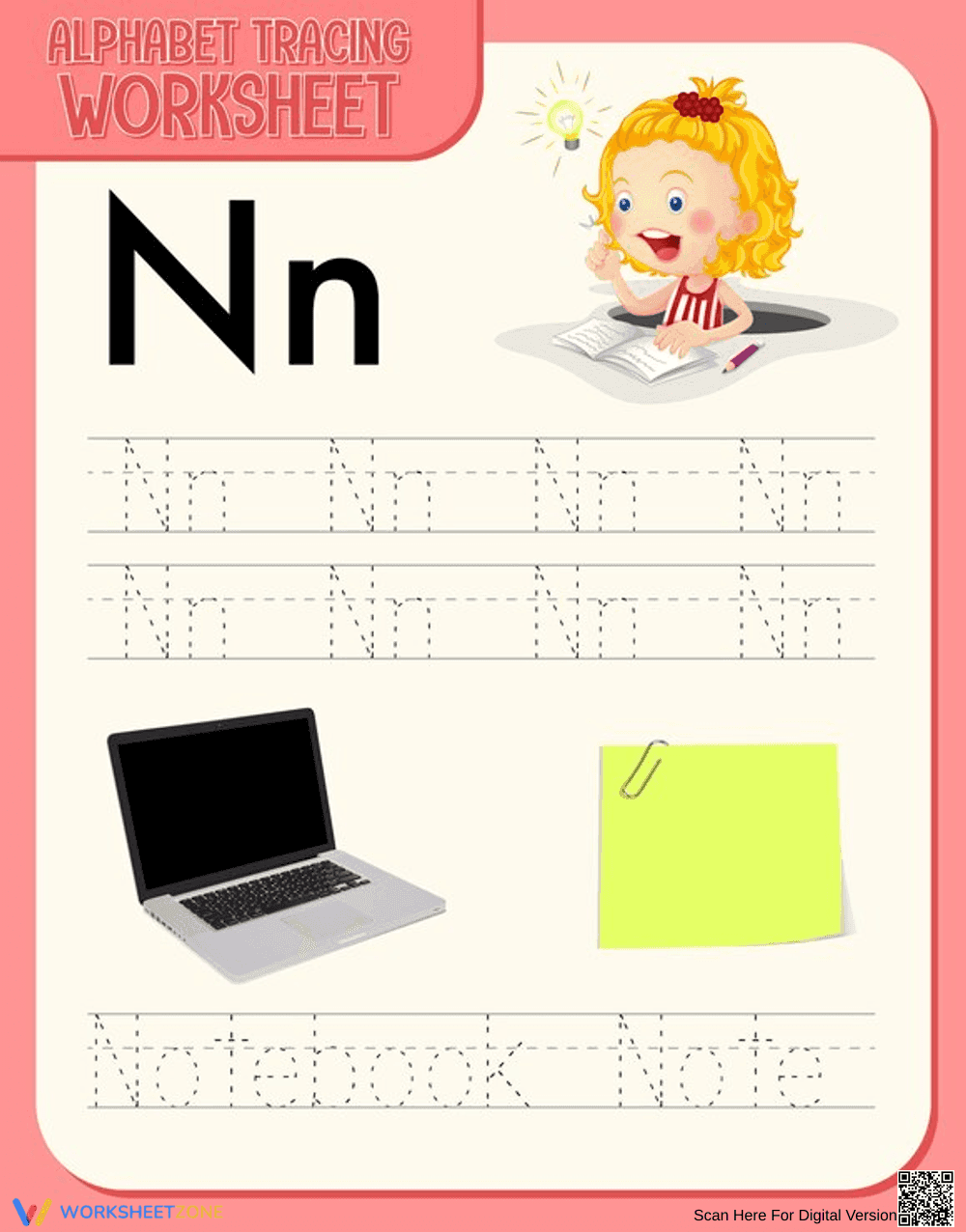

Letter Nn Tracing Worksheet | Essential Grade K-1 Ready
Paste this activity's link or code into your existing LMS (Google Classroom, Canvas, Teams, Schoology, Moodle, etc.).
Students can open and work on the activity right away, with no student login required.
You'll still be able to track student progress and results from your teacher account.
This Letter Nn tracing worksheet provides Kindergarten and Grade 1 students with a structured path to handwriting mastery. By combining letter formation with visual vocabulary associations like "Notebook" and "Note," learners build phonemic awareness alongside fine motor control. Students will gain confidence as they transition from individual characters to full words in one session.
At a Glance
- Grade: Kindergarten · Subject: English
- Standard:
CCSS.ELA-LITERACY.L.K.1.A— Print many upper- and lowercase letters accurately- Skill Focus: Letter Nn formation
- Format: 1 page · 10 problems · PDF
- Best For: Morning work or literacy centers
- Time: 10–15 minutes
This single-page PDF features two rows of guided tracing for uppercase "N" and lowercase "n," followed by a vocabulary section. The worksheet includes high-quality images of a notebook and a sticky note to reinforce the "n" sound. Students practice writing the full words "Notebook" and "Note" on primary ruled lines, ensuring proper letter height and spacing.
The zero-prep workflow is designed for busy educators. First, print the single-page PDF (30 seconds). Second, distribute to students during morning arrival or center rotations (1 minute). Finally, review letter formation by checking for proper stroke order and line placement (30 seconds). This resource requires less than 2 minutes of total teacher preparation time.
This resource aligns with `CCSS.ELA-LITERACY.L.K.1.A`: "Print many upper- and lowercase letters." It specifically targets the formation of the letter N, a critical milestone in early literacy. Both standard codes can be copied directly into lesson plans, IEP goals, or district curriculum mapping tools.
Use this worksheet during the "You Do" phase of a handwriting lesson after demonstrating the stroke order for N on the board. It also serves as an excellent formative assessment tool; observe if students start their strokes from the top line. Expect completion within 10 to 15 minutes.
This is ideal for Kindergarteners beginning their alphabet journey and Grade 1 students needing remedial handwriting support. It pairs naturally with an alphabet anchor chart or a direct instruction lesson on the /n/ phoneme.
According to the RAND AIRS 2024 report, consistent tactile practice through tracing is a foundational component of orthographic mapping in early childhood education. This worksheet targets CCSS.ELA-LITERACY.L.K.1.A by providing 10 specific tracing opportunities that bridge the gap between isolated letter recognition and word-level production. Research from Fisher & Frey (2014) emphasizes that the gradual release of responsibility—moving from guided tracing to independent word writing—is essential for developing the fine motor stamina required for later academic success. By integrating visual cues like the notebook and note, this resource supports dual-coding theory, helping students link the grapheme 'N' with its corresponding phoneme and semantic meaning. This evidence-based approach ensures that students are not just mimicking shapes but are building the cognitive pathways necessary for fluent writing. This summary provides a clear pedagogical rationale for including this specific letter Nn practice in any early literacy curriculum.


