


























Views
Downloads

All Fools' Day Reading | Essential Grade 4 History Worksheet
Paste this activity's link or code into your existing LMS (Google Classroom, Canvas, Teams, Schoology, Moodle, etc.).
Students can open and work on the activity right away, with no student login required.
You'll still be able to track student progress and results from your teacher account.
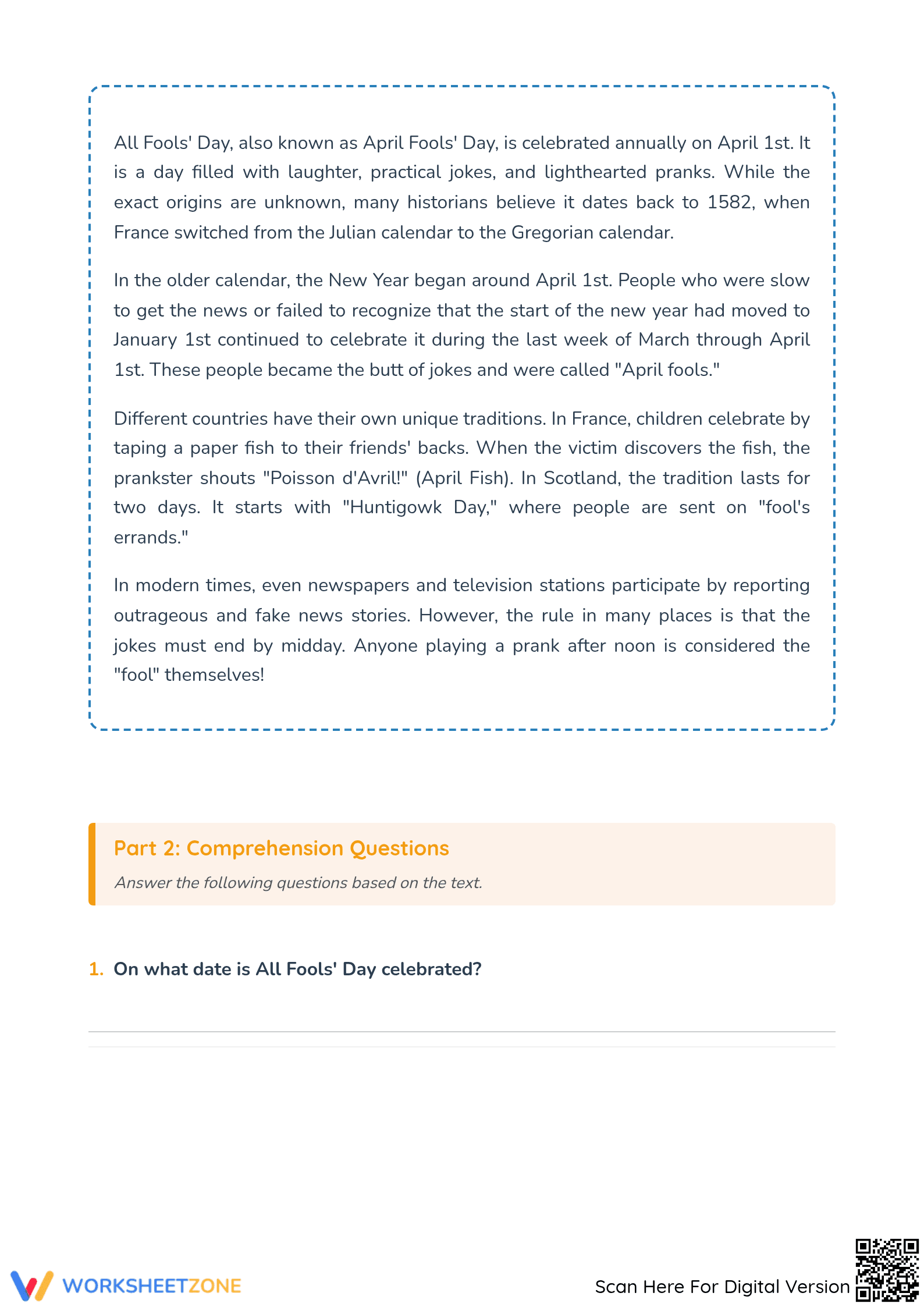
This Grade 4 All Fools' Day reading comprehension worksheet enables students to master informational text analysis while exploring the fascinating global history of April 1st. Students will identify key details from a multi-page passage, matching historical evidence to specific cultural traditions to build a sophisticated understanding of how holidays evolve over centuries.
At a Glance
- Grade: 4 · Subject: English Language Arts
- Standard:
CCSS.ELA-LITERACY.RI.4.1— Refer to details and examples in a text when explaining what it says- Skill Focus: Historical context, evidence-based reading, and vocabulary acquisition
- Format: 4 pages · 13 problems · Answer key included · PDF
- Best For: Informational text practice and holiday-themed literacy centers
- Time: 30–45 minutes
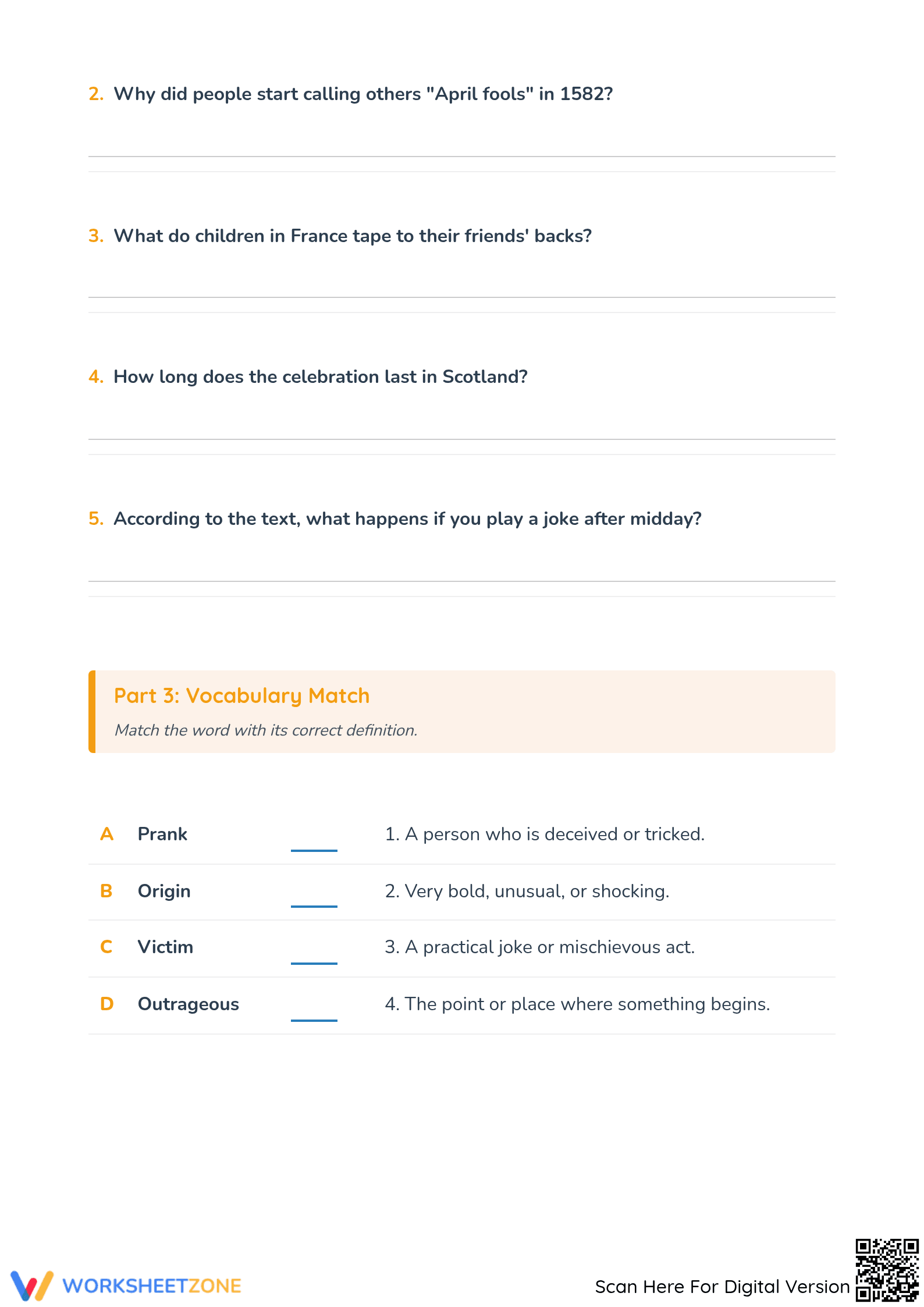
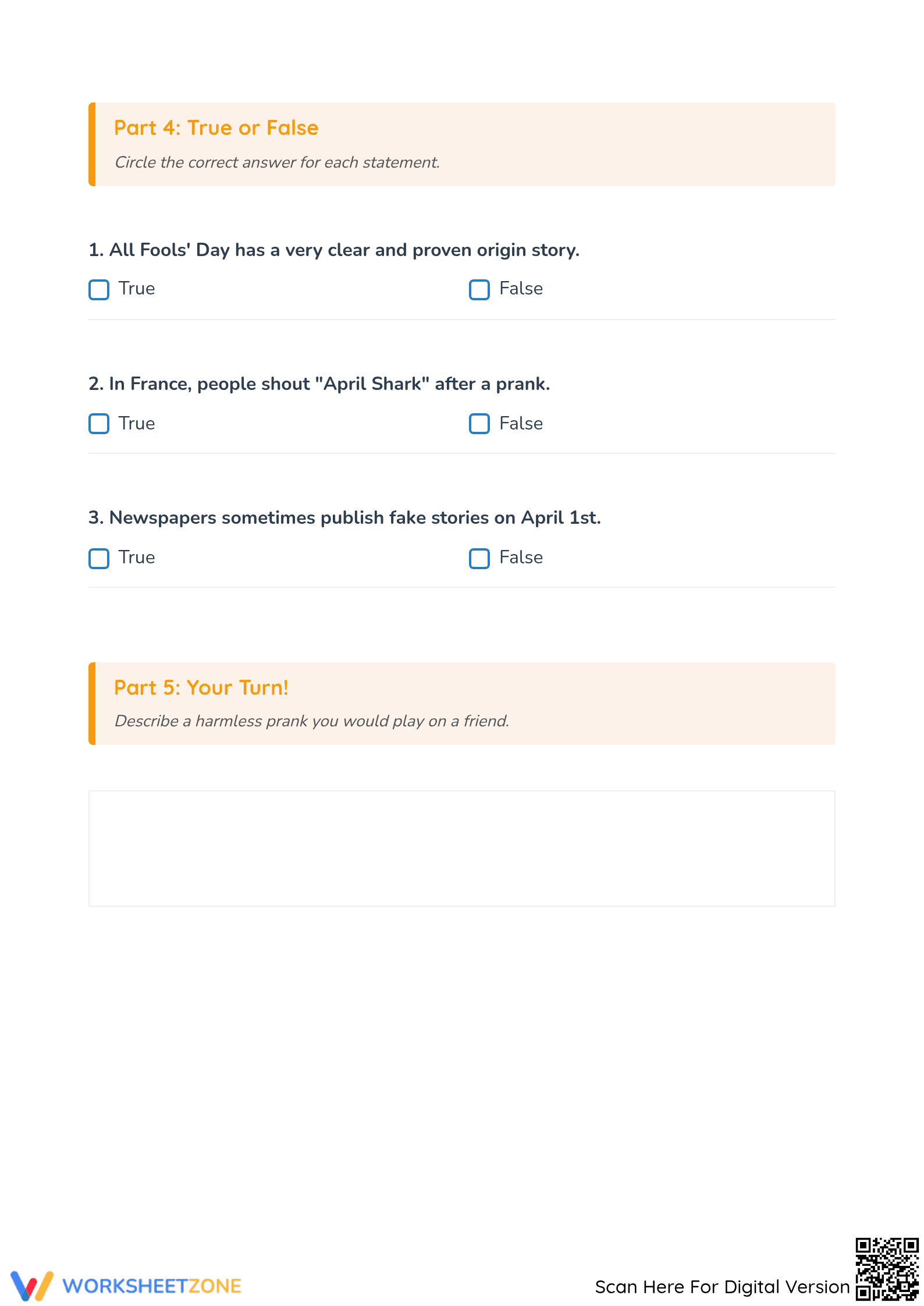
This four-page instructional packet features a detailed historical narrative on the 1582 Gregorian calendar shift and international customs. It includes five open-ended comprehension questions, a four-term vocabulary matching exercise, a true-or-false validation, and a creative writing prompt for personal application of the holiday's lighthearted themes.
Skill Progression and Scaffolding
- Guided Practice: Initial reading features structured layout with wide margins for note-taking, enabling students to highlight four primary historical facts.
- Supported Practice: Vocabulary matching and multiple-choice components provide anchor points, helping learners define words like "Outrageous" and "Origin" within the April 1st narrative.
- Independent Practice: The final writing task requires students to synthesize "harmless pranks" rules with their own creative ideas, fostering higher-order thinking and personal expression.
This sequence follows a gradual-release model, moving from literal comprehension to critical evaluation and personal response.
Standards Alignment
The primary alignment is `CCSS.ELA-LITERACY.RI.4.1`, which requires students to refer to details and examples in a text when explaining what the text says explicitly. Additionally, the matching section supports `CCSS.ELA-LITERACY.RI.4.4` by focusing on domain-specific vocabulary. Both standard codes can be copied directly into lesson plans, IEP goals, or district curriculum mapping tools.
How to Use It
Ideal for use during the first week of April as a literacy lesson. Teachers can use the "At a Glance" section to set a timer for 35 minutes, providing 15 minutes for shared reading and 20 minutes for independent task rotation.
Who It's For
While designed for fourth-grade classrooms, the clear text structure makes it accessible for third-grade enrichment or fifth-grade review. It serves as a natural pairing for an anchor chart on chronological text structures or a social studies unit on European history and calendar systems.
Research by Fisher & Frey (2014) shows that students achieve higher retention with complex informational texts when historical facts are paired with interactive response tasks. This All Fools' Day resource applies this by having learners map dates like 1582 to the Julian-to-Gregorian calendar shift. Engaging with `CCSS.ELA-LITERACY.RI.4.1`, students move beyond surface-level reading to identify causal relationships between historical events and modern traditions. The 13 PDF tasks balance literal recall with contextual vocabulary. ScienceDirect TpT Analysis notes high-quality holiday-themed materials that maintain academic rigor are crucial for engagement during seasonal shifts. This worksheet ensures the study of April 1st remains a meaningful academic exercise.


