


























Views
Downloads

Identifying Emotions Worksheet | Grade 3-5 Essential
Paste this activity's link or code into your existing LMS (Google Classroom, Canvas, Teams, Schoology, Moodle, etc.).
Students can open and work on the activity right away, with no student login required.
You'll still be able to track student progress and results from your teacher account.
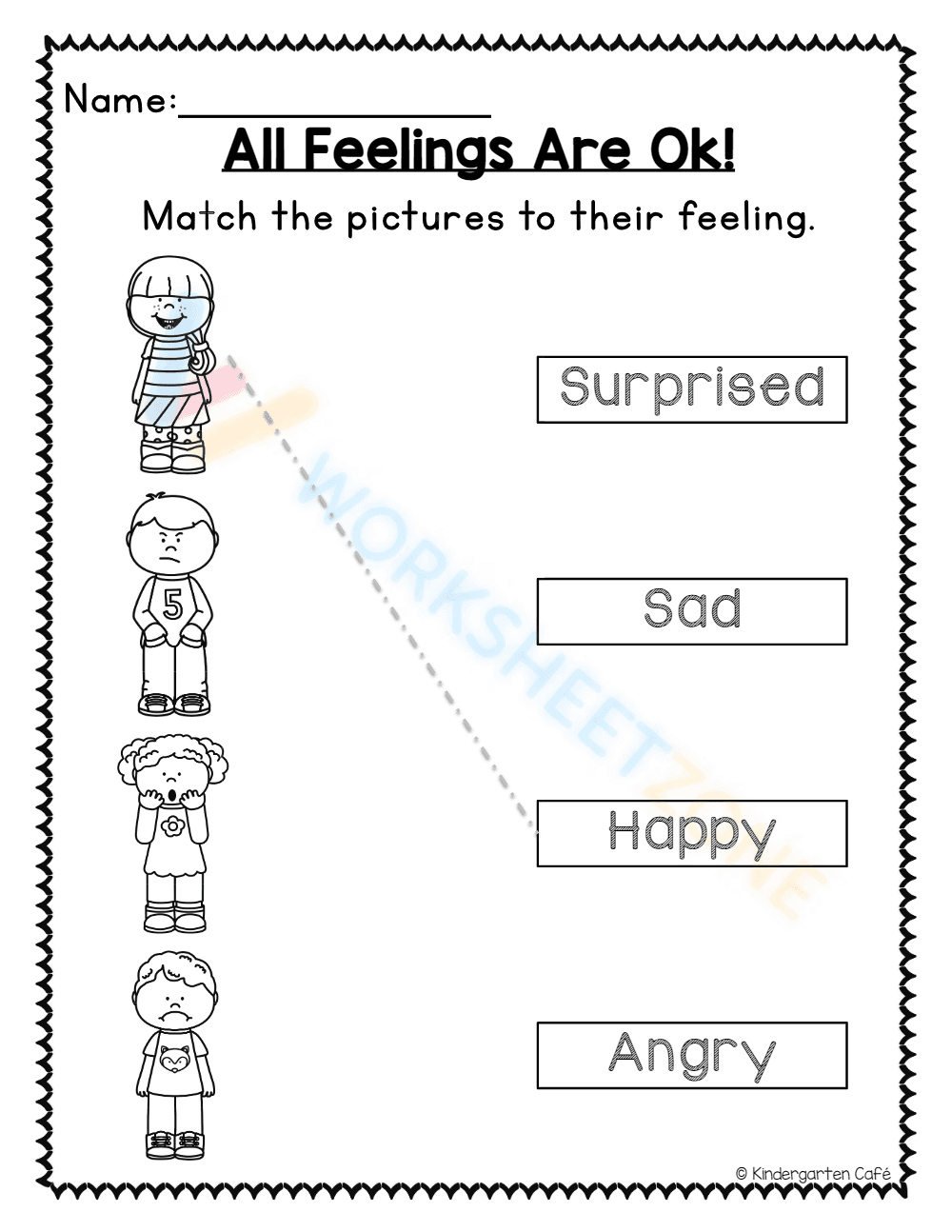
This identifying emotions worksheet helps students recognize and label core feelings through visual cues and vocabulary matching. By connecting facial expressions to specific emotional terms, learners develop the foundational social-emotional literacy required for effective communication and interpersonal understanding. It provides a clear, structured way to practice empathy and self-awareness.
At a Glance
- Grade: 3-5 · Subject: English / SEL
- Standard:
CCSS.ELA-LITERACY.L.3.5.C— Identify real-life connections between words and their use to describe feelings- Skill Focus: Visual emotion recognition
- Format: 1 page · 4 problems · Answer key included · PDF
- Best For: Morning meetings or counseling sessions
- Time: 5–10 minutes
This single-page PDF features four distinct character illustrations, each displaying a clear facial expression corresponding to a primary emotion. Students are presented with a list of four vocabulary words: Surprised, Sad, Happy, and Angry. The layout is clean and uncluttered, featuring large text and bold borders to support visual processing. A full answer key is provided to facilitate quick grading or student self-correction.
The zero-prep design allows for immediate implementation in any learning environment. First, print the single-page document (30 seconds). Second, distribute the sheets to students during a transition or as a warm-up activity (1 minute). Third, review the answers as a whole group to discuss the specific facial cues, such as eyebrow position or mouth shape, that signal each feeling (2 minutes). Total teacher preparation time is under two minutes, making it an ideal sub plan addition.
The primary focus is `CCSS.ELA-LITERACY.L.3.5.C`, which requires students to distinguish shades of meaning among related words and identify real-life connections. By matching the word "Angry" to a scowling face, students demonstrate an understanding of how language maps to physical reality. This also supports `CCSS.ELA-LITERACY.SL.3.1` by providing the vocabulary necessary for collaborative discussions. Both standard codes can be copied directly into lesson plans, IEP goals, or district curriculum mapping tools.
Use this worksheet as a formative assessment during a social-emotional learning (SEL) block to gauge student baseline knowledge of emotional vocabulary. Alternatively, assign it as a check-in activity after a recess conflict to help students identify their current state. Teachers should observe whether students hesitate between "Surprised" and "Happy," as this provides a natural opening to discuss subtle differences in non-verbal communication. Completion typically takes 5 to 10 minutes.
This resource is designed for elementary students in grades 3 through 5, particularly those who benefit from visual supports or are working on social skills goals. It is an excellent fit for English Language Learners (ELLs) building basic descriptive vocabulary. Pair this worksheet with a Feelings Anchor Chart or a short narrative passage where characters experience these specific emotions to reinforce the concepts in a broader context.
Research from Fisher & Frey (2014) emphasizes that visual literacy and the ability to decode non-verbal signals are critical components of overall reading comprehension and social success. This worksheet targets the CCSS.ELA-LITERACY.L.3.5.C standard by requiring students to bridge the gap between abstract emotional labels and concrete visual evidence. By engaging with 4 specific tasks that isolate facial expressions, students build the shades of meaning necessary for advanced literacy. According to the RAND AIRS 2024 report, explicit instruction in emotional vocabulary significantly improves classroom climate and student engagement. This resource provides a structured, evidence-based approach to identifying feelings, ensuring that students have the linguistic tools to express themselves and understand others. The inclusion of an answer key and clear formatting aligns with best practices for instructional materials, providing a reliable tool for both general education and specialized intervention settings.


