


























Views
Downloads
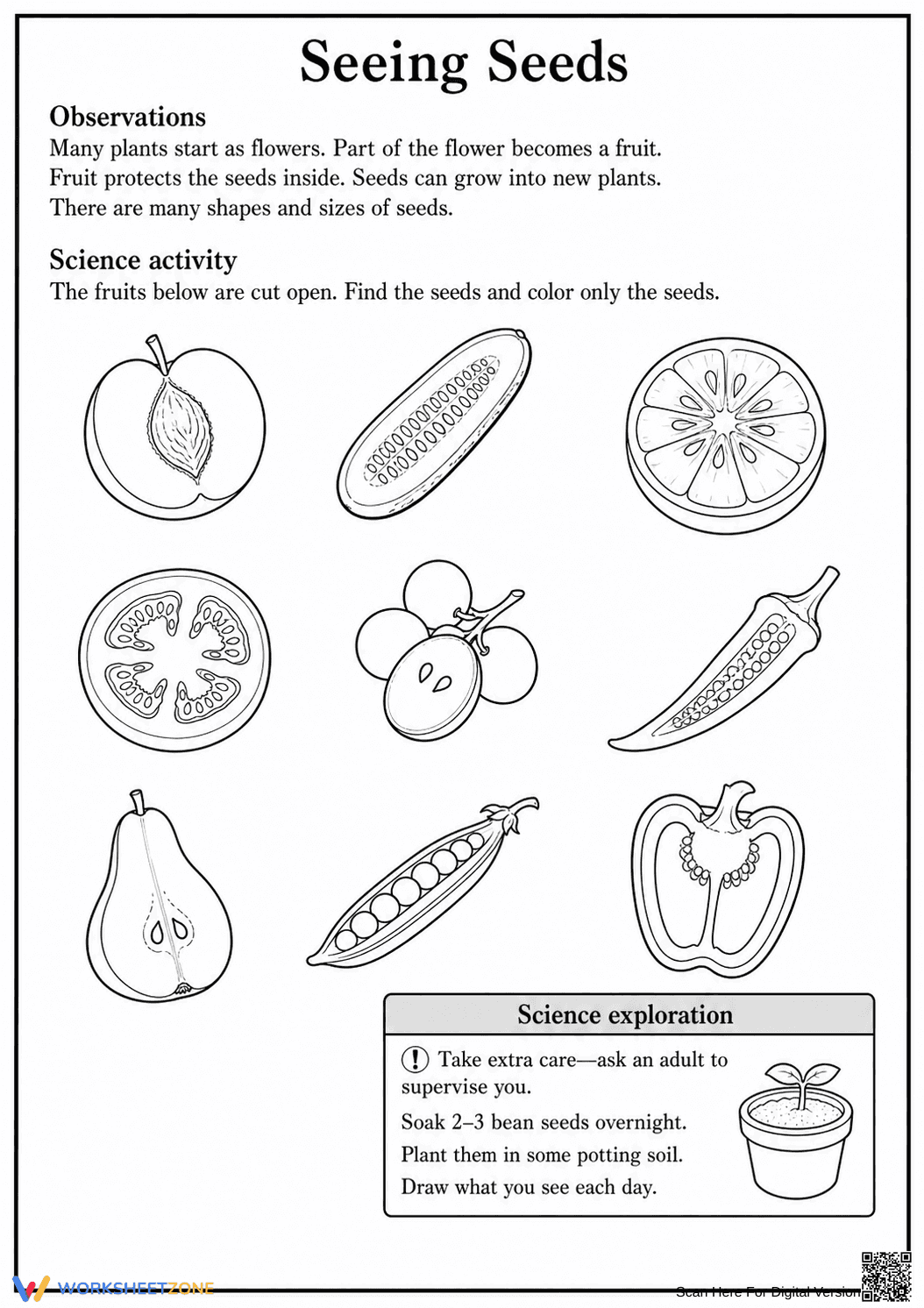
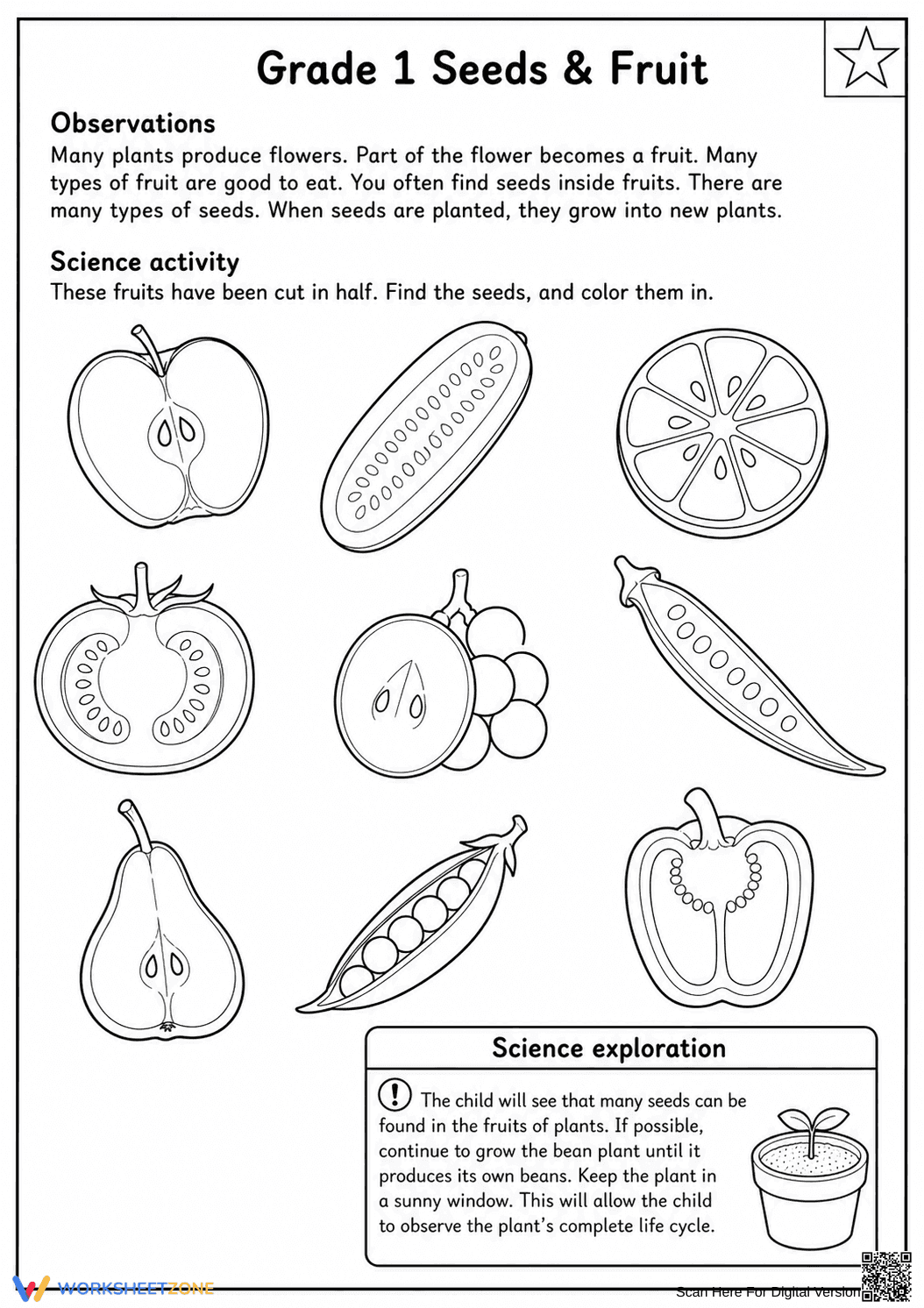

Grade 1 Seeds & Fruit — Printable No-Prep Worksheet
Paste this activity's link or code into your existing LMS (Google Classroom, Canvas, Teams, Schoology, Moodle, etc.).
Students can open and work on the activity right away, with no student login required.
You'll still be able to track student progress and results from your teacher account.
This printable Grade 1 science worksheet introduces young learners to the relationship between flowers, fruit, and seeds. Students observe illustrations of fruits cut in half to identify and color the internal seeds, reinforcing the concept that seeds are protected by fruit. This activity helps students visualize plant life cycles and growth stages.
At a Glance
- Grade: 1 · Subject: Science
- Standard:
1-LS1-1— Identify plant parts and how they help plants survive- Skill Focus: Seed identification and plant life cycles
- Format: 2 pages · 9 problems · PDF
- Best For: Introductory biology and plant units
- Time: 15–20 minutes
What's Inside
The worksheet features clear instructions explaining the flower-to-fruit transition. The main activity includes nine illustrated tasks where students locate and color seeds within various familiar fruits, including apples, tomatoes, and pea pods. A "Science Exploration" sidebar provides a hands-on extension for planting bean seeds, encouraging real-world observation and daily journaling to track growth patterns over time.
Zero-Prep Workflow
- Print: Generate the PDF for your class (30 seconds).
- Distribute: Hand out sheets with coloring supplies and read the observation text aloud (1 minute).
- Review: Discuss different seed shapes and sizes as a group to check for understanding (30 seconds).
Total teacher preparation time is under two minutes, making it an ideal choice for busy classrooms or substitute plans that require immediate, high-quality science instruction without complex setup.
Standards Alignment
Aligned with 1-LS1-1, this resource helps students understand how plant parts facilitate survival and growth. By identifying seeds and their protective fruits, students gain a foundational understanding of biological structures. Both standard codes can be copied directly into lesson plans, IEP goals, or district curriculum mapping tools.
How to Use It
Use this worksheet during the "Explore" phase of a science lesson on living things. It serves as an excellent formative assessment tool; observe if students distinguish between fruit flesh and seeds while coloring. A second use case is as a morning work activity to settle students while reinforcing previous lessons on plant biology. Expected completion time is 15 to 20 minutes before moving into physical fruit dissections.
Who It's For
Designed for first-grade students, this activity is adaptable for kindergarteners requiring enrichment or second-graders needing review. It benefits visual learners and students who enjoy fine-motor coloring activities. Pair this worksheet with a classroom anchor chart displaying the flowering plant life cycle or a hands-on planting project to maximize student engagement and conceptual depth.
The Grade 1 science curriculum focuses heavily on the structural adaptations of plants, specifically how external parts like seeds and fruits facilitate reproduction and survival. This worksheet addresses the core requirements of the 1-LS1-1 standard by requiring students to identify plant parts and how they help plants survive. According to the ScienceDirect TpT Analysis, high-quality visual aids and coloring activities in primary science education significantly improve retention rates for terminology and biological concepts. By connecting the abstract idea of a life cycle to familiar foods like apples and tomatoes, the resource bridges the gap between daily experience and scientific inquiry. Teachers can utilize this printable to gather evidence of student mastery in identifying plant structures and their functions. This approach ensures that learners develop a cohesive mental model of how living things reproduce, which is a prerequisite for more advanced ecological studies in later elementary grades.


