


























Views
Downloads



Aligned Rational Number Operations Worksheet | Grade 7 Math
Paste this activity's link or code into your existing LMS (Google Classroom, Canvas, Teams, Schoology, Moodle, etc.).
Students can open and work on the activity right away, with no student login required.
You'll still be able to track student progress and results from your teacher account.
This Grade 7 math worksheet equips students to master addition, subtraction, multiplication, and division with positive and negative rational numbers. Through 16 rigorous exercises, learners analyze sign rules, solve multi-step real-world problems involving elevation and finance, and justify algebraic properties, building fluent computational accuracy and deep conceptual understanding.
At a Glance
- Grade: 7 · Subject: Math
- Standard:
7.NS.A.3— Solve real-world and mathematical problems involving the four operations with rational numbers- Skill Focus: Signs and Rational-Number Operations
- Format: 5 pages · 16 problems · Answer key included · PDF
- Best For: Independent practice, intervention, or review
- Time: 45–60 minutes
What's Inside
The 5-page worksheet includes a foundational Core Rules reference box detailing sign conventions, additive inverses, and fractional operations. Students encounter 16 multi-step problems divided into conceptual distinctions, contextual word problems, and transfer-level error analyses. A complete 4-page answer key provides step-by-step solutions, intermediate calculations, and written explanations for efficient grading.
Skill Progression
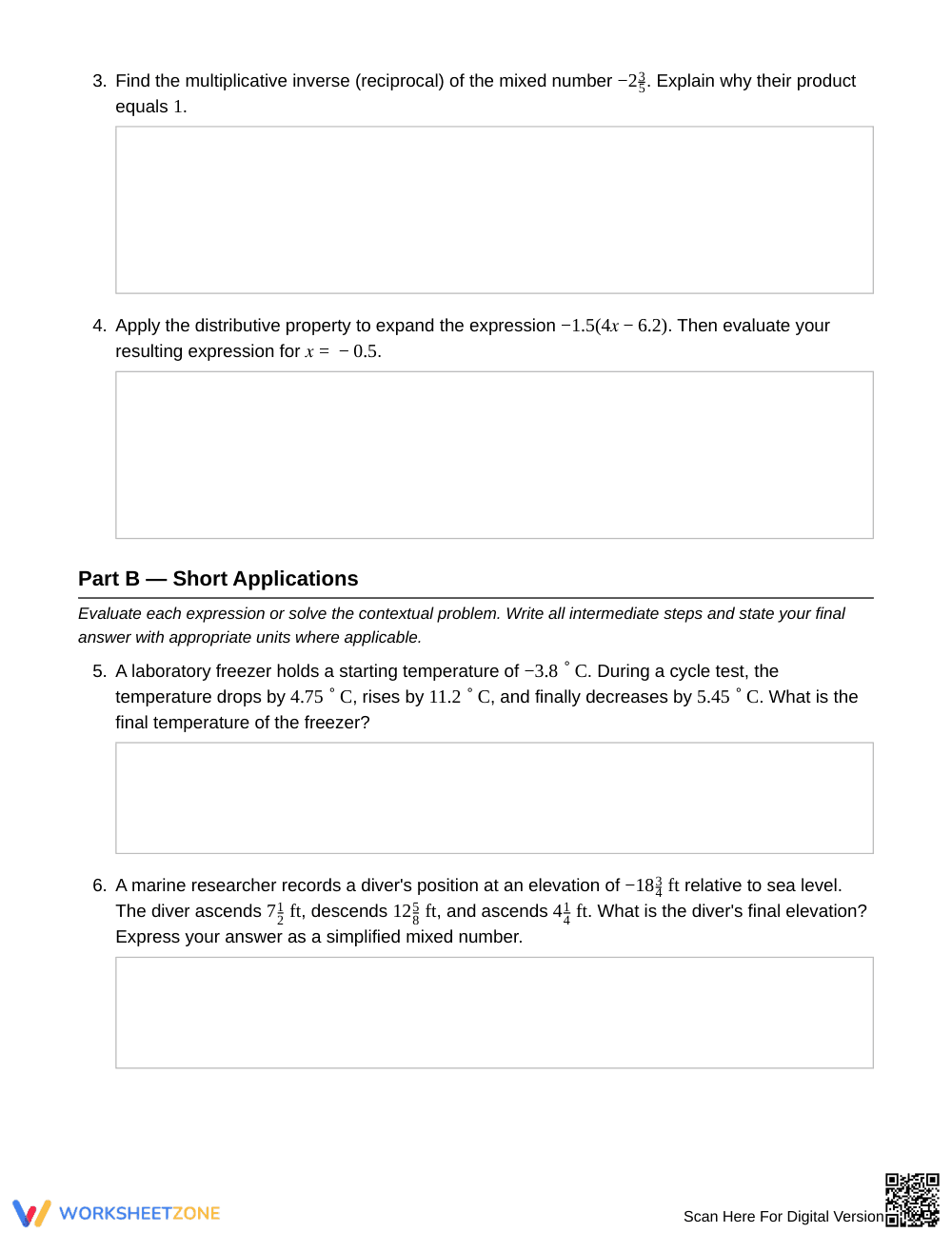
- Guided practice (Items 1–4): Students examine sign conventions, identify non-equivalent fractions, reason about expression signs without calculating, and apply the distributive property supported by the on-page rule box.
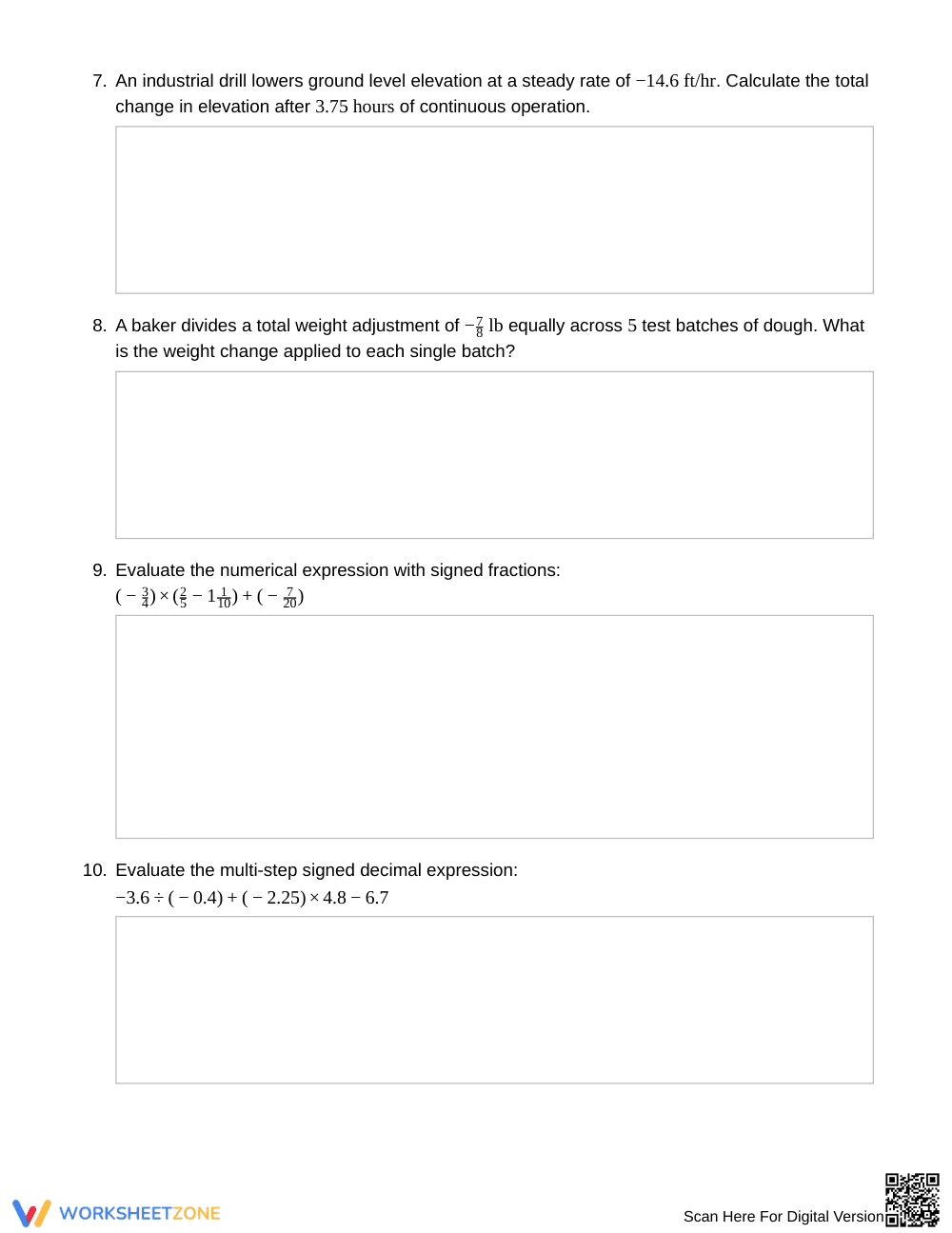
- Supported practice (Items 5–12): Learners tackle contextual word problems and numerical evaluations featuring temperatures, financial changes, and rate of descent, transitioning from explicit formulas to multi-step execution.
- Independent practice (Items 13–16): Students perform detailed order-of-operations error analysis, model multi-stage temperature shifts, test algebraic variable conditions, and balance multi-step financial ledgers without scaffolding.
This sequence mirrors the gradual release of responsibility model, guiding students systematically from basic sign recognition to independent mathematical modeling.
Standards Alignment
Primary Standard: `7.NS.A.3` — Solve real-world and mathematical problems involving the four operations with rational numbers, including complex fractions. As a supporting foundational standard, `7.NS.A.2` addresses the multiplication and division of signed rational numbers. Both standard codes can be copied directly into lesson plans, IEP goals, or district curriculum mapping tools.
How to Use It
Deploy this resource during post-instruction practice following direct instruction on integer and rational sign rules. For targeted formative assessment, review student responses on Item 2 to evaluate whether students deduce signs conceptually or depend entirely on manual arithmetic. In a standard 50-minute class period, assign Parts A and B for collaborative classwork (25–30 minutes) and reserve Part C for summative assessment or partner problem-solving (15–20 minutes).
Who It's For
This worksheet serves general Grade 7 mathematics students, accelerated Grade 6 math learners, and Grade 8 students requiring algebra-readiness intervention. Teachers can provide sentence starters for the written justifications in Part C to support English language learners. Pair this printable resource with a rational numbers anchor chart or an introductory lesson on number-line modeling.
According to Fisher & Frey (2014), structured cognitive scaffolding enables middle school students to achieve procedural fluency while developing higher-order problem-solving skills. Standard 7.NS.A.3 requires students to solve real-world and mathematical problems involving the four operations with rational numbers, encompassing signed decimals, integers, and positive and negative fractions. This worksheet operationalizes evidence-based pedagogy by pairing conceptual sign distinctions with contextual problem solving across elevation, financial deficits, and rate changes. The inclusion of student error analysis and algebraic sign testing directly addresses documented student misconceptions concerning the order of operations and negative signs. By transitioning from rule-based reminders to unprompted mathematical reasoning, the 16 tasks help seventh-grade learners solidify foundational computational stamina essential for introductory algebra and advanced quantitative reasoning. Teachers gain immediate diagnostic data on operational fluency through the provided step-by-step answer key.


