


























Views
Downloads




Aligned Adapting Appeals Worksheet | Grade 10 English II
Paste this activity's link or code into your existing LMS (Google Classroom, Canvas, Teams, Schoology, Moodle, etc.).
Students can open and work on the activity right away, with no student login required.
You'll still be able to track student progress and results from your teacher account.
This Grade 10 English II worksheet trains high school readers to dissect rhetorical strategies in civic discourse and recalibrate persuasive appeals for different audiences. Working with an authentic municipal budget hearing speech, students evaluate ethos, pathos, and logos in context before redesigning arguments to achieve a practical outcome with peer audiences.
At a Glance
- Grade: 10 · Subject: English II
- Standard:
RI.9-10.6— Analyze how authors use rhetoric to advance point of view and purpose- Skill Focus: Adapt an Appeal for a New Audience
- Format: 6 pages · 10 problems · Answer key included · PDF
- Best For: Rhetorical analysis and persuasive writing practice
- Time: 45–60 minutes
What's Inside
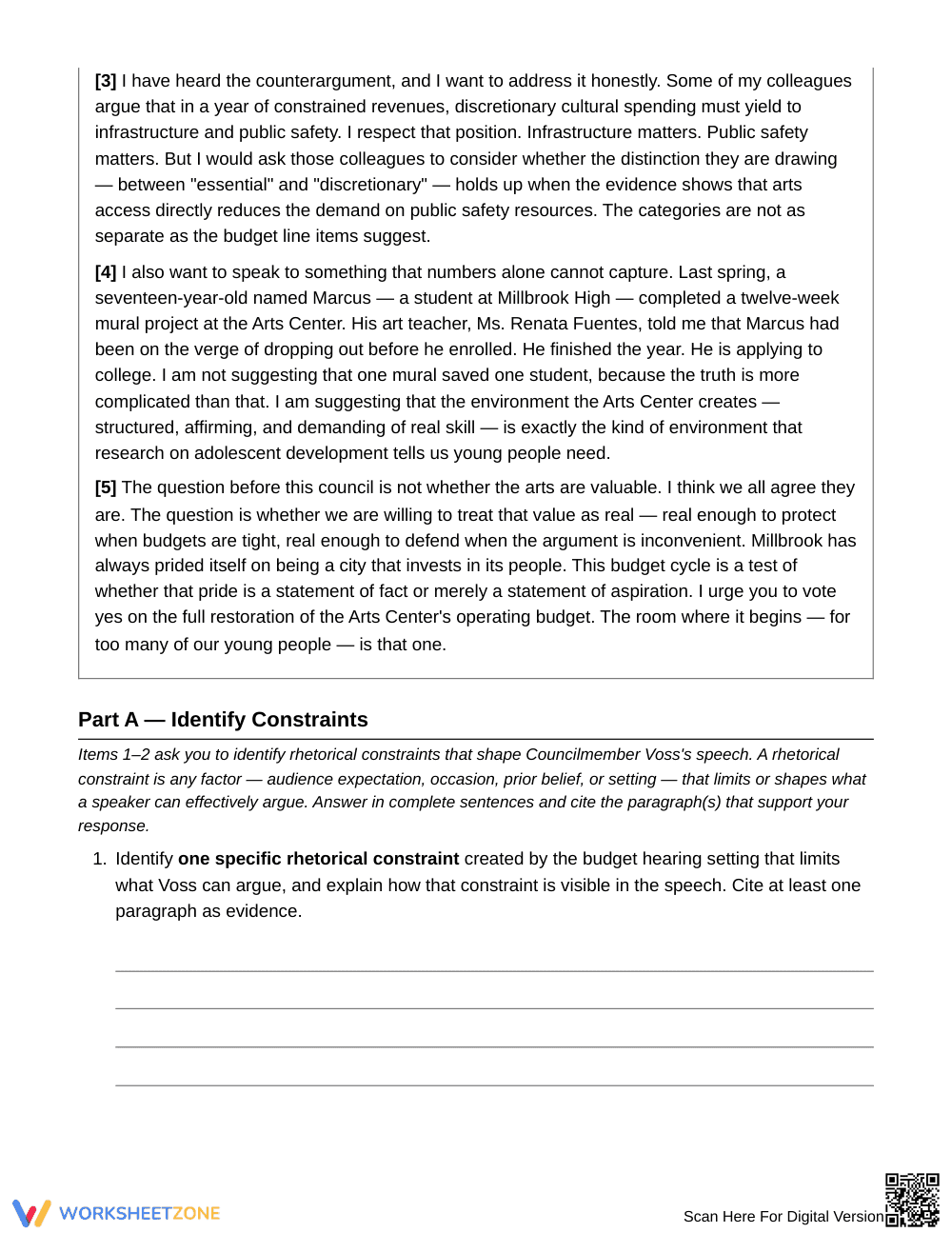
The 6-page printable resource centers on "The Room Where It Begins," a five-paragraph civic speech delivered by Councilmember Daria Voss during a city budget hearing. It includes a foundational key terms reference box, text-dependent short-answer questions, a structured rhetorical appeal rating matrix, and scenario-based synthesis prompts. A complete 7-page explanatory answer key supports objective evaluation.
Skill Progression
- Guided practice (Part A — Items 1–2): Identifies institutional constraints and opposing arguments within the budget hearing setting using direct textual evidence.
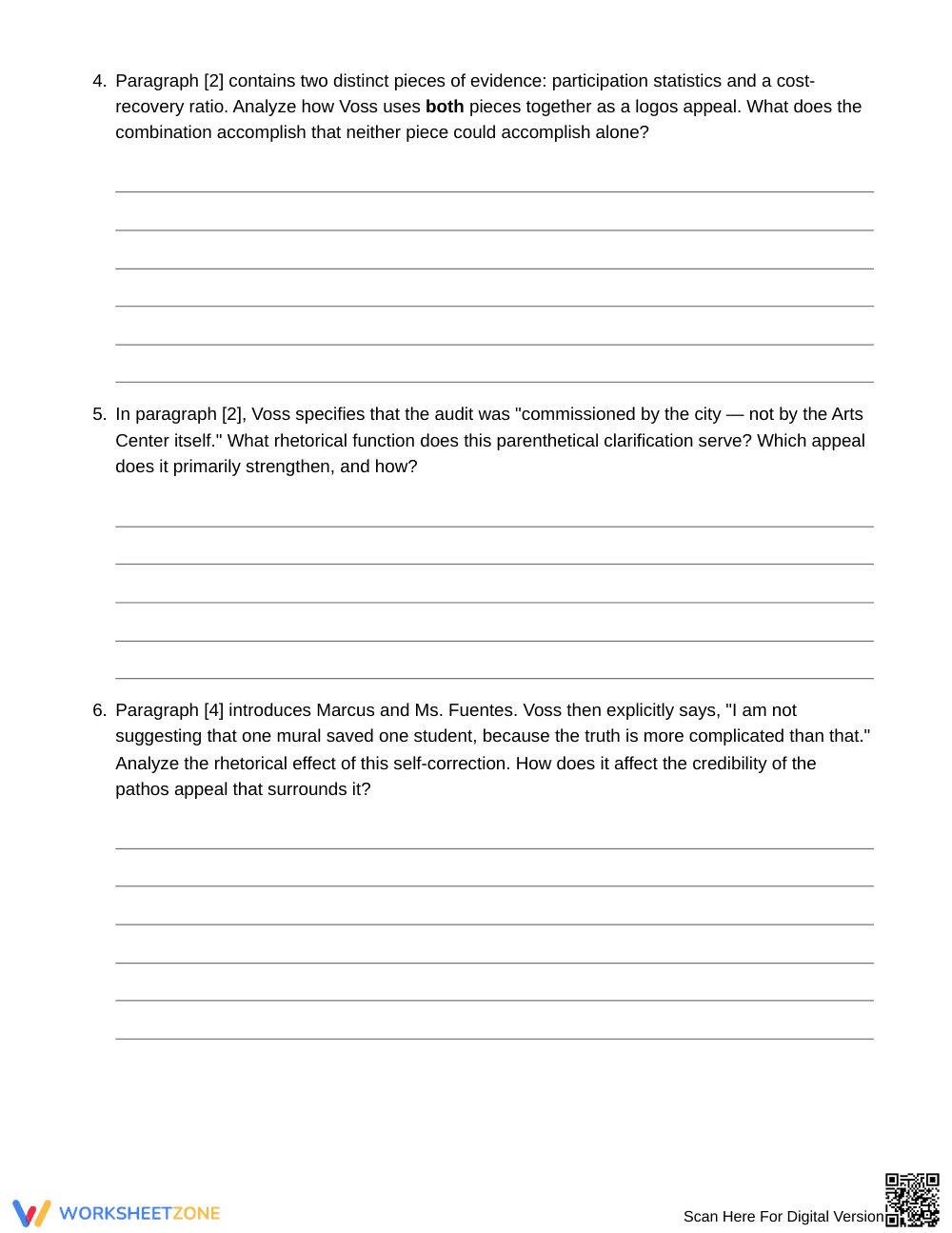
- Supported practice (Part B — Items 3–8): Examines specific instances of ethos, pathos, and logos, culminating in a three-tier appeal matrix rating relative argumentative weight.
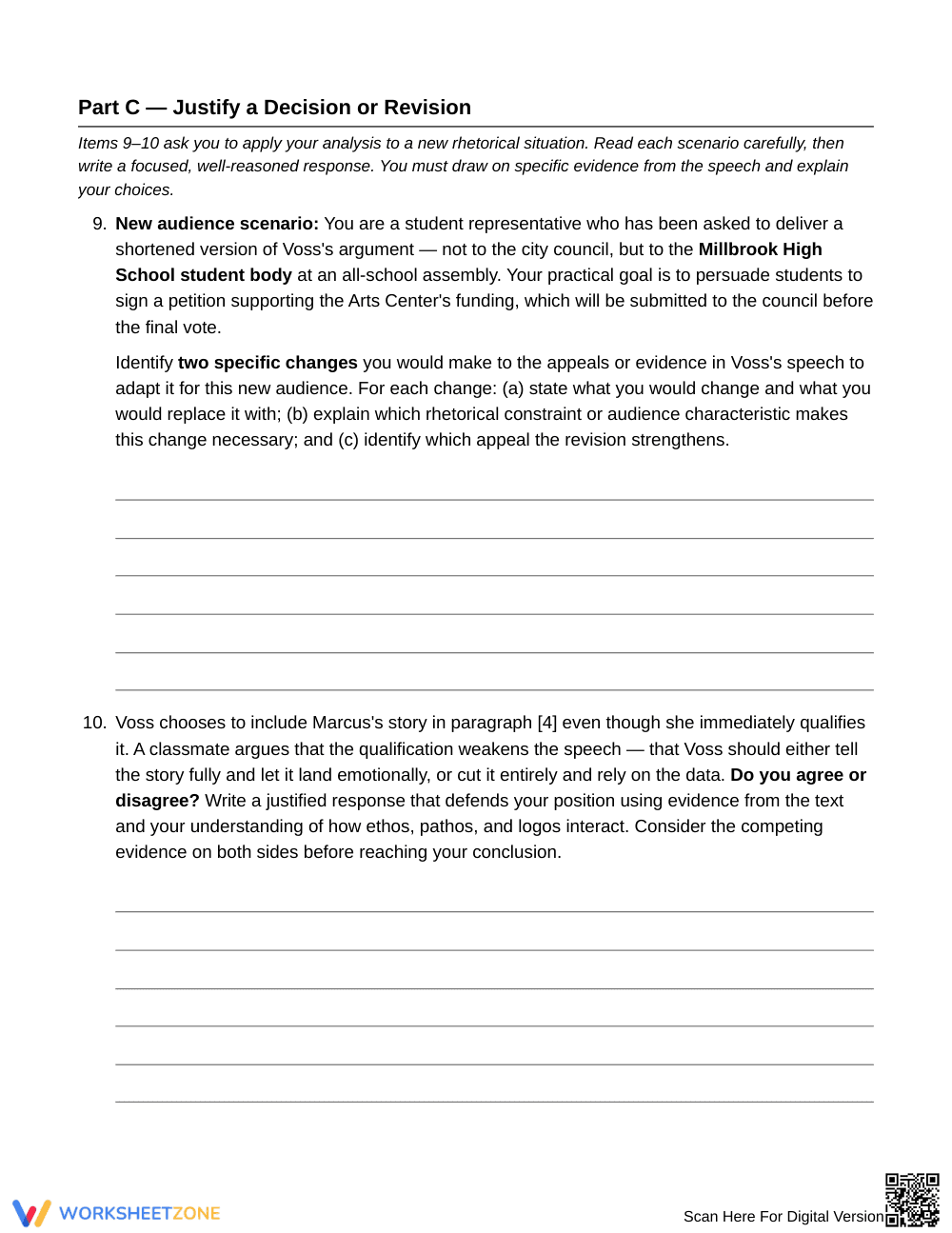
- Independent practice (Part C — Items 9–10): Tasks students with transferring rhetorical data into an all-school assembly petition speech and defending nuanced rhetorical qualifications.
This sequence embodies the gradual release of responsibility model, guiding learners from initial textual deconstruction to independent rhetorical composition.
Standards Alignment
Primary standard RI.9-10.6 requires students to determine an author's point of view or purpose in a text and analyze how an author uses rhetoric to advance that point of view or purpose. Supporting standard RI.9-10.1 reinforces citing strong and thorough textual evidence. Both standard codes can be copied directly into lesson plans, IEP goals, or district curriculum mapping tools.
How to Use It
Implement this resource directly after explicit instruction on Aristotle's rhetorical triangle. For whole-group instruction, have students complete Part A in collaborative pairs to identify rhetorical constraints before independently analyzing Voss's appeals in Part B. As a formative assessment check, monitor how accurately students distinguish between statistical logos and ethos-driven qualifications in item 5. Expect 45 to 60 minutes for completion.
Who It's For
This activity is designed for Grade 10 English language arts students, pre-AP English cohorts, and student debaters mastering argument construction. For struggling readers, the embedded key terms box clarifies unfamiliar rhetorical vocabulary, while advanced learners receive critical thinking extension through Part C. Pair this worksheet directly with mentor text speech analysis or civic debate units.
Mastering standard RI.9-10.6 requires high school learners to move beyond passive identification of rhetorical terms toward understanding how purpose, audience constraints, and persuasive strategies interact dynamically in argumentative texts. Research by Fisher & Frey (2014) demonstrates that structured literacy tasks integrating close reading with authentic adaptation scenarios yield measurable gains in secondary analytical reasoning and written discourse. When students analyze how a speaker establishes ethos, structures empirical logos, and mobilizes pathos within civic constraints, they develop sophisticated metalinguistic awareness necessary for college-level argument evaluation. By systematically translating evidence from a formal municipal budget hearing into an engaging peer-facing student assembly speech, this 10-task instructional framework reinforces practical transfer of rhetorical appeals. Educators can utilize the comprehensive seven-page answer key to evaluate student mastery of rhetorical adaptation, argumentative nuance, and text-dependent analytical justification across diverse instructional settings.


