


























Views
Downloads

Aladdin Vocab Worksheet | Grade 3 Essential
Paste this activity's link or code into your existing LMS (Google Classroom, Canvas, Teams, Schoology, Moodle, etc.).
Students can open and work on the activity right away, with no student login required.
You'll still be able to track student progress and results from your teacher account.
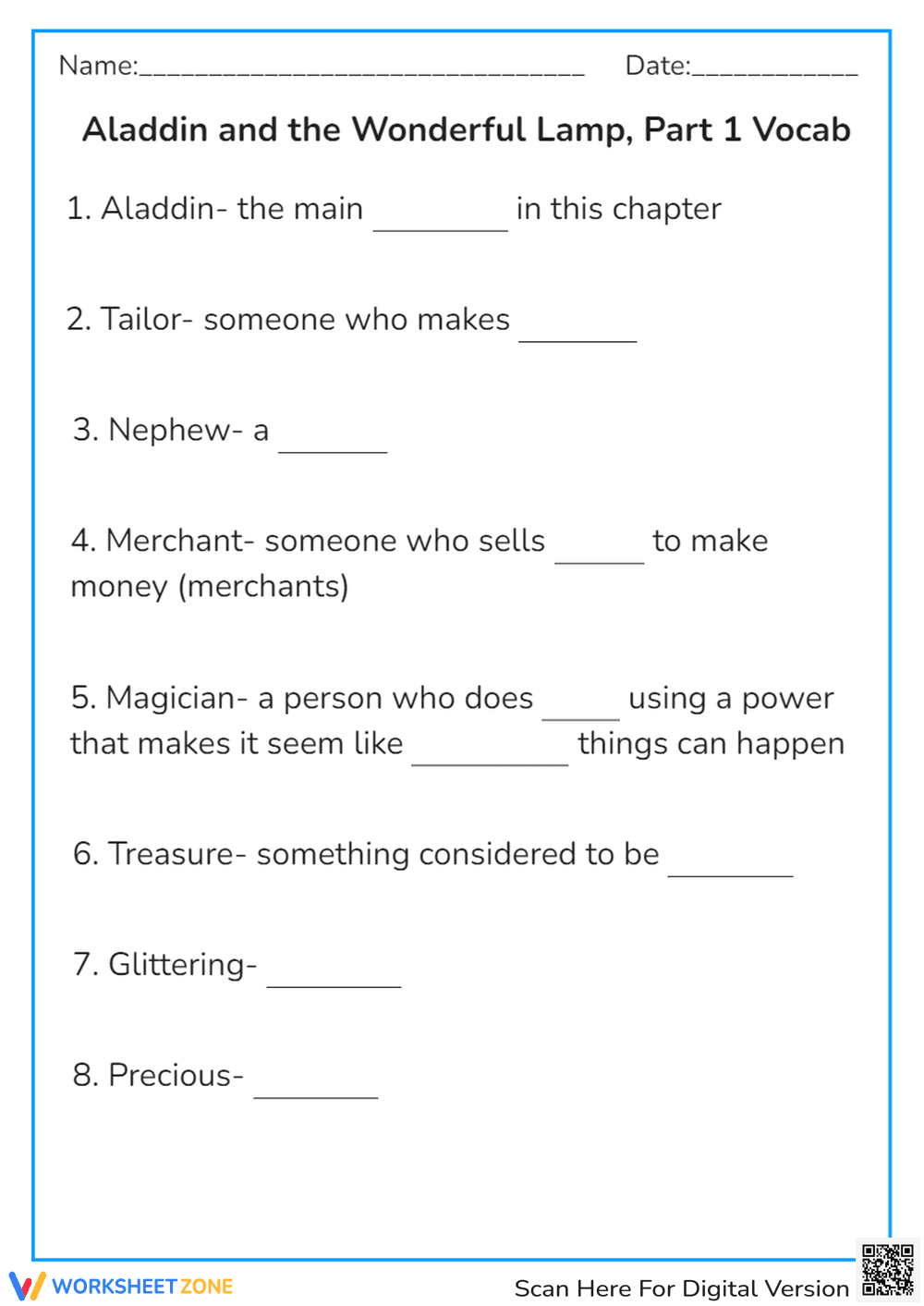
This Grade 3 vocabulary worksheet helps students master key terms from the first part of "Aladdin and the Wonderful Lamp." By completing definition-based fill-in-the-blank exercises, learners solidify their understanding of character roles and descriptive adjectives. This resource ensures students are prepared for deeper literary analysis of the classic tale.
At a Glance
- Grade: 3 · Subject: ELA
- Standard:
CCSS.ELA-LITERACY.L.3.4— Determine or clarify the meaning of unknown and multiple-meaning words and phrases- Skill Focus: Contextual Vocabulary
- Format: 1 page · 8 problems · Answer key included · PDF
- Best For: Post-reading check or homework assignment
- Time: 10–15 minutes
The worksheet features 8 targeted vocabulary items including "merchant," "magician," and "precious." Each item provides a partial definition with blanks for students to complete, encouraging active recall. The single-page PDF layout is clean and distraction-free, featuring a clear header for student names and dates. A comprehensive answer key is provided for quick grading.
Teachers can implement this resource in three simple steps. First, print the single-page PDF (30 seconds). Second, distribute the sheets to students during a literacy block or as a transition activity (1 minute). Finally, review the answers as a whole group to clarify any misconceptions (5 minutes). Total teacher preparation time is under 2 minutes, making it an ideal sub-plan or warm-up.
This resource aligns with `CCSS.ELA-LITERACY.L.3.4`, which requires students to determine or clarify the meaning of unknown and multiple-meaning words and phrases. It specifically addresses sub-standard A by using sentence-level context as a clue to the meaning of a word. Both standard codes can be copied directly into lesson plans, IEP goals, or district curriculum mapping tools.
Use this worksheet as a formative assessment immediately after reading the first chapter of Aladdin to gauge comprehension of key terminology. Alternatively, assign it as a "bell-ringer" activity the following day to reinforce retention. Observe if students can identify the "magician" or "merchant" roles, as these are pivotal to the plot's progression. Expected completion time ranges from 10 to 15 minutes.
This worksheet is designed for third-grade students but is also suitable for English Language Learners (ELL) or fourth-grade students needing remedial support. It pairs naturally with a read-aloud of the original text or a graphic organizer focusing on character traits and setting descriptions. It serves as a bridge between basic decoding and complex reading comprehension.
According to Fisher & Frey (2014), intentional vocabulary instruction is a cornerstone of literacy development, particularly when words are tied to specific literary contexts. This worksheet addresses CCSS.ELA-LITERACY.L.3.4 by requiring students to engage with 8 specific terms from "Aladdin and the Wonderful Lamp." By defining words like "precious" and "glittering" within the framework of the story, students build the lexical depth necessary for reading complex informational and narrative texts. Research from the NAEP suggests that students who demonstrate strong command of academic and domain-specific vocabulary consistently outperform peers on standardized reading assessments. This resource provides the structured, low-stakes practice required to bridge the gap between word recognition and conceptual mastery. Using this printable ensures that Grade 3 learners develop the linguistic tools needed to access higher-level literature while maintaining engagement through familiar storytelling elements.


