


























Views
Downloads
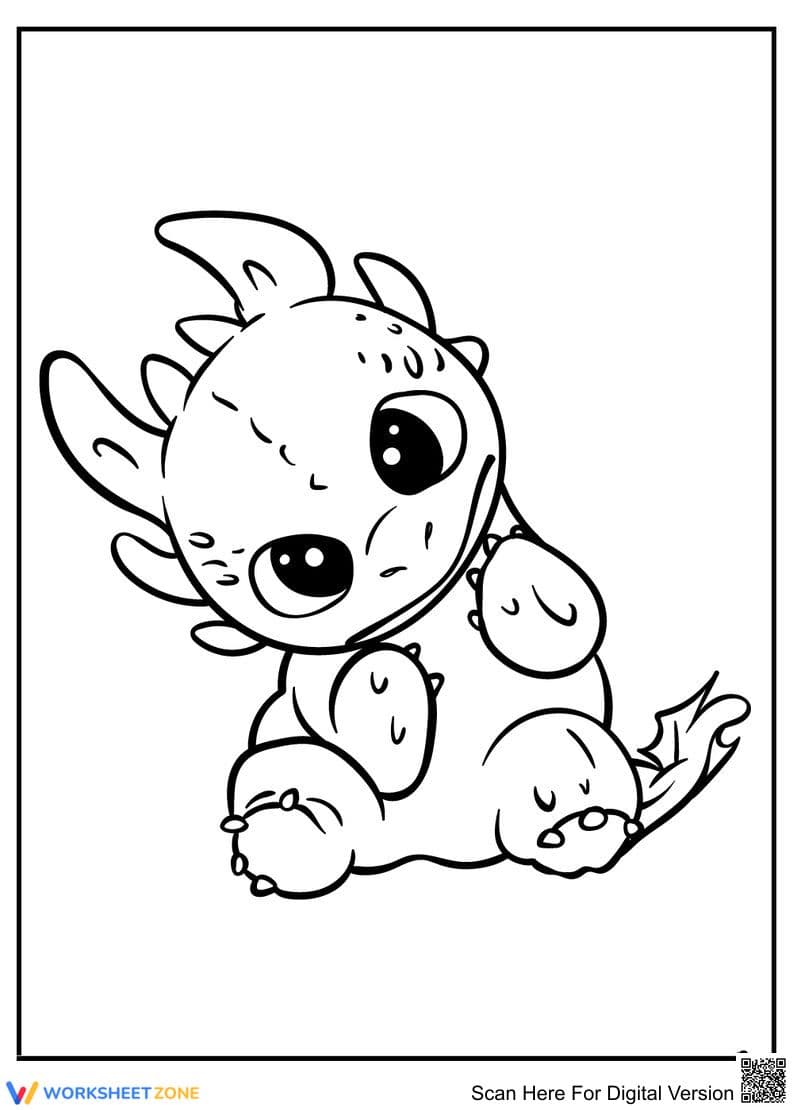

Grade K Baby Dragon Coloring — Printable No-Prep Worksheet
Paste this activity's link or code into your existing LMS (Google Classroom, Canvas, Teams, Schoology, Moodle, etc.).
Students can open and work on the activity right away, with no student login required.
You'll still be able to track student progress and results from your teacher account.
This printable baby dragon coloring worksheet develops essential fine motor skills in early learners. By engaging with a familiar character illustration, young students strengthen pencil grip and spatial awareness while connecting visual art to storytelling. This single-page activity provides immediate, meaningful practice for early childhood classrooms.
At a Glance
- Grade: Kindergarten · Subject: ELA & Fine Arts
- Standard:
CCSS.ELA-LITERACY.RL.K.7— Connect illustrations to the story with prompting and support- Skill Focus: Fine Motor Skills & Coloring
- Format: 1 page · 1 problem · Answer key included · PDF
- Best For: Independent practice and sub plans
- Time: 15–20 minutes
This single-page resource features a bold-lined illustration of a baby dragon ready for student coloring. The clean design provides clear boundaries for developing motor control without visual clutter. The worksheet includes 1 primary coloring task designed for standard classroom printing, ensuring crisp lines for crayons or markers. An answer key format is included as a completed full-color reference guide.
Zero-Prep Workflow
- Print (30 seconds): Access the PDF file and send directly to the classroom printer. No complex assembly required.
- Distribute (30 seconds): Hand out the single-page sheet along with standard coloring supplies.
- Review (1 minute): Observe student grip and coloring accuracy, prompting them to describe the dragon.
Total teacher preparation time clocks in at under 2 minutes. This direct simplicity makes the worksheet highly suitable for emergency sub plans, morning work, or independent literacy centers.
Standards Alignment
This worksheet aligns directly with CCSS.ELA-LITERACY.RL.K.7, requiring students to connect illustrations to story elements with prompting and support. As students color, teachers can facilitate discussions about character traits. A supporting standard includes visual arts frameworks for exploring tools and materials. Both standard codes can be copied directly into lesson plans, IEP goals, or district curriculum mapping tools.
How to Use It
Deploy this worksheet during morning arrival routines to establish a calm environment before direct instruction. Alternatively, assign it after a read-aloud session to reinforce character comprehension. For formative assessment, observe each student's pincer grasp and ability to stay within line boundaries, noting any needs for motor support. Expected completion time ranges from 15 to 20 minutes.
Who It's For
This resource serves kindergarten students developing foundational fine motor control. For differentiation, provide thicker crayons for students needing motor support, or challenge advanced learners to write a descriptive sentence beneath the illustration. This worksheet pairs naturally with fantasy picture books, character anchor charts, or direct instruction lessons.
Integrating structured coloring activities within early childhood literacy blocks provides essential foundational support for both motor development and narrative comprehension in young learners. Aligned with CCSS.ELA-LITERACY.RL.K.7, this activity prompts young learners to connect illustrations to story elements while refining the fine motor mechanics required for future handwriting success. According to research from Fisher & Frey (2014), purposeful independent tasks that connect visual representations to classroom learning significantly increase student engagement and reinforce core instructional themes without requiring extensive teacher intervention. By utilizing targeted visual tasks, educators foster essential hand-eye coordination and spatial awareness in a highly motivating context. This dual focus on physical coordination and character recognition ensures that classroom minutes remain highly productive, supporting early literacy benchmarks while accommodating diverse developmental learning paces across the primary classroom environment.


