


























Views
Downloads

Grade 1 Adjectives — Printable No-Prep Worksheet
Paste this activity's link or code into your existing LMS (Google Classroom, Canvas, Teams, Schoology, Moodle, etc.).
Students can open and work on the activity right away, with no student login required.
You'll still be able to track student progress and results from your teacher account.
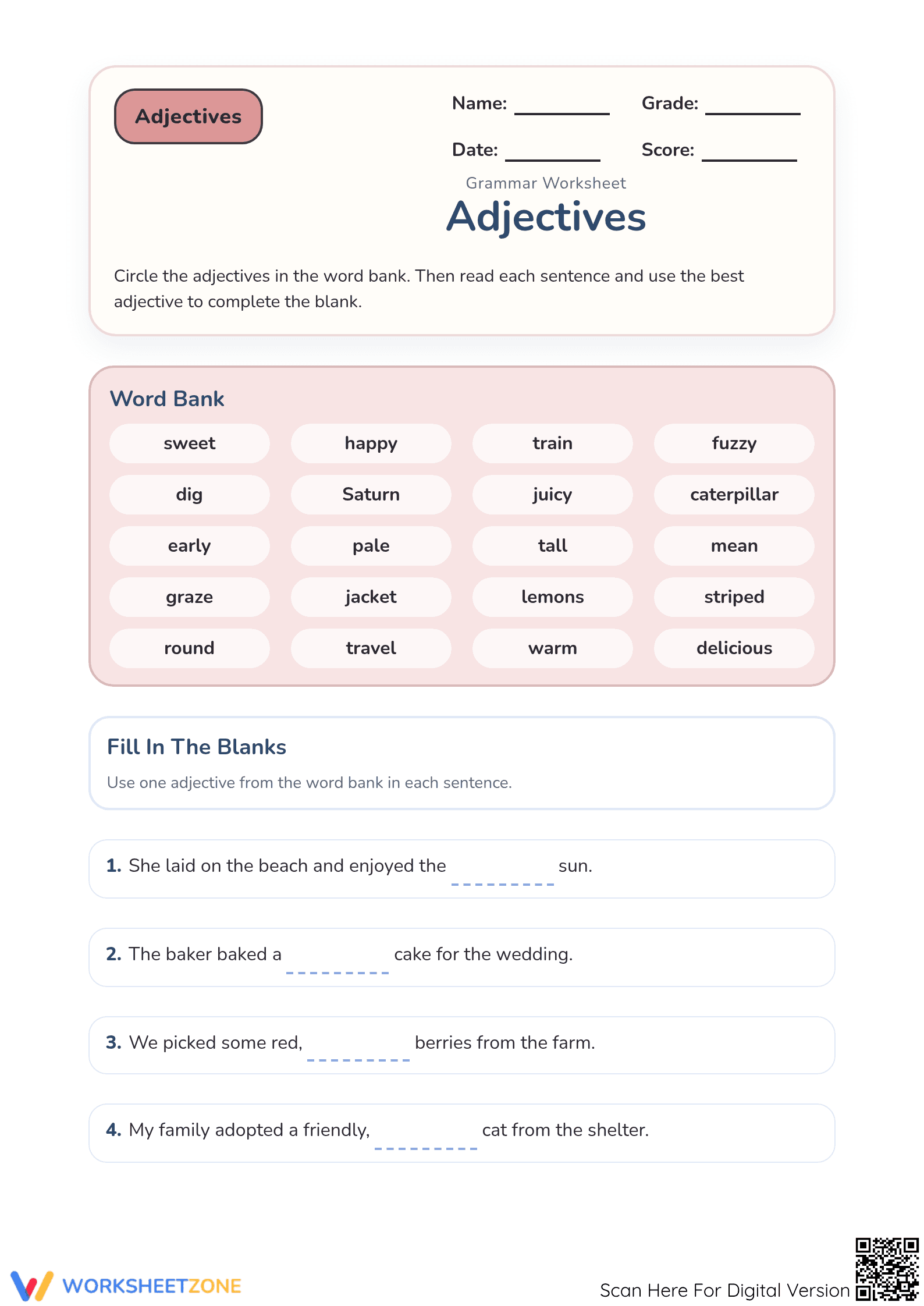
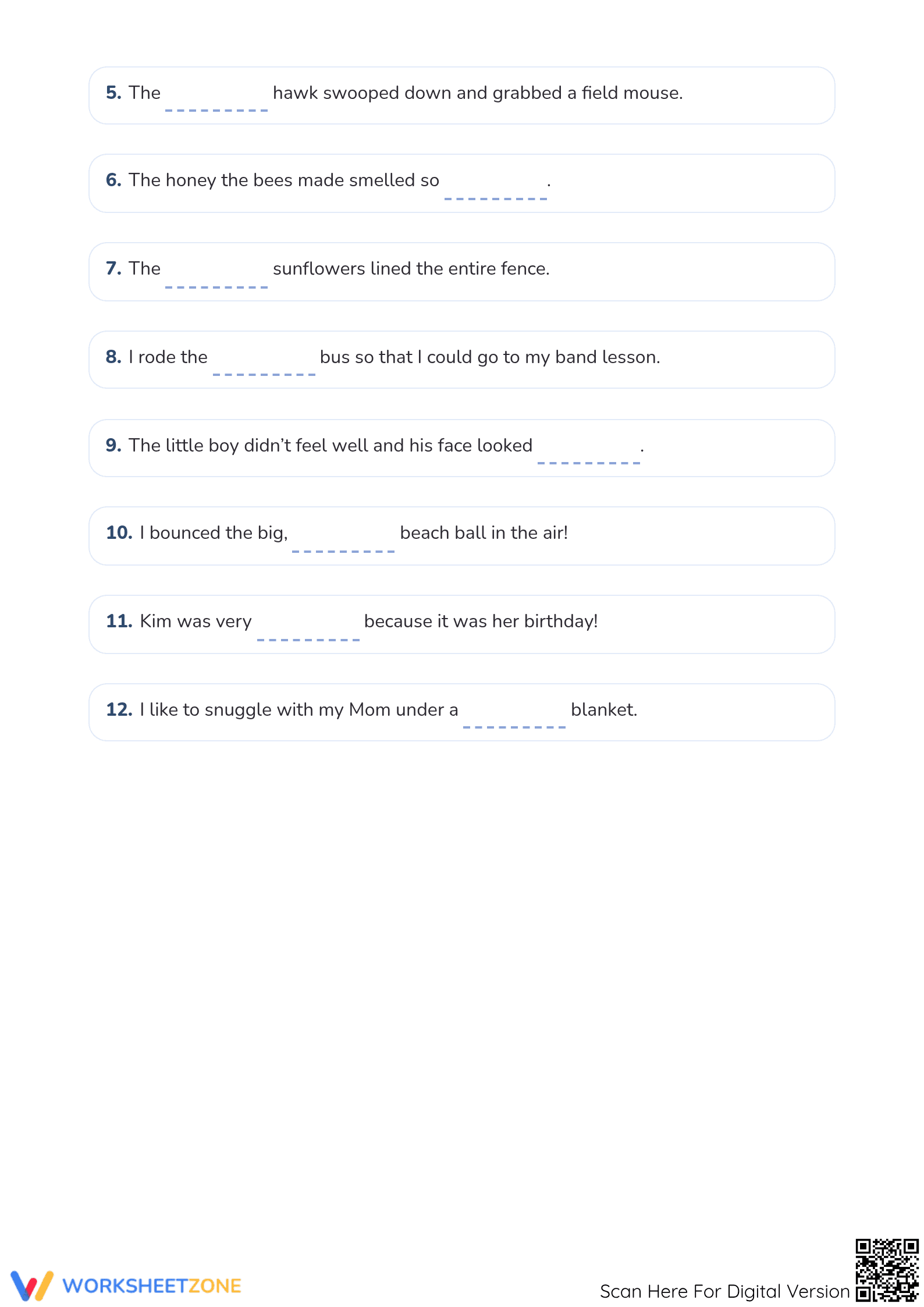
This Grade 1 adjectives worksheet provides students with 12 structured sentences to practice identifying and applying describing words in context. By selecting the correct adjective from a curated word bank, learners strengthen their understanding of how modifiers enhance noun meanings. This resource ensures students can accurately use frequently occurring adjectives to improve their writing and reading comprehension.
At a Glance
- Grade: 1 · Subject: ELA
- Standard:
CCSS.ELA-LITERACY.L.1.1.F— Use frequently occurring adjectives to describe people, places, and things- Skill Focus: Adjective identification and application
- Format: 2 pages · 12 problems · Answer key included · PDF
- Best For: Independent practice or morning work
- Time: 15–20 minutes
What's Inside: The package contains a two-page student activity and a corresponding two-page answer key. The first page features a 20-word bank where students must first distinguish adjectives from other parts of speech. Following this, 12 fill-in-the-blank sentences provide contextual practice. The layout is clean and spacious, designed specifically for early elementary handwriting and focus.
This resource is designed for immediate classroom implementation with a total teacher prep time of under 2 minutes. First, print the two-page PDF for your class. Second, distribute the sheets during your grammar block or as a transition activity. Finally, use the included answer key for rapid grading or student self-correction. It serves as an ideal sub plan or emergency literacy center.
Standards Alignment: This worksheet is primary aligned to `CCSS.ELA-LITERACY.L.1.1.F`, which requires students to use frequently occurring adjectives. It also supports L.1.5.A by helping students sort words into categories (adjectives vs. non-adjectives). Both standard codes can be copied directly into lesson plans, IEP goals, or district curriculum mapping tools.
How to Use It: Assign this worksheet during the independent practice phase of a gradual release lesson on parts of speech. It works best after a whole-group brainstorm of describing words. As a formative assessment, observe if students can correctly filter out the nouns (like "train" or "Saturn") from the word bank before they begin the sentences. Completion typically takes 15 to 20 minutes.
Who It's For: This activity is tailored for first-grade students but serves as an excellent review for second graders or a scaffolded resource for kindergarteners ready for a challenge. It pairs naturally with a mentor text focused on sensory details or an anchor chart displaying common color, size, and shape adjectives.
According to research from Fisher & Frey (2014), the use of word banks and cloze-style sentences provides the necessary scaffolding for early learners to internalize grammatical structures. This Grade 1 worksheet targets CCSS.ELA-LITERACY.L.1.1.F by requiring students to select and apply frequently occurring adjectives within meaningful sentence frames. By distinguishing adjectives from nouns and verbs in the initial word bank, students engage in categorical thinking that reinforces lexical development. The 12-task structure provides sufficient repetition to move toward mastery without causing cognitive fatigue. Educational analyses, such as those found in EdReports 2024, emphasize that high-quality grammar practice must be grounded in context rather than isolated memorization. This resource meets that need by providing clear, relatable sentences that demonstrate how adjectives function to describe people, places, and things in everyday language.


