


























Views
Downloads

Grade 1 Adjectives Worksheet | Essential Printable
Paste this activity's link or code into your existing LMS (Google Classroom, Canvas, Teams, Schoology, Moodle, etc.).
Students can open and work on the activity right away, with no student login required.
You'll still be able to track student progress and results from your teacher account.
This Grade 1 ELA worksheet provides a focused environment for students to identify adjectives within a mixed word list. By distinguishing describing words from nouns and other parts of speech, learners build the foundational vocabulary necessary for descriptive writing and reading comprehension. It offers a clear, distraction-free layout for early elementary students.
At a Glance
- Grade: 1 · Subject: ELA
- Standard:
CCSS.ELA-LITERACY.L.1.1.F— Use frequently occurring adjectives to describe people, places, and things- Skill Focus: Adjective Identification
- Format: 3 pages · 30 problems · Answer key included · PDF
- Best For: Independent practice or quick formative assessment
- Time: 10–15 minutes
What's Inside
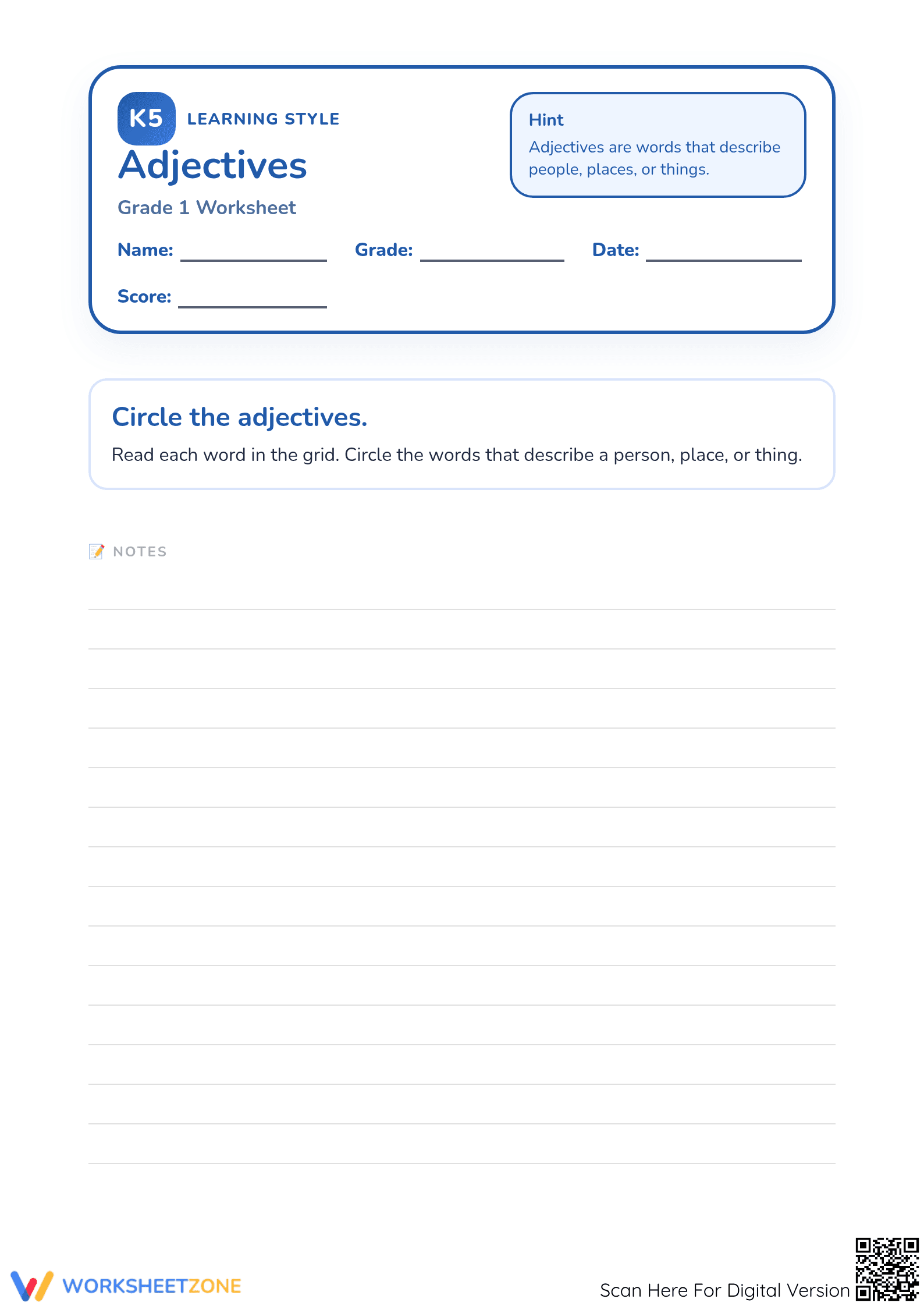
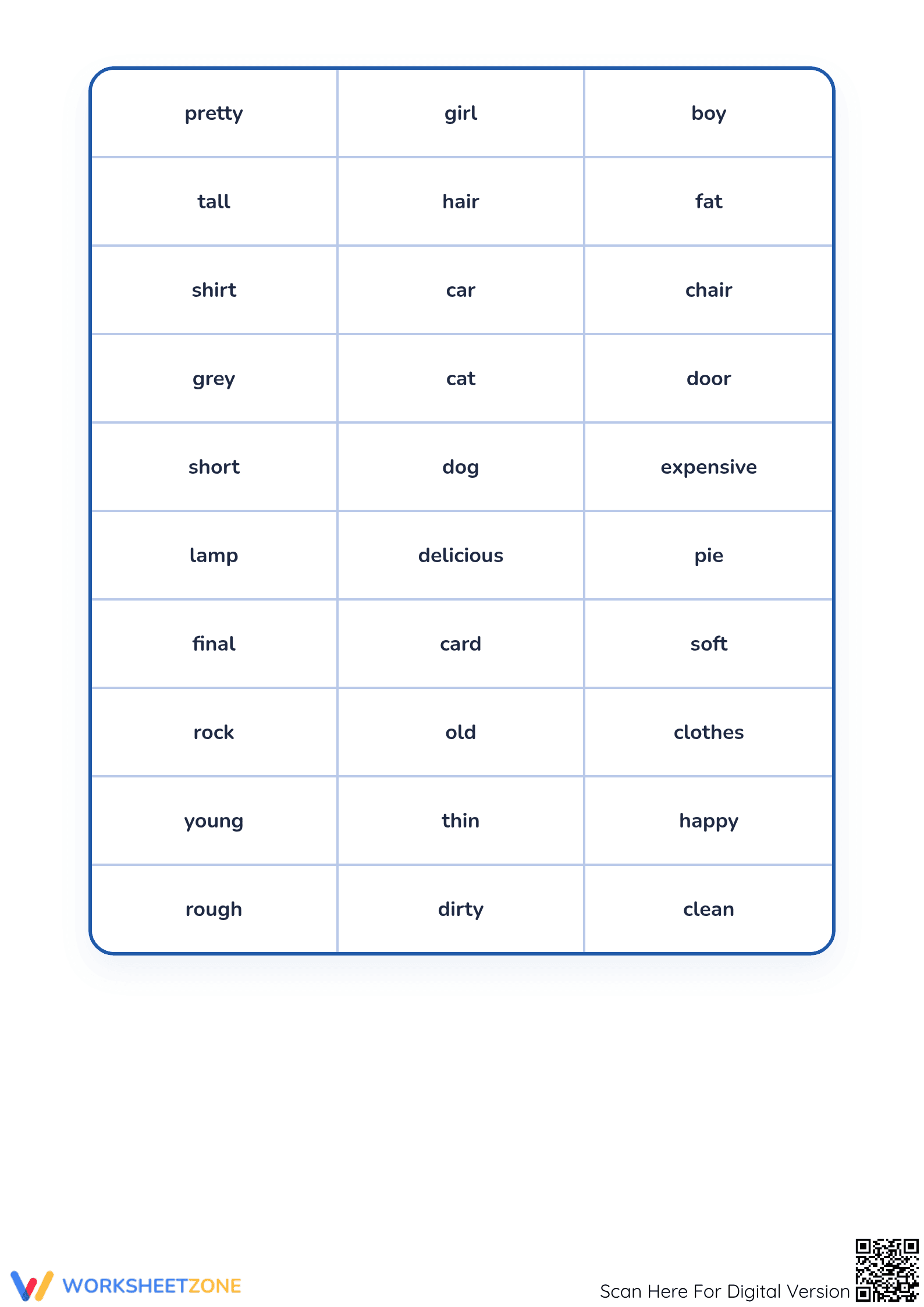
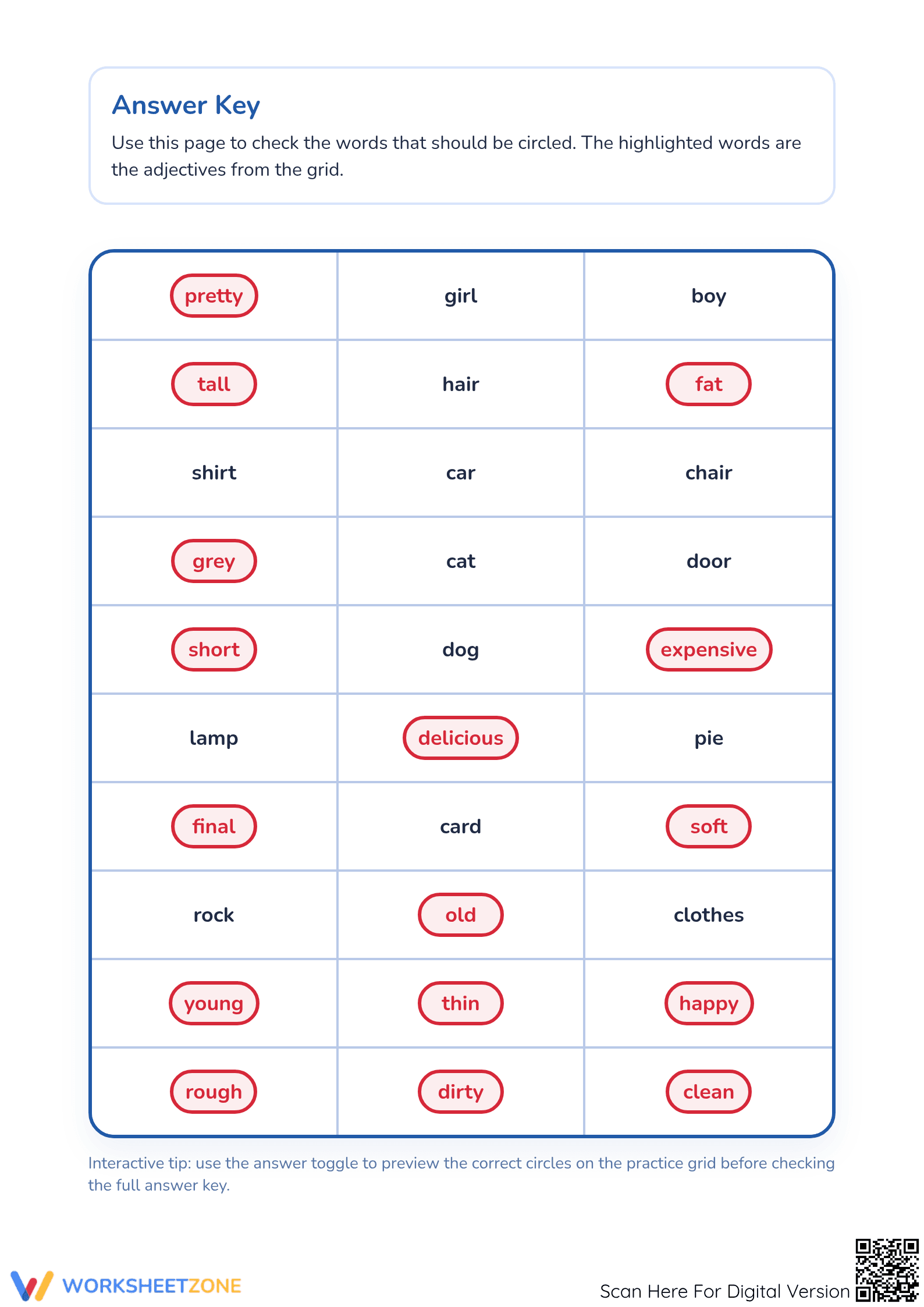
The resource consists of three pages. The first page introduces the concept with a hint box and a notes section. The second page features a 3x10 grid containing 30 high-frequency words, including nouns like "car" and adjectives like "pretty." The final page is a full-color answer key that highlights correct selections, making grading instantaneous.
Zero-Prep Workflow
This worksheet is designed for immediate implementation with a prep time under 2 minutes. First, print the word grid (30 seconds). Second, distribute the sheets for a quiet independent work block or "do now" activity (30 seconds). Finally, use the answer key to review results as a group or for rapid individual grading (1 minute). It is an ideal candidate for emergency sub plans.
Standards Alignment
This resource is directly aligned with `CCSS.ELA-LITERACY.L.1.1.F`, which requires students to "use frequently occurring adjectives." By isolating the identification phase, students master the prerequisite skill of recognizing these words before being asked to generate them in original sentences. This standard code can be copied directly into lesson plans, IEP goals, or district curriculum mapping tools.
How to Use It
Use this worksheet during the "You Do" phase of a gradual release lesson on parts of speech. It serves as an excellent formative assessment tool; as students work, walk around and observe if they are confusing nouns with the adjectives that describe them. Completion typically takes 10 to 15 minutes, making it perfect for a literacy center rotation or a quick check for understanding after a direct instruction session.
Who It's For
This printable is tailored for first-grade students but is also highly effective for second-grade review or English Language Learners (ELLs) who need to build their descriptive vocabulary. It pairs naturally with a descriptive picture book or an anchor chart listing common sensory adjectives.
Research by Fisher & Frey (2014) emphasizes the importance of the gradual release of responsibility, where students move from teacher-led modeling to independent application. This worksheet facilitates that transition by providing a structured, low-stakes environment for students to apply their knowledge of CCSS.ELA-LITERACY.L.1.1.F. By evaluating 30 distinct words, students engage in the repetitive practice necessary to move adjective recognition into long-term memory. This type of discrete skill practice is a recognized component of effective literacy instruction, as noted in the NAEP frameworks for early language development. Providing an immediate answer key further supports the learning cycle by allowing for timely feedback, which is a critical factor in student growth. This resource ensures that Grade 1 learners can confidently identify describing words, setting the stage for more complex syntactic structures in later grades.


