


























Views
Downloads



Adjective Word Order Exercise | Grade 6-7 Essential
Paste this activity's link or code into your existing LMS (Google Classroom, Canvas, Teams, Schoology, Moodle, etc.).
Students can open and work on the activity right away, with no student login required.
You'll still be able to track student progress and results from your teacher account.
This Grade 6 and 7 grammar resource helps students master the complex Royal Order of Adjectives. By providing a clear visual anchor and structured practice, students learn to arrange multiple descriptors—such as size, age, and origin—in the sequence that sounds natural to native speakers. It ensures students produce sophisticated, grammatically correct sentences.
At a Glance
- Grade: 6-7 · Subject: ELA Grammar
- Standard:
CCSS.ELA-LITERACY.L.4.1.D— Order adjectives within sentences according to conventional patterns like size and color- Skill Focus: Adjective Word Order (OSASCOMP)
- Format: 3 pages · 14 problems · Answer key included · PDF
- Best For: Independent practice or grammar review
- Time: 15–25 minutes
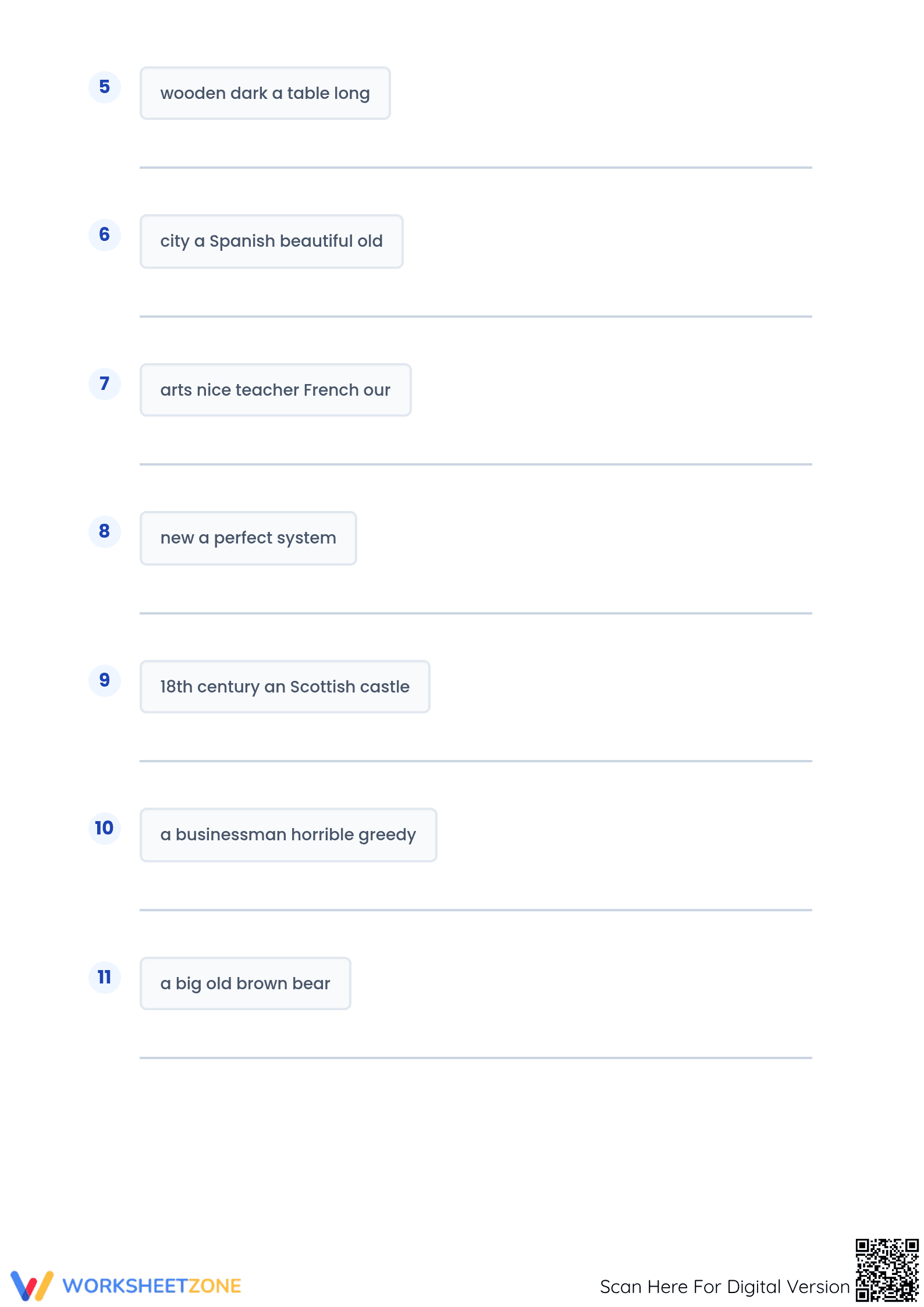
The worksheet includes a comprehensive 3-page layout designed for clarity. At the top of the first page, a visual diagram breaks down the hierarchy: Opinion, Condition, Size, Age, Colour, Origin, and Material. Following this guide are 14 rigorous sentence-scramble tasks where students must reorder jumbled words into a coherent noun phrase. A full answer key is provided for immediate feedback.
This resource is designed for a zero-prep classroom environment. Teachers can follow a simple three-step workflow: Print the three-page PDF (30 seconds), distribute to students as a bell-ringer or independent center activity (1 minute), and review the answers using the provided key (5 minutes). It is an ideal solution for unexpected sub plans or quick grammar reinforcements.
This activity aligns with CCSS.ELA-LITERACY.L.4.1.D, which requires students to order adjectives within sentences according to conventional patterns. While introduced in earlier grades, mastery is essential for middle school writing fluency. This standard code can be copied directly into lesson plans, IEP goals, or district curriculum mapping tools.
Use this worksheet during the independent practice phase of a grammar lesson. After explaining the OSASCOMP acronym, assign these 14 problems to assess student understanding. For a formative assessment, observe if students struggle more with opinion versus condition placements. It typically takes students 20 minutes to complete the full set accurately.
This is perfect for Grade 6 and 7 students who need to refine their descriptive writing. It also serves as an excellent scaffold for English Language Learners (ELLs) who often find English adjective sequencing counterintuitive. Pair this with a descriptive writing prompt or a mentor text analysis to see the skills in action.
According to a Fisher & Frey (2014) analysis of literacy instruction, the use of visual scaffolds like the adjective order diagram provided here significantly reduces cognitive load during complex syntax acquisition. By isolating the specific linguistic rule of CCSS.ELA-LITERACY.L.4.1.D, students can focus on the logic of word placement without the distraction of paragraph-level composition. Research from the RAND AIRS 2024 report suggests that targeted, discrete grammar practice, when paired with immediate feedback via answer keys, leads to higher retention of mechanical rules in middle school learners. This worksheet provides exactly that balance of support and independent challenge, ensuring that the 14 included tasks move students toward mastery of conventional English patterns. It is a reliable tool for any ELA curriculum focused on improving student writing precision and grammatical accuracy.


