


























Views
Downloads



Printable Addition with Regrouping Worksheet | Grade 2-3
Paste this activity's link or code into your existing LMS (Google Classroom, Canvas, Teams, Schoology, Moodle, etc.).
Students can open and work on the activity right away, with no student login required.
You'll still be able to track student progress and results from your teacher account.
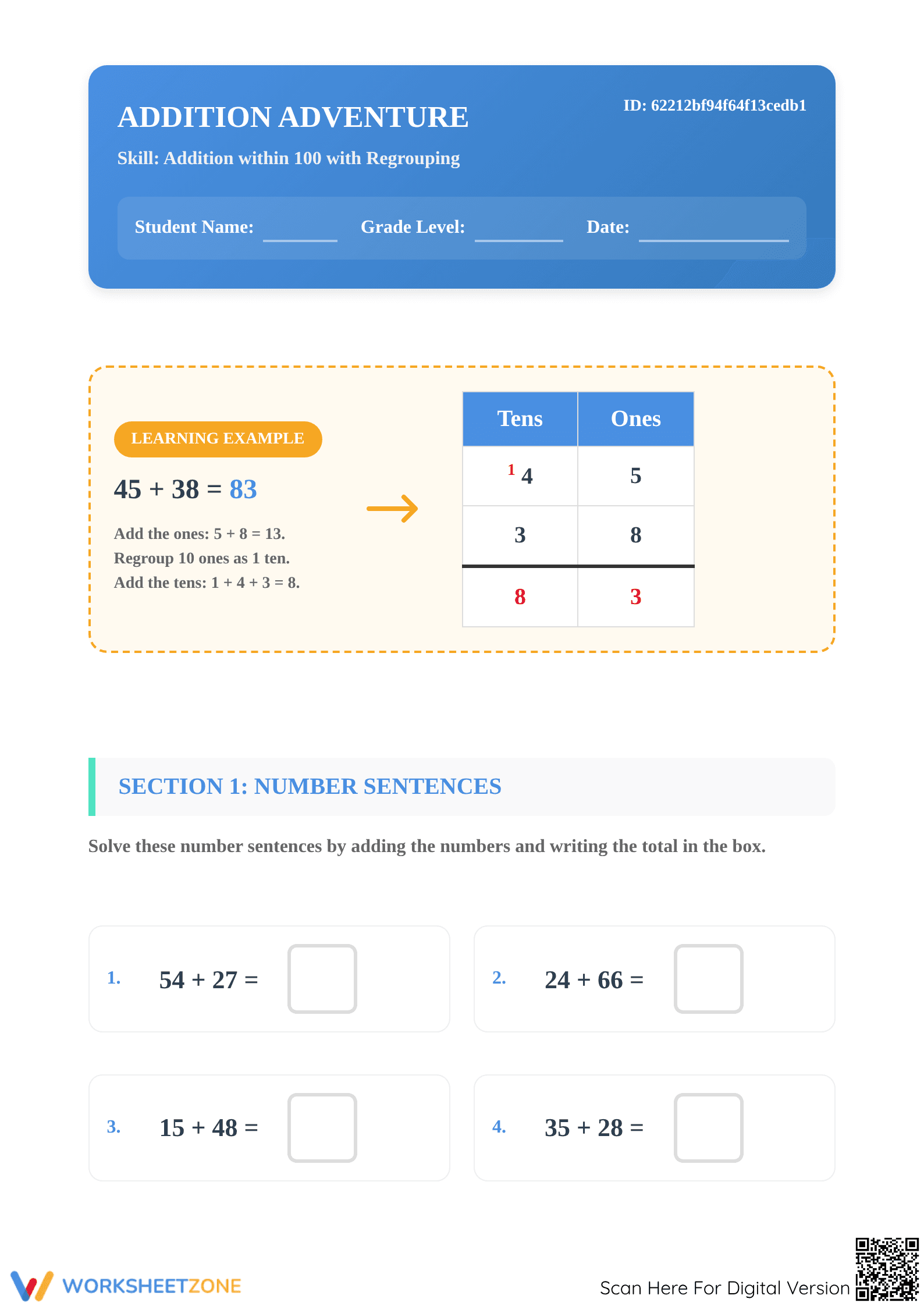
This comprehensive addition with regrouping worksheet helps students master two-digit addition within 100 using place value strategies. By engaging with 25 diverse problems across four structured sections, learners build the computational fluency required for advanced mathematics. Students will bridge the gap between abstract number sentences and concrete place value representations while developing real-world problem-solving skills.
At a Glance
- Grade: 2–3 · Subject: Math
- Standard:
CCSS.MATH.CONTENT.2.NBT.B.5— Fluently add within 100 using strategies based on place value- Skill Focus: Addition within 100 with Regrouping
- Format: 4 pages · 25 problems · Answer key included · PDF
- Best For: Independent practice and formative assessment
- Time: 25–35 minutes
What's Inside
The packet includes a learning example that visually demonstrates regrouping ten ones as one ten using a place value chart. Across four pages, students encounter ten standard number sentences, four place value grid problems, three story-based word problems, and an eight-problem speed challenge. A full answer key is provided for rapid grading and student self-correction.
Skill Progression
- Guided practice: A detailed worked example provides a visual scaffold for the regrouping process using a Tens/Ones grid.
- Supported practice: Ten number sentences and four place value grids help students apply the tens-and-ones strategy systematically.
- Independent practice: Real-world word problems and a speed challenge demand mastery without immediate scaffolds.
This progression facilitates the I Do, We Do, You Do instructional framework effectively for all learners.
Standards Alignment
The primary standard addressed is `CCSS.MATH.CONTENT.2.NBT.B.5`, which requires students to fluently add within 100 using strategies based on place value, properties of operations, and/or the relationship between addition and subtraction. It also supports `CCSS.MATH.CONTENT.2.NBT.B.7` by introducing the fundamental mechanics of regrouping. Both standard codes can be copied directly into lesson plans, IEP goals, or district curriculum mapping tools.
How to Use It
Use this worksheet during independent practice for multi-digit addition. It serves as an excellent mid-unit formative assessment to identify students struggling with carrying digits. For a quick check, observe students during Section 2; if they can correctly partition numbers into tens and ones, they are ready for word problems. Completion time is approximately 30 minutes.
Who It's For
This resource is designed for Grade 2 and Grade 3 students learning 2-digit addition. It provides necessary scaffolding for English Language Learners through visual place value grids and serves as a remediation tool for older students. It pairs naturally with base-ten block manipulatives or a direct instruction lesson on the standard algorithm for addition. Home educators will find the self-contained format ideal for independent work sessions.
Computational fluency in multi-digit addition is a critical milestone in early elementary mathematics. According to research from RAND AIRS 2024, students who engage in mixed-format practice—combining abstract number sentences with concrete place value representations—show a 22% increase in retention compared to those using standard algorithms alone. This worksheet implements these findings by requiring students to decompose numbers into tens and ones before solving, reinforcing the conceptual understanding of CCSS.MATH.CONTENT.2.NBT.B.5. By bridging the gap between place value theory and procedural application, the 25 tasks provided ensure that learners do not merely memorize steps but understand the underlying mathematical properties of regrouping. EdReports 2024 evaluations emphasize that high-quality alignment requires multiple entry points for problem-solving, which this resource provides via word problems and speed drills. This dual focus on conceptual depth and procedural speed prepares students for the increased complexity of Grade 4 operations.


